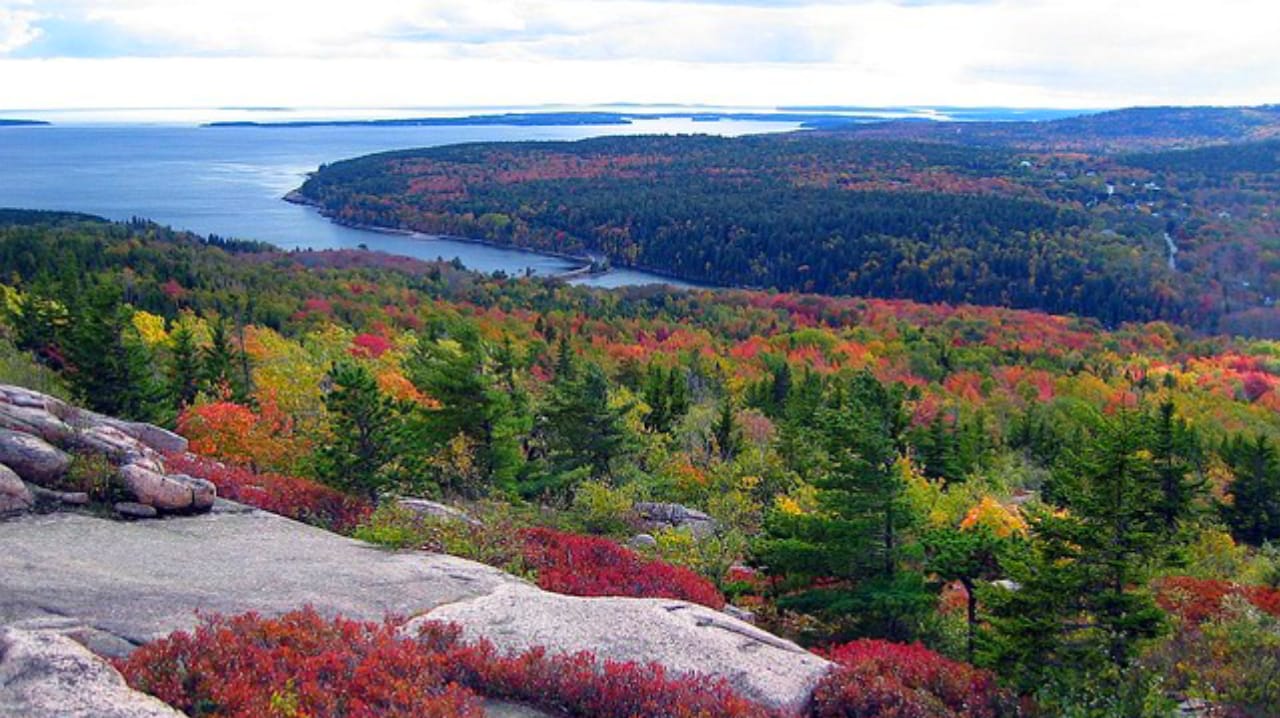
Perched along the rugged coast of Maine, Acadia National Park stands today as one of the most visited national parks in the United States, drawing millions of travelers each year to its granite peaks, quiet lakes, and windswept shoreline.
But long before hikers climbed Cadillac Mountain to watch the sunrise or cyclists pedaled the famous carriage roads, this landscape carried thousands of years of human history, shaped by glaciers, indigenous peoples, European explorers, wealthy summer residents, and a devastating fire that nearly erased it all. Understanding the history of Acadia National Park means understanding a story of geology, culture, philanthropy, and preservation that is as layered and fascinating as the park’s famous pink granite cliffs.
This article traces that story from its earliest geological origins through the modern day, exploring how a remote, rocky island off the coast of Maine became the first national park established east of the Mississippi River-and remains, nearly a century later, a symbol of American conservation.
The Ancient Origins of Acadia’s Landscape
Before any human ever set foot on the shores of what is now Acadia National Park, the land itself was being sculpted by forces far older than history. The mountains of Mount Desert Island, where most of Acadia National Park sits, are made primarily of granite that formed roughly 400 to 420 million years ago, when molten rock cooled slowly beneath the earth’s surface. Over hundreds of millions of years, erosion wore away the softer rock above, gradually exposing the granite domes that define the park’s skyline today.
The most dramatic reshaping of the landscape, however, came far more recently in geological terms. During the last Ice Age, roughly 18,000 to 20,000 years ago, massive glaciers more than a mile thick crept southward across what is now New England.
These glaciers acted like giant sculptors, grinding down mountains, carving deep U-shaped valleys, and depositing rock and debris as they eventually retreated. Somes Sound, often described as the only fjord on the eastern seaboard of the United States, was carved by this glacial action, as was the distinctive rounded shape of Cadillac Mountain and its neighboring peaks.
As the glaciers melted, sea levels rose and the coastline took on its current form, creating the intricate patchwork of islands, inlets, and peninsulas that make Mount Desert Island and the surrounding region so visually striking. This geological foundation set the stage for everything that followed first for the plants and animals that colonized the land, and eventually for the humans who would call it home.
Acadia’s First People
Long before Europeans arrived, the area now protected as Acadia National Park was inhabited by the Wabanaki people, whose name translates roughly to “people of the dawn land.” The Wabanaki Confederacy includes several distinct nations, including the Penobscot, Passamaquoddy, Maliseet, and Micmac (Mi’kmaq), and archaeological evidence suggests that indigenous peoples have lived in the region for at least 12,000 years, arriving not long after the glaciers retreated.
The Wabanaki referred to Mount Desert Island as “Pemetic,” meaning “the sloping land” or “range of mountains,” a fitting description of the island’s dramatic topography. For the Wabanaki, the island and surrounding coastal waters were not a wilderness to be conquered but a homeland rich with resources.
They fished for salmon, alewives, and shellfish, hunted deer and moose, and gathered berries and medicinal plants throughout the seasons. Archaeologists have found shell middens-large deposits of discarded clam and mussel shells at various sites around the island, evidence of centuries of seasonal harvesting.
The Wabanaki practiced a seasonal migration pattern, moving between coastal areas in the warmer months, when fish and shellfish were abundant, and inland areas during the winter, where they could hunt more effectively and find shelter from harsh coastal winds. This rhythm of life, deeply attuned to the natural cycles of the land and sea, persisted for thousands of years and left a lasting cultural imprint on the region.
Today, the Wabanaki presence in the Acadia area continues, and the National Park Service has worked in recent years to more fully acknowledge and incorporate Wabanaki history and perspectives into the park’s interpretation.
Place names throughout the park, including “Acadia” itself which some historians believe may derive from the Mi’kmaq word “quoddy” or “cady,” meaning a piece of land, though this etymology is debated hint at this deep indigenous heritage that predates any European presence by thousands of years.
European Exploration and the Naming of Mount Desert Island
The written history of the region most Americans are familiar with begins in 1604, when French explorer Samuel de Champlain sailed along the Maine coast during an expedition to map the region for potential French settlement. As his ship approached the island, Champlain noted its bare, rocky summits, stripped by wind and weather, and gave it the name “Isles des Monts Deserts,” meaning “island of barren mountains.”
This name, later anglicized to Mount Desert Island, has stuck for more than four centuries, even though the island is anything but a desert in the traditional sense-it is, in fact, richly forested and biologically diverse, with the “desert” reference applying only to the bare granite peaks that Champlain observed from the water.
Champlain’s expedition was part of a broader French effort to establish a colonial foothold in North America, an effort that gave the entire region its enduring name: Acadia. The term “Acadia” (or “Acadie” in French) referred to a much larger territory encompassing parts of present-day Maine, New Brunswick, Nova Scotia, and Prince Edward Island. French colonists, known as Acadians, settled portions of this territory throughout the 17th century, establishing farms, fishing communities, and trading relationships with indigenous peoples.
The region became a contested borderland between French and English colonial interests for more than a century, with control shifting back and forth as European powers vied for dominance in North America. This conflict culminated most tragically in the 1755 expulsion of the Acadians, known as “Le Grand Dérangement,” in which British colonial authorities forcibly removed thousands of French-speaking Acadian settlers from the region, scattering them across the American colonies, the Caribbean, and eventually Louisiana, where their descendants became known as “Cajuns.”
While Mount Desert Island itself saw relatively little permanent Acadian settlement compared to areas further north, the broader historical context of French colonization and conflict with the British is embedded in the name that would eventually be chosen for the national park in the 20th century, linking the modern park to this centuries-old chapter of North American history.
Early American Settlement and the Rise of Coastal Industry
Following the resolution of colonial conflicts and the establishment of American independence, Mount Desert Island began attracting permanent English-speaking settlers in the latter half of the 18th century. These early settlers were drawn by the region’s abundant natural resources: dense forests suitable for shipbuilding and lumber, rich fishing grounds, and fertile land for small-scale farming.
By the early 19th century, small towns had taken root around the island, including Bar Harbor (originally known as Eden), Southwest Harbor, and Northeast Harbor. These communities developed economies centered on fishing, shipbuilding, granite quarrying, and subsistence farming.
The rocky coastline, while inhospitable to large-scale agriculture, proved excellent for harvesting the abundant fish stocks of the Gulf of Maine, and local shipyards built vessels that plied both coastal and international trade routes.
Granite quarrying became particularly important to the local economy during this period. The high-quality pink and gray granite found throughout the island was cut and shipped to cities up and down the East Coast, where it was used in the construction of prominent buildings, bridges, and monuments. Remnants of old quarry sites can still be found within the park today, silent reminders of this industrial chapter in the island’s history.
Life on Mount Desert Island during this era was, by most accounts, modest and hardworking. Fishing families and farmers lived close to the land and sea, largely disconnected from the broader currents of American culture and commerce. This would change dramatically, however, with the arrival of a new class of visitors in the mid-19th century.
The Rusticators
The transformation of Mount Desert Island from a remote fishing community into a fashionable destination began, somewhat unexpectedly, with painters. In the 1840s, artists associated with the Hudson River School, a movement dedicated to romantic, dramatic landscape painting, began traveling to Mount Desert Island in search of inspiration. Thomas Cole, one of the founders of the Hudson River School, visited the island in 1844, and his paintings of its rugged coastline and mist-shrouded mountains introduced the landscape to a broader American audience.
Frederic Edwin Church, one of Cole’s most celebrated students, followed shortly after and became perhaps the most influential artistic ambassador for the region. Church’s luminous, detailed paintings of Mount Desert Island’s coastline captured the imagination of wealthy East Coast art patrons, many of whom had never previously heard of this remote corner of Maine. His work, exhibited in galleries in New York and other major cities, sparked growing curiosity about the island among the urban elite.
This artistic attention coincided with a broader cultural shift in 19th-century America: a growing romantic fascination with untamed wilderness as a source of spiritual renewal and escape from the pressures of industrializing cities. Influenced by transcendentalist philosophy and the picturesque aesthetic popularized by European Romanticism, affluent Americans increasingly sought out dramatic natural landscapes for recreation and reflection.
By the 1850s and 1860s, small numbers of these curious travelers soon nicknamed “rusticators” for their willingness to embrace simple, rustic accommodations in pursuit of natural beauty began making the arduous journey to Mount Desert Island.
They stayed in local farmhouses and modest inns, hiked the island’s mountains, sailed its coastal waters, and generally embraced a simpler mode of life than they were accustomed to at home. Word of the island’s beauty spread through their social networks, and the trickle of visitors gradually grew into a steady stream.
The Gilded Age Cottage Era
The rusticator period gave way, in the final decades of the 19th century, to a far more opulent chapter in the island’s history. As word of Mount Desert Island’s beauty spread among America’s wealthiest families, the modest farmhouse stays of the rusticators were increasingly replaced by the construction of elaborate summer estates. In a striking display of Gilded Age understatement, these massive mansions some with dozens of rooms and full staffs of servants were referred to, without apparent irony, as “cottages.”
Bar Harbor, in particular, emerged as one of the most fashionable summer resorts in the entire United States during this era, rivaling Newport, Rhode Island, as a playground for America’s industrial and financial elite.
Families with names synonymous with the era’s extraordinary wealth-Vanderbilt, Astor, Morgan, Pulitzer, and Carnegie among them-built lavish summer residences on the island, complete with manicured gardens, private tennis courts, and stables. The social season in Bar Harbor featured elaborate parties, yacht races, and a constant whirl of social engagements that occupied the wealthy families and their guests throughout the summer months.
This influx of wealth transformed the local economy and infrastructure. Hotels, restaurants, and shops sprang up to serve the growing tourist population, and local residents increasingly found employment as domestic staff, groundskeepers, and craftsmen serving the cottage community. The contrast between the opulence of the summer colony and the modest circumstances of the island’s year-round working population created a distinctive social dynamic that would characterize the region for decades.
Yet even amid this display of Gilded Age excess, a countervailing impulse was taking shape—one that would ultimately prove far more consequential for the island’s long-term future than any mansion or garden party.
George B. Dorr The Father of Acadia
No single individual did more to shape the creation of Acadia National Park than George Bucknam Dorr, a man whose decades of tireless effort earned him the enduring title “Father of Acadia.” Born in 1853 to a wealthy Boston family, Dorr first visited Mount Desert Island as a young man and quickly developed a deep, almost spiritual attachment to its landscape.
By the early 20th century, Dorr had grown increasingly alarmed by threats to the island’s natural beauty. Logging operations were clearing forests, and there were even proposals to build a summit railway to the top of Cadillac Mountain (then known as Green Mountain), which Dorr and like-minded conservationists feared would irrevocably damage the mountain’s wild character.
Development pressures associated with the island’s growing popularity as a resort destination raised further concerns that the very qualities drawing visitors to Mount Desert Island would eventually be destroyed by that popularity.
In 1901, Dorr joined a group of concerned citizens, including Harvard University president Charles W. Eliot, to form the Hancock County Trustees of Public Reservations. This organization, which Dorr would lead and fund largely through his own personal fortune, was created with the specific purpose of acquiring and preserving land on Mount Desert Island for public benefit, protecting it from development in perpetuity.
Dorr dedicated the remainder of his life-and the vast majority of his personal wealth-to this cause. He negotiated tirelessly with landowners, often personally funding land purchases when the organization’s resources fell short, and worked to build public and political support for permanent conservation of the island’s most scenic areas.
His efforts were not without significant personal sacrifice; Dorr, who never married, essentially devoted his entire adult life and inheritance to the creation and protection of what would eventually become Acadia National Park, dying in 1944 with his personal fortune largely depleted in service of this cause.
From Land Trust to National Monument
Dorr’s persistent efforts began to bear fruit in the 1910s, as the Hancock County Trustees of Public Reservations steadily accumulated land holdings across Mount Desert Island. However, Dorr recognized that private land trust status alone would not provide the level of permanent protection the landscape required. He set his sights on a far more ambitious goal: federal protection as part of the National Park System, then still in its relative infancy.
This was an audacious aim. At the time, all existing national parks were located in the American West-places like Yellowstone, Yosemite, and Glacier-vast, largely unpopulated landscapes on federal land that had never required extensive private land acquisition. The idea of establishing a national park in the more densely populated, privately owned landscape of the eastern United States was essentially unprecedented, and many in Washington were skeptical that a park composed primarily of donated private land could or should receive federal designation.
Dorr traveled repeatedly to Washington, D.C., lobbying government officials and cultivating relationships with key figures, including Interior Department officials. His persistence eventually paid off. In 1916, President Woodrow Wilson signed a proclamation establishing Sieur de Monts National Monument, named in honor of Pierre Dugua, Sieur de Mons, the French nobleman who had led the original 1604 expedition that included Champlain.
This designation, achieved through executive proclamation rather than the more involved congressional process required for full national park status, provided federal protection for the roughly 6,000 acres that had been donated to that point.
The creation of Sieur de Monts National Monument represented a landmark moment in American conservation history-it demonstrated that meaningful natural landscapes existed and could be protected even in the more developed eastern United States, and it established a model of land conservation built primarily through private philanthropy and donation rather than government land already held by the federal government.
Lafayette National Park
Dorr’s ambitions did not stop at national monument status. He continued to push for the more prestigious and more permanently secure designation of national park status, which would require an act of Congress. His efforts, combined with continued donations of land from wealthy summer residents eager to see the landscape permanently protected, eventually succeeded.
In February 1919, Congress passed legislation establishing Lafayette National Park, named in honor of the Marquis de Lafayette, the French military officer who had played a celebrated role in supporting American independence during the Revolutionary War. This designation made it the first national park established east of the Mississippi River, a historic milestone that validated Dorr’s vision and years of tireless advocacy.
The choice of the Lafayette name reflected the era’s diplomatic considerations. The United States had recently emerged from World War I as an ally of France, and honoring a French historical figure associated with American independence carried significant symbolic weight in the context of post-war American-French relations. It also connected, somewhat loosely, to the region’s French colonial history dating back to Champlain’s original exploration.
Dorr was appointed the first superintendent of Lafayette National Park, a position he held (largely without salary) until his death in 1944, continuing to shepherd the park’s growth and development for another quarter century after its initial establishment.
John D. Rockefeller Jr. and the Carriage Roads
While George Dorr provided the political will and organizational leadership behind the park’s creation, another figure proved equally essential to shaping the physical landscape and infrastructure that visitors experience in Acadia National Park today: John D. Rockefeller Jr., son of the Standard Oil founder and one of the wealthiest men in America during the early 20th century.
Rockefeller first visited Mount Desert Island in 1908 and, like so many before him, fell in love with its natural beauty. Unlike many of his fellow summer residents, however, Rockefeller possessed both the resources and the personal inclination to leave a lasting physical mark on the landscape-one carefully designed to enhance appreciation of the natural scenery rather than detract from it.
Beginning in 1913 and continuing for the next 27 years, Rockefeller personally designed and financed the construction of an extraordinary network of carriage roads throughout what is now Acadia National Park. Eventually totaling approximately 57 miles, these crushed-stone roads were engineered with remarkable attention to detail and aesthetic sensitivity.
Rockefeller, who had a genuine passion for road engineering and landscape design, worked closely with skilled craftsmen and engineers to ensure that the roads followed the natural contours of the land, offering carefully framed views of mountains, lakes, and the ocean at scenic intervals.
The carriage roads featured an array of beautifully constructed stone bridges-seventeen in total-each uniquely designed and built using native granite, along with distinctive stone gate lodges marking the entrances to the road system.
Notably, Rockefeller insisted that the carriage roads be closed to motor vehicles, a decision motivated partly by his desire to preserve the tranquility of the landscape and partly by ongoing tensions between motoring enthusiasts and horse-and-carriage traditionalists during this transitional period in transportation history. This restriction remains in place today, and the carriage roads are now beloved by hikers, cyclists, horseback riders, and cross-country skiers who can traverse the park’s interior away from vehicle traffic.
Rockefeller’s contributions extended beyond the carriage roads themselves. He also funded the construction of the Park Loop Road, a scenic roadway designed to give automobile-driving visitors access to the park’s most spectacular coastal and mountain views, and he donated substantial acreage to the park throughout his decades of involvement.
His meticulous attention to landscape design and infrastructure has left an enduring legacy that shapes how visitors experience Acadia to this day, representing one of the most significant private philanthropic contributions to any unit of the National Park System.
Becoming Acadia National Park
By the late 1920s, the name “Lafayette National Park” had begun to seem somewhat disconnected from the park’s actual character and history to some observers, and there was growing sentiment that a name more directly tied to the region’s own heritage would be more fitting. In January 1929, Congress passed legislation officially renaming the park Acadia National Park, reviving the historical term that had described the broader French colonial territory encompassing this stretch of the North American coast centuries earlier.
This renaming also coincided with the park’s continued geographic expansion. Over the following decades, Acadia National Park grew to include land beyond Mount Desert Island itself, incorporating portions of the Schoodic Peninsula on the mainland (donated in 1929) and, much later, Isle au Haut, a more remote and less-visited island that became part of the park in 1943 through a donation from the Bowditch family.
This gradual expansion reflected the ongoing conservation ethic established by Dorr and continued by subsequent generations of donors and park advocates, ensuring that Acadia’s protected boundaries would extend beyond its original core to encompass additional significant coastal Maine landscapes.
The Great Fire of 1947
Perhaps no single event in the 20th-century history of Mount Desert Island and Acadia National Park was as dramatic or consequential as the catastrophic wildfire that swept across the island in October 1947. Following an unusually dry summer and autumn, a fire believed to have started near a town dump close to Bar Harbor quickly grew out of control, fueled by drought conditions and strong winds.
Over the course of several days, the fire burned through more than 17,000 acres, including roughly 10,000 acres within Acadia National Park itself. The blaze destroyed 67 of the grand summer “cottages” that had defined Bar Harbor’s Gilded Age character, along with numerous smaller homes, businesses, and significant sections of Rockefeller’s carefully constructed carriage road system.
Remarkably, despite the fire’s ferocity, only a handful of lives were lost, largely due to a massive and well-organized evacuation effort that included the U.S. Navy assisting with the removal of residents by boat when roads became impassable.
The Great Fire of 1947 fundamentally and permanently altered both the physical landscape and the social character of the region. Many of the destroyed cottage estates were never rebuilt, as the postwar economic climate, combined with rising taxes and changing social patterns, made the maintenance of such enormous properties increasingly impractical for their wealthy owners.
The Gilded Age era of Bar Harbor as an exclusive playground for America’s elite effectively came to an end with the fire, giving way to a more middle-class tourism economy in the postwar decades.
Ecologically, the fire also transformed portions of the park’s forest composition. Areas that burned experienced a natural process of forest succession, with fast-growing deciduous species like birch and aspen initially colonizing burned areas before slower-growing conifers gradually reestablished themselves over subsequent decades.
Visitors to certain sections of the park today, particularly around Bar Harbor, can still observe forest characteristics shaped by this dramatic mid-century event, even as the landscape has largely healed and matured in the more than seven decades since the fire occurred.
Acadia in the Modern Era
In the decades following the 1947 fire, Acadia National Park settled into its modern identity as a beloved destination for outdoor recreation and natural beauty, drawing a far more diverse and numerous visitor population than the exclusive summer colony of the Gilded Age. Improvements in transportation, including the growth of automobile travel and eventually commercial air service to the region, made the park increasingly accessible to middle-class American families rather than remaining the province of the wealthy elite.
The National Park Service, which had assumed management responsibility for the park since its earliest days as a national monument, worked throughout the mid-to-late 20th century to develop visitor facilities, hiking trails, and educational programs while balancing the ongoing challenge of accommodating growing visitation without compromising the natural resources the park was created to protect.
Popular destinations within the park, including the summit of Cadillac Mountain (renamed from Green Mountain and famous for offering, for part of the year, the first sunrise visible in the continental United States), Jordan Pond, Sand Beach, and Thunder Hole, became iconic attractions drawing visitors from around the world.
Acadia’s popularity has continued to grow substantially in recent decades, with annual visitation regularly exceeding three million people, making it consistently one of the ten most visited national parks in the entire National Park System despite its relatively modest size of approximately 49,000 acres.
This popularity has brought its own set of modern management challenges, including traffic congestion, parking shortages, and concerns about the impact of heavy visitation on fragile natural resources, particularly at popular sites like the summit of Cadillac Mountain and Sand Beach.
In response to these pressures, the National Park Service implemented a vehicle reservation system for sunrise viewing at Cadillac Mountain, along with expanded use of the free Island Explorer shuttle bus system, which was introduced in 1999 to help reduce automobile congestion throughout the park during peak summer months.
These management strategies reflect an ongoing effort to preserve the same qualities of natural beauty and relative tranquility that first drew rusticators, artists, and conservationists to the island more than a century and a half ago.
Acknowledging Wabanaki Heritage Today
In recent years, the National Park Service and Acadia National Park have made concerted efforts to more fully recognize and incorporate the deep Wabanaki history of the region into the park’s interpretive programs and management approach.
This has included expanded educational signage, partnerships with Wabanaki tribal nations on cultural programming, and greater acknowledgment throughout park materials that the landscape’s human history extends back thousands of years before European contact, not merely to the Gilded Age cottage era that often dominates popular understanding of the park’s past.
This ongoing effort reflects a broader shift within the National Park Service toward more inclusive and historically complete storytelling at parks across the country, recognizing that a full understanding of Acadia’s history must include not just the philanthropists and artists of the 19th and 20th centuries but the indigenous peoples who called this landscape home for millennia before them and who continue to maintain cultural connections to the region today.
1 thought on “Acadia National Park history”