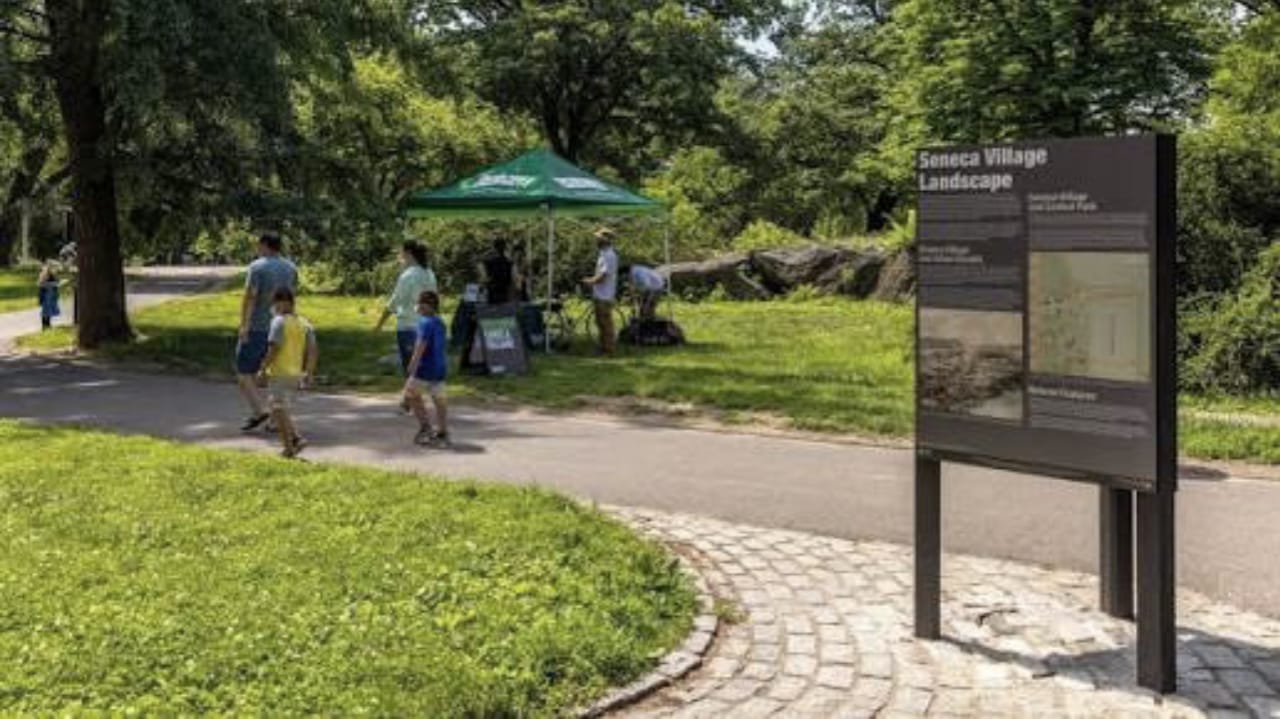
Most visitors walk right past it. Somewhere between the West 85th Street entrance and the Great Lawn, joggers and picnickers cross a patch of Central Park that once held homes, churches, gardens, and a school belonging to one of the most significant free Black communities in pre-Civil War America. There isn’t a single building left to mark the spot. But a Seneca Village tour can turn that quiet stretch of park into one of the most moving history lessons New York City has to offer.
If you’re planning a trip and searching for Seneca Village tour, this guide covers everything you need: the history behind the site, how to book an official Central Park Conservancy tour, what you’ll actually see (and won’t), self-guided options, nearby attractions, and practical tips for making the most of your visit.
What Was Seneca Village?
Seneca Village was a predominantly African American community that stood on the west side of what is now Central Park, roughly between West 82nd and West 89th Streets, from 1825 until the community was displaced in the late 1850s.
It’s frequently described as the largest community of free Black property owners in New York City before the Civil War, and its story is one of the most important and least known chapters of the city’s history.
The Founding 1825
The village began in the fall of 1825, when a white farming couple, John and Elizabeth Whitehead, subdivided their land uptown and began selling it off in individual lots. On September 27, 1825, a 25-year-old African American man named Andrew Williams, who worked as a bootblack, bought three of those lots for $125.
On the same day, Epiphany Davis, a store clerk and trustee of the African Methodist Episcopal Zion (AME Zion) Church, purchased twelve lots for $578. The AME Zion Church itself bought six more lots that same week.
Within a matter of days, the foundation of an entire community had been laid and it kept growing. By 1832, African Americans had acquired dozens more lots in the area. When New York State abolished slavery in 1827, the community grew even faster, offering newly free Black New Yorkers a chance to own land and build a life away from the crowded, discriminatory conditions of downtown Manhattan.
Growth and Daily Life
By the 1830s, Seneca Village had around ten houses. By the mid-1850s, it had grown into a real neighborhood: roughly 50 homes, three churches, a school, and multiple cemeteries, spread across the rocky, hilly terrain of upper Manhattan. Residents kept gardens, raised livestock, fished nearby, and drew water from a natural spring.
The 1855 census recorded about 225 residents. Roughly two-thirds were African American, and about a third were Irish immigrants, with a small number of German families as well. It was, by the standards of the era, a remarkably integrated and stable community three-quarters of residents had lived there since at least 1840, giving Seneca Village a sense of permanence that was rare for any working-class neighborhood at the time, let alone one built by free Black Americans.
Land ownership mattered enormously. In 1821, New York State had imposed a property requirement of at least $250 specifically on Black male voters (a bar not applied to white men), along with a three-year residency requirement, in order to qualify to vote.
By 1845, of the roughly 100 Black New Yorkers who met that threshold citywide, ten lived in Seneca Village. In other words, this small hillside community accounted for an outsized share of the city’s Black electorate a direct result of the property ownership its founders had fought to establish.
The community’s institutions reflected its stability. All Angels’ Church, along with the AME Zion and African Union churches, anchored religious and social life. Colored School No. 3 educated the community’s children. Contrary to a persistent myth that has followed Seneca Village for over a century, this was not a shantytown of squatters roughly half of residents owned their homes by 1855, a homeownership rate far higher than the city average.
Displacement and Erasure
Seneca Village’s story took a sharp turn in the 1850s, when city planners set their sights on the land for a new public park. In 1853, the New York State Legislature authorized the city to acquire more than 700 acres of land including all of Seneca Village through eminent domain to build what would become Central Park.
Residents fought the seizure, but by 1857 the last holdouts had been forced out, their homes and churches demolished. Compensation, when it was paid at all, was often far below what property owners believed their land and buildings were worth. Within a few years, virtually every physical trace of the community had been erased from the landscape, and its story faded from public memory for well over a century.
It wasn’t until the 1990s and 2000s that historians, led in large part by the Seneca Village Project (a partnership of researchers from Columbia University and other institutions), began piecing the community’s history back together through census records, tax rolls, maps, and eventually archaeological digs.
Excavations conducted in 2011 uncovered household items, foundation walls, and other physical evidence confirming details about how residents actually lived evidence that directly contradicted the old squatter narrative and cemented Seneca Village’s place in the historical record.
Why Take a Seneca Village Tour?
You could read all of the above online. But standing on the actual site on ground that was once someone’s front yard, or the steps of a church, or a child’s walk to school changes how the history lands. A guided tour translates a list of facts into a real, walkable place, pointing out exactly where specific families lived, where each church stood, and how the terrain itself (rocky outcrops, that famous Manhattan schist) shaped the community’s daily life.
Guides also do the essential work of connecting Seneca Village to the bigger picture: how it fits into the broader history of Black land ownership and voting rights in New York, what archaeology has revealed in just the last couple of decades, and how the story of displacement for “public good” echoes forward into later chapters of American urban history.
How to Take an Official Seneca Village Tour
The Central Park Conservancy, the nonprofit that manages and restores Central Park, runs the primary guided tours of the Seneca Village site, and it’s the best starting point for planning a visit.
Central Park Conservancy Seneca Village Tour
The Conservancy’s standard guided tour walks participants through the physical landscape once occupied by the village, with staff guides explaining the community’s history, its three churches, and the events that led to residents’ displacement through eminent domain.
Tours are recommended for anyone interested in Black history, social history, New York City history, or archaeology, and they’re designed to work whether or not you’ve read up on Seneca Village beforehand.
Seneca Village History Tours have run seasonally, with a stretch of tours scheduled from mid-April through late May. Exact dates shift year to year, so it’s worth checking the Conservancy’s official tours page close to your travel dates rather than relying on a fixed schedule.
Cost: Pricing varies by season and event.During Black History Month in February, the Conservancy has offered $10 public tours, with free year-round access for New York City educators. Other tours throughout the year including special partnership tours have been offered free of charge.
Meeting point: Tours typically begin at the Seneca Village kiosk near West 85th Street and the West Drive, with visitors entering the park at the West 85th Street entrance.
Free Seasonal and Special Event Tours
Beyond the standard paid tour, the Conservancy periodically runs free special-event tours tied to broader programming:
- Sacred Sites Open House weekend: Held in mid-May, this free tour is offered in partnership with the New York Landmarks Conservancy as part of a citywide weekend celebrating historic and sacred sites across New York, with tours also beginning at the Seneca Village kiosk near West 85th Street.
- Seneca Village Photo Walk: A roughly two-hour guided walk pairs park history with hands-on photography instruction, inviting participants to bring their own cameras and interpret the landscape through images. This one leans more creative than historical, but it still covers the community’s story in depth.
- Themed community tours: The Conservancy has occasionally partnered with community organizations for tours paired with additional programming, such as guided walks followed by group wellness activities on the surrounding lawns.
Registration for these special tours can open and close quickly, and some events pause registration between seasons, so building in a flexible travel schedule or checking back a few times before your trip pays off.
Private and Third-Party Guided Tours
If the Conservancy’s public schedule doesn’t line up with your visit, several licensed New York City tour operators and independent historians run private or small-group Seneca Village tours, often bookable on demand rather than tied to a fixed calendar.
These tours are typically led by a licensed New York City guide alongside a historian, using the Conservancy’s outdoor exhibit as a reference point while sharing period maps, photographs, and detailed stories about the people who lived there.
These can be a good option for groups, school trips, or travelers who want a specific date rather than waiting for a public tour slot.
Self-Guided Visits
You don’t need a scheduled tour to visit Seneca Village at all. The Conservancy has installed a permanent outdoor exhibit called Discover Seneca Village a series of interpretive signs placed throughout the former village site that mark the locations of churches, homes, and other landmarks, paired with historical images and context.
Enter the park at West 85th Street and West Drive, and you can follow the signage on your own schedule, no reservation required. For travelers whose visit doesn’t line up with a guided tour, or who simply prefer exploring independently, this is a genuinely satisfying way to experience the site just budget extra time to read each sign carefully, since there’s no guide filling in the gaps between them.
If you can’t make it to the park at all, the Conservancy has also built an online hub collecting research, maps, and a 3D digital model reconstructing the community, along with downloadable versions of the interpretive signage.
What You’ll Actually See on the Tour
This is worth setting expectations for: there are no standing structures from Seneca Village. The city demolished every building in the 1850s, and today the site looks like an ordinary, beautifully landscaped stretch of park lawns, rock outcroppings, mature trees, and walking paths.
What a good tour gives you instead is context and imagination. Guides point out specific locations where William Godfrey Wilson, a church sexton, lived with his family in a three-story home; where All Angels’ Church stood; where the rocky terrain that made this land undesirable to downtown developers became an asset for a community seeking privacy and autonomy.
You’ll see period maps overlaid on the modern landscape, historical photographs, and (on some tours) archaeological findings recovered from digs conducted in the area. The Conservancy’s interpretive signage does similar work for self-guided visitors, using historical maps and images to show you exactly what stood where.
It’s a different kind of park tour than the ones focused on landscape architecture or bird-watching this one asks you to see the park as a site of loss as much as a place of leisure.
Planning Your Visit: Practical Tips
Getting there: The core Seneca Village site sits inside Central Park near West 85th Street. The closest subway access is the B/C train at 86th Street–Central Park West, about a five-minute walk to the West 85th Street park entrance.
What to bring: Comfortable walking shoes are essential the terrain includes uneven, rocky ground that reflects the original landscape residents navigated. Bring water, especially for tours during summer months, and a light layer even in spring, since much of the walk happens in open, shaded parkland.
Accessibility: If you need accommodations such as a hearing loop for telecoil-compatible hearing aids, request them in advance the Conservancy has offered this for select tours with sufficient notice by email.
Timing: Standard guided tours generally run about an hour; add extra time if you plan to combine your visit with the self-guided interpretive signage or a stop at nearby park attractions.
Best time of year: Spring and fall tend to offer the most comfortable walking weather and the fullest tour calendars. February tours around Black History Month often come with reduced pricing and additional public programming, making it a particularly rich time to visit if your travel dates allow.
Pairing Your Tour with Nearby Central Park Attractions
Since you’ll already be at the West 85th Street entrance, it’s easy to build a longer itinerary around your Seneca Village tour:
- The Great Lawn: A short walk south, ideal for a picnic after your tour.
- The Reservoir (Jacqueline Kennedy Onassis Reservoir): A scenic 1.58-mile loop just east of the site, popular for walking and running.
- American Museum of Natural History: Directly across from the park at West 79th Street and Central Park West, easily combined with a morning tour.
- Strawberry Fields: A short walk south near West 72nd Street, another site with its own layered history within the park.
Why This History Matters
Seneca Village isn’t just a historical footnote it’s a case study in how cities decide whose history gets preserved and whose gets built over.
For more than a century, the community’s existence was reduced to a line or two in park history books, sometimes mischaracterized as an informal squatter settlement rather than what it actually was: a stable, majority-Black community of property owners with churches, a school, and a functioning civic life, torn apart through eminent domain to build a park still celebrated today as one of America’s great public spaces.
The Central Park Conservancy’s ongoing research, archaeology, and commemoration efforts including a multi-year initiative supported by the Mellon Foundation aimed at permanently marking the site within the park reflect a broader, overdue effort to restore Seneca Village to public memory. Taking a tour is a small but meaningful way to participate in that process.
FAQs
Is the Seneca Village tour free?
It depends on the tour. Some special-event tours, including the Sacred Sites Open House weekend tour, are free. Standard tours have sometimes been priced around $10, particularly during Black History Month promotions, with free access for New York City educators year-round. Check the specific tour listing for current pricing before you go.
How long does the tour take?
Most guided tours run around 60 minutes, though themed tours (like the photo walk) can run closer to two hours.
Do I need to book in advance?
For official Central Park Conservancy tours, yes registration is typically required and can fill up or pause between seasons. Self-guided visits using the outdoor interpretive signage don’t require any booking.
Is the tour accessible for wheelchairs or mobility devices?
The site includes uneven, rocky terrain typical of Central Park’s natural landscape, so check with the tour organizer about specific accessibility needs before booking.
Can kids join the tour?
Yes, and it’s a genuinely valuable field-trip-style experience for school-age children, though the content is best suited to kids old enough to engage with the history of slavery, racial discrimination, and displacement in an age-appropriate way.
Are there physical remains of Seneca Village to see?
No standing structures remain the village was fully demolished in the 1850s. What you’ll see is the landscape itself, paired with interpretive signage, maps, photographs, and (on some tours) information about archaeological artifacts recovered from digs in the area.