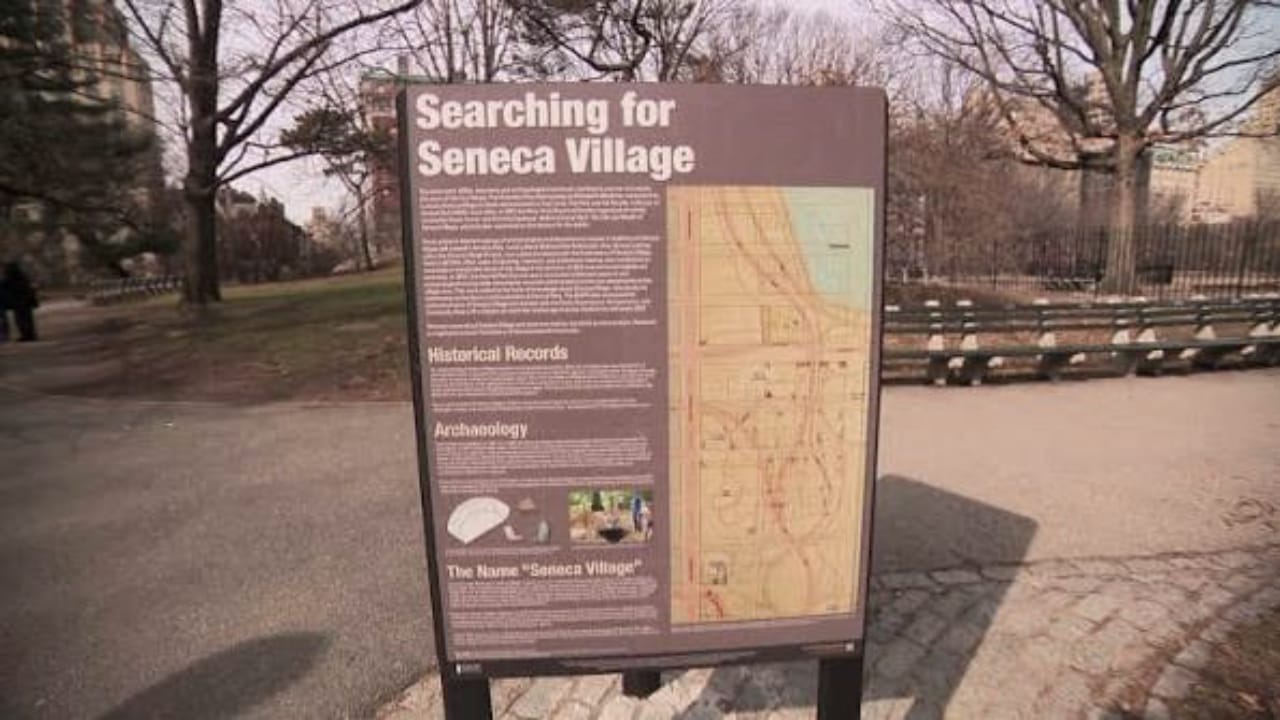
Millions of visitors walk through Central Park every year, past the Great Lawn, the Reservoir, and the winding paths near West 85th Street, without knowing they are walking over the remains of a thriving 19th-century community.
Before the park existed, the land between West 82nd and West 89th Streets was home to Seneca Village Manhattan’s first significant community of African American property owners, and one of the most important, and most overlooked, chapters in New York City history.
This article explores the full Seneca Village history: how the community began, who lived there, what daily life looked like, why it was destroyed, and how archaeologists and historians have worked since the 1990s to bring its story back into public memory.
What Was Seneca Village?
Seneca Village was a small, largely self-sufficient settlement that existed on Manhattan’s Upper West Side from 1825 to 1857. Located roughly between what is now West 82nd and West 89th Streets, and Seventh and Eighth Avenues, the community sat on land that is today part of Central Park, near the West 85th Street entrance and bordering the present-day Arthur Ross Pinetum.
At its height in the mid-1850s, Seneca Village was home to approximately 225 to 264 residents, according to the 1855 New York State census. The population was roughly two-thirds African American, one-third Irish immigrant, with a small number of German immigrant families as well.
This made Seneca Village not only a haven for Black landowners, but one of New York’s earliest multi-ethnic residential communities a place where African American, Irish, and German families lived, worshipped, and raised children as neighbors decades before that kind of integration was common anywhere else in the city.
The Founding of Seneca Village in 1825
Seneca Village traces its origin to a single land transaction. In 1825, a white couple, John and Elizabeth Whitehead, subdivided a plot of farmland they owned on Manhattan’s rural Upper West Side and began selling it off in roughly 200 individual lots.
Andrew Williams, a 25-year-old African American shoeshiner, became the community’s first documented landowner when he purchased three lots for $125. Within days, other Black New Yorkers followed his lead, buying up parcels of the newly subdivided land. This wave of purchases marked the beginning of what would become Seneca Village.
The timing mattered enormously. In 1821, New York State had introduced a property requirement specifically for Black male voters: they needed to own at least $250 worth of real estate, free and clear of debt, to qualify to vote a bar that white male voters did not have to clear.
Owning land in Seneca Village gave African American men a rare and direct path to enfranchisement, along with financial stability and a measure of independence that was nearly impossible to find in the increasingly crowded, discriminatory, and disease-prone neighborhoods of downtown Manhattan. For many families, moving to Seneca Village was not just a housing decision. It was an act of political and economic self-determination.
Why the Community Formed Where It Did
In the early 1800s, the area that would become Seneca Village was considered remote countryside, far from Manhattan’s dense, built-up downtown core. That distance was part of the appeal. Black New Yorkers who settled there were able to escape overcrowded tenements, the frequent outbreaks of cholera and yellow fever that swept through lower Manhattan, and the routine racial discrimination and violence they encountered in more densely populated parts of the city.
The rocky, hilly terrain that made the land undesirable to wealthier developers made it accessible and affordable to working- and middle-class Black families looking to build something of their own. Over the following three decades, the settlement grew from a handful of landowners into an organized community with its own institutions.
Where Did the Name “Seneca Village” Come From?
Interestingly, historians are not entirely sure where the name “Seneca Village” originated, and there is no evidence that residents themselves used the name while the community existed. The earliest known reference to the settlement as “Seneca Village” appears in an 1873 publication, more than 15 years after the community had already been destroyed.
Several theories exist. Some historians believe the name may reference the Seneca Nation, one of the Native American nations of the Haudenosaunee (Iroquois) Confederacy. Others believe it may be a distortion of “Senegal,” reflecting West African ancestry among some residents, or possibly a coded term used along the Underground Railroad.
Still others have suggested the name honored the Roman Stoic philosopher Seneca, whose writings on morality were popular reading among African American activists and abolitionists of the era. No single explanation has been definitively proven, and the true origin of the name remains one of the community’s enduring mysteries.
Daily Life in Seneca Village
Contrary to the dismissive descriptions that circulated in the press at the time, Seneca Village was not a shantytown. Historical and archaeological evidence points to a stable, working- and middle-class community with real infrastructure and social organization.
By the 1850s, the settlement included:
- Around 50 homes, ranging from modest wood-frame houses to larger, more substantial dwellings
- Three churches, which served as the anchors of community life
- At least two schools educating the community’s children
- Multiple cemeteries associated with the churches
- Gardens, livestock, and small-scale farming that helped families sustain themselves
The Churches of Seneca Village
Religious institutions were the backbone of the community. The African Union Methodist Church, believed to be the first church built in the village around 1840 near West 85th Street, served the African American congregation.
The AME Zion Church similarly anchored the Black community and also housed one of the local schools in its basement. All Angels’ Church, by contrast, was racially integrated, drawing both African American residents and European immigrant families. When Central Park’s construction forced its original wooden structure to close, All Angels’ congregation relocated nearby to West End Avenue, where a successor congregation continues today.
Education
Seneca Village’s children had access to schooling at a time when educational opportunities for Black children in New York City were extremely limited. One school operated out of the AME Zion Church basement. The other, Colored School No. 3, was a city-run institution located near the African Union Church. Colored School No. 3 traced its roots back to schools founded by the New York Manumission Society.
Including the African Free School part of a broader, decades-long effort by Black New Yorkers and abolitionist allies to secure formal education for Black children in the city.
Notable Residents
Among Seneca Village’s landowners and residents were members of the Lyons family, who were active participants in the Underground Railroad, reportedly operating a safe house for freedom seekers. The family’s business was later attacked and burned during the 1863 Draft Riots, a wave of violence targeting Black New Yorkers elsewhere in Manhattan.
One Lyons daughter, Maritcha Lyons, went on to co-found one of the country’s earliest women’s rights and racial justice organizations in 1892, a legacy that traces directly back to the values and networks built in Seneca Village.
Archaeological work has also illuminated the life of William Godfrey Wilson, who served as a porter and sexton at one of the village’s churches, and his wife Charlotte, who together raised eight children in a home whose foundation walls were rediscovered by archaeologists in 2011.
The Destruction of Seneca Village
Seneca Village’s fate was sealed by a decision that had nothing to do with the community itself: New York City’s push to create a large public park.
By the early 1850s, city planners and civic leaders inspired by the great public parks of European capitals had settled on a plan for a massive public green space in the heart of Manhattan. In 1853, the New York State Legislature authorized the city to use eminent domain, the government’s legal power to seize private property for public use, to acquire roughly 700 acres of land, including all of Seneca Village, for what would become Central Park.
The eminent domain process affected all of the roughly 1,600 people living across the future park’s footprint, not just the residents of Seneca Village. But because Seneca Village’s residents were overwhelmingly landowners rather than renters, the destruction of the community carried a particular weight: it wiped out one of the only concentrated pockets of Black-owned property and Black civic infrastructure churches, a school, cemeteries, homes in the entire city.
Residents were legally entitled to compensation for their land, and most received payment, though many historians argue the amounts were often unfairly low relative to the property’s value. City officials and newspapers of the era also frequently mischaracterized Seneca Village in disparaging terms, downplaying its stability in ways that made its removal easier to justify politically.
By 1857, all Seneca Village residents had been forced to leave. Their homes, churches, and school were demolished. The community was never reestablished elsewhere as a unified group; families scattered across the city and beyond. Central Park itself would not fully open until 1859, and the surrounding landscaping and construction continued for years afterward, gradually erasing almost every physical trace that Seneca Village had ever existed.
More Than 130 Years of Silence
After its destruction, Seneca Village largely vanished from public memory. No photographs of the community are known to survive, and for well over a century, no personal letters, diaries, or living descendants had been identified making the community difficult to research through conventional historical methods.
Seneca Village’s story resurfaced in 1992, when historians Roy Rosenzweig and Elizabeth Blackmar included a detailed account of the community in their book on the history of Central Park, The Park and the People. That publication sparked renewed academic interest, and the New-York Historical Society followed with educational programming, walking tours, and lectures.
In 1997–98, the Society mounted a widely praised exhibition titled “Before Central Park: The Life and Death of Seneca Village,” curated by Grady T. Turner and Cynthia R. Copeland, which introduced the community’s history to a much wider public audience for the first time since the 1850s.
Rediscovering Seneca Village Through Archaeology
The most significant breakthrough in Seneca Village research came in 2011, when a team of archaeologists from Columbia University and the City University of New York, working with the Institute for the Exploration of Seneca Village History and the Central Park Conservancy, conducted a formal excavation of the site.
Using soil borings and ground-penetrating radar to identify promising areas beforehand, the team spent roughly eight weeks excavating select locations within the former village footprint. The dig proved remarkably productive. Archaeologists uncovered stone foundation walls, cellar deposits, and several thousand artifacts, including:
- An iron tea kettle and a roasting pan
- A stoneware beer bottle
- Fragments of Chinese export porcelain
- A child’s small leather-and-fabric shoe
- The handle of a bone toothbrush
- Glass fragments from candlesticks or lamps
- A yellowware pitcher
Perhaps the most significant find was the foundation and cellar of the home belonging to William Godfrey Wilson, the church sexton, and his family offering a rare, tangible connection to the everyday domestic life of a specific, named Seneca Village household.
These artifacts, researchers have noted, help reveal how middle-class Black families in Seneca Village used household goods and consumer items to express identity, status, and stability at a time when mainstream society denied them both.
Researchers have also identified what appear to be grave sites within the former village boundaries through ground-penetrating radar, though it remains uncertain whether any human remains still lie beneath the park landscape today.
Honoring Seneca Village Today
In recent years, efforts to memorialize Seneca Village have expanded significantly. In 2019, the Central Park Conservancy installed a system of 16 outdoor interpretive signs at the historic site, along with a central kiosk explaining the community’s origins, demographics, and destruction, allowing visitors to learn about specific residents in the very location where they once lived.
The Conservancy also offers guided Seneca Village tours that walk visitors through the community’s history and the findings of the 2011 excavation.
Advocacy groups and historians have continued pushing for a permanent monument to Seneca Village within Central Park, ensuring the community’s story becomes a fixed and visible part of the park’s landscape rather than a footnote available only to those who go looking for it.
Why Seneca Village History Still Matters
Seneca Village occupies a unique place in American history: a self-built, thriving community of free Black landowners, deliberately erased to make way for one of the most celebrated public spaces in the world. Its story complicates the popular, uncomplicated narrative of Central Park as an unblemished civic gift, revealing instead a more difficult history of displacement carried out in the name of public good.
At the same time, Seneca Village stands as powerful evidence of what free African Americans built for themselves in the decades before the Civil War landownership, churches, schools, and a genuinely integrated neighborhood despite facing legal discrimination and social hostility at nearly every turn.
Understanding Seneca Village’s history means understanding a fuller, more honest version of New York City’s past, and recognizing a community whose achievements deserve to be remembered on their own terms, not just as a prelude to the park that replaced them.
The next time you find yourself walking through Central Park near West 85th Street, take a moment to consider what came before the trees, the lawns, and the winding paths: a community of families who owned their homes, worshipped together, sent their children to school, and built a life of their own choosing until it was taken from them in the name of progress.
Seneca Village and the Broader Fight for Black Land Ownership
Seneca Village did not exist in isolation. Its rise was part of a wider, often overlooked movement of free Black communities forming across the antebellum North, from Weeksville in Brooklyn to Sandy Ground on Staten Island, as African Americans sought land, autonomy, and distance from the discrimination of dense urban centers.
What set Seneca Village apart was its scale and its proximity to what would become the literal center of Manhattan’s most famous public space, which is part of why its loss is so often cited as a case study in how urban development has historically displaced Black communities.
The property qualification tied to Black voting rights in New York gives this history added significance. Because the state required Black men to own $250 in real estate to vote a restriction not placed on white residents land in Seneca Village functioned as more than shelter. It was a mechanism for political power in a system explicitly designed to keep that power out of reach.
How Historians and Archaeologists Pieced the Story Back Together
Because no photographs, diaries, or personal letters from Seneca Village residents are known to survive, researchers have had to reconstruct the community’s history almost entirely from indirect sources, including:
- The 1855 New York State census, taken just two years before the village was razed, which recorded names, occupations, ages, and household compositions
- Land deeds and property records, documenting who purchased which lots and when
- Maps created during the city’s eminent domain proceedings, including a detailed 1856 survey by engineer Egbert Viele that shows the village’s houses, roads, and terrain in the years just before demolition
- Church records, offering glimpses of baptisms, marriages, and congregational life
- Contemporary newspaper coverage, though historians caution that much of this reporting reflected the racial prejudices of the era and often described the community in dismissive or inaccurate terms
Cross-referencing these fragmentary sources with the physical evidence recovered during the 2011 excavation has allowed historians to build a far more accurate and human picture of Seneca Village than was possible before archaeological work began.
FAQs
When did Seneca Village exist?
Seneca Village existed from 1825, when Andrew Williams purchased the first lots, until 1857, when the last residents were forced out to make way for Central Park’s construction.
How many people lived in Seneca Village?
According to the 1855 New York State census, Seneca Village had approximately 225 to 264 residents, made up of roughly two-thirds African Americans, one-third Irish immigrants, and a small number of German immigrant families.
Is there anything left of Seneca Village today?
Physical structures are gone, but archaeological excavations in 2011 uncovered stone foundation walls and thousands of artifacts beneath the park’s surface. The Central Park Conservancy has since installed interpretive signage at the site and offers guided tours of the location.
Where was Seneca Village located?
The community was located within present-day Central Park, roughly between West 82nd and West 89th Streets, and Seventh and Eighth Avenues, near what is now the park’s West 85th Street entrance.