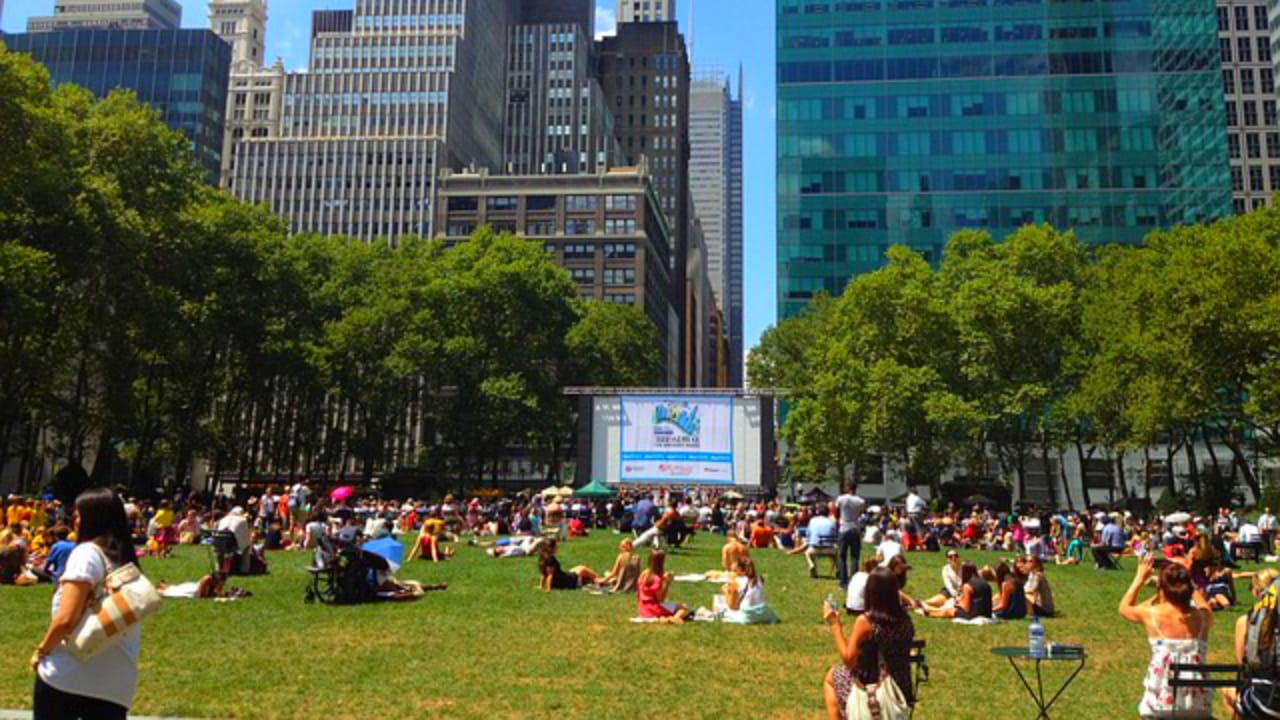
If you’ve ever stretched out on the lawn at Bryant Park with a coffee in hand, watched a free outdoor movie under the stars, or laced up your skates at the winter rink, it’s hard to imagine this seven-acre patch of Midtown Manhattan as anything but a peaceful urban retreat. Yet the Bryant Park History is anything but simple. Tucked behind the iconic New York Public Library between 40th and 42nd Streets and Fifth and Sixth Avenues, this beloved park has served as a battlefield, a burial ground, a reservoir, a World’s Fair site, an army encampment, and for a dark stretch in the 20th century a symbol of urban decay before its remarkable rebirth.
Understanding the history of Bryant Park means tracing more than 300 years of New York City’s evolution, from colonial farmland to Gilded Age ambition to modern public-private partnership. Here’s the full story of how this small but mighty park became one of the most cherished public spaces in the world.
Colonial Beginnings Public Land Since 1686
The land that would eventually become Bryant Park has been designated public property for longer than the United States has existed.
In 1686, New York’s first royal governor, Thomas Dongan, set aside this parcel along with other unappropriated lands as property under the control of the city’s Common Council, the precursor to today’s City Council. For more than a century, the area remained largely untouched, existing on the outskirts of a young and growing city.
That changed dramatically during the American Revolution. In 1776, following their defeat at the Battle of Long Island, General George Washington and his Continental Army troops are believed to have passed directly through the site as they retreated northward from advancing British forces.
It’s a striking image: one of the most tranquil green spaces in modern Manhattan once served as a corridor for a desperate wartime withdrawal.
As New York City expanded northward, the Commissioners’ Plan of 1811 laid out Manhattan’s now-famous street grid, and by 1822 the land encompassing today’s park was formally absorbed into the city. A year later, in 1823, the site took on a much grimmer purpose.
Potter’s Field
Long before it hosted lunchtime picnics and outdoor film screenings, the land was used as a potter’s field a public cemetery reserved for New Yorkers who couldn’t afford private burial plots, as well as unidentified or unclaimed bodies. This solemn chapter lasted from 1823 until 1840, when the city’s rapid growth demanded a new use for the land: fresh water infrastructure.
The Croton Reservoir and Reservoir Square
By the late 1830s, New York City faced a serious public health crisis. Fires, disease, and a booming population had overwhelmed the city’s inadequate water supply. The solution was the Croton Aqueduct system, which piped fresh water more than 40 miles from the Croton River in Westchester County into Manhattan.
As part of this ambitious engineering project, the city built the Croton Distributing Reservoir directly on the site of the old potter’s field, with construction running from roughly 1839 to 1842.
The reservoir was an engineering marvel for its time: a four-acre, man-made lake enclosed by massive granite walls that stood roughly 50 feet high and 25 feet thick. Those imposing walls quickly became a popular destination in their own right.
Fashionable New Yorkers climbed to the top for a promenade with sweeping views of the still-developing city, and the reservoir attracted prominent visitors of the era, including the writer Edgar Allan Poe.
The land immediately to the west of the reservoir became known as Reservoir Square, and in the 1850s, it briefly transformed the neighborhood into a global tourist destination.
The Crystal Palace and America’s First World’s Fair
In 1853, Reservoir Square played host to the Exhibition of the Industry of All Nations, more popularly remembered as the New York Crystal Palace Exhibition essentially America’s answer to London’s Great Exhibition of 1851.
A dazzling structure of iron and glass was erected on the site, and the exhibition ran through 1854, drawing over a million visitors and igniting one of New York’s earliest major tourism booms.
Despite its popularity, the exhibition was a financial disaster for its organizers, who reportedly lost around $300,000 on the venture. Still, the Crystal Palace structure remained standing after the exhibition closed and was leased out for various purposes over the following years, cementing the square’s reputation as a site of grand civic ambition even when that ambition didn’t quite pay off.
Civil War Encampment and the Draft Riots
The mid-1800s brought some of the darkest moments in the site’s history. During the Civil War, Reservoir Square served as a training and encampment ground for Union Army troops. Then, in March 1863, the federal government issued the first military draft notices in American history and New York City erupted.
The resulting New York City Draft Riots were among the deadliest civil disturbances in U.S. history, and the area in and around Reservoir Square was swept up in the chaos. One of the most horrifying episodes of the riots was the burning of the Colored Orphan Asylum on Fifth Avenue, just blocks from the square a grim reminder that this small patch of land has borne witness to some of the city’s most painful moments, not just its triumphs.
Becoming Bryant Park A New Name for a New Era
Throughout the late 19th century, city officials debated what to do with the reservoir site and the adjacent square, entertaining a range of proposals, including a rejected plan to convert the space into a military armory. In 1871, the land was officially designated a public park.
Then, in 1884, the space was renamed Bryant Park in honor of William Cullen Bryant, the influential poet and longtime editor of the New York Evening Post, who had died the previous year and was a champion of both the arts and public green space in the city.
Around this same period, plans were moving forward for what would become one of New York’s most iconic buildings. The Croton Reservoir, having become obsolete as the city developed newer water infrastructure, was decommissioned and dismantled beginning in the late 1880s and through the 1890s, clearing the way for construction of the New York Public Library’s main branch.
The New York Public Library Rises
City officials approved designs submitted by architects John Merven Carrère and Thomas Hastings for a grand Beaux-Arts library building on the site of the old reservoir, fronting Fifth Avenue. Construction broke ground in the late 1890s, and the building now known as the Stephen A. Schwarzman Building officially opened to the public on May 23, 1911.
Flanked by the famous marble lion sculptures nicknamed Patience and Fortitude, the library became an instant architectural landmark, with Bryant Park taking shape directly behind it as a kind of green backyard for the grand institution.
Even today, traces of the old reservoir’s foundation are reportedly still visible beneath the library’s lowest level a hidden reminder of the site’s watery past.
Life in the park during this era, however, wasn’t always pleasant. Starting in 1878, the elevated tracks of the Sixth Avenue Railway loomed over the western edge of the park, casting shadows and noise over what should have been a peaceful green space.
Rather than a bucolic retreat, turn-of-the-century Bryant Park could feel cramped, noisy, and claustrophobic a public space still searching for its identity.
The 1930s Redesign
The most significant transformation of Bryant Park’s physical layout came in the 1930s, under the administration of newly elected Mayor Fiorello La Guardia, who in 1933 consolidated New York City’s park management under a single Parks Commissioner: the formidable Robert Moses.
With funding and labor support from Depression-era public works programs, the park was completely redesigned in the French Classical tradition the elegant, symmetrical style still visible today.
Landscape architect Lusby Simpson’s plan introduced the park’s signature formal elements: a central great lawn, tree-lined gravel promenades along the perimeter, geometric plantings, and a raised terrace behind the library. This redesign gave Bryant Park the elegant bones that, decades later, would make its restoration possible.
Bryant Park’s Darkest Chapter
Despite its handsome French Classical design, Bryant Park fell into serious decline during the mid-20th century. As one of hundreds of parks under the jurisdiction of New York City’s perpetually underfunded Parks Department. Bryant Park struggled for resources through decades of municipal budget crises, culminating in the fiscal near-collapse of the city in the 1970s.
The park’s location compounded its problems. Sitting in a Midtown business district that emptied out after office hours, Bryant Park had little natural foot traffic in the evenings, making it an easy target for illicit activity.
By the 1970s and into the early 1980s, the park had earned a grim reputation as a hub for drug dealing and other crime, and many New Yorkers actively avoided it, especially after dark. Dense shrubbery and raised walls ironically, part of the original elegant design created hidden pockets that sheltered illegal activity from view and made the park feel unsafe rather than welcoming.
In 1974, the New York City Landmarks Preservation Commission designated Bryant Park a Scenic Landmark, praising its French Classical design as a source of civic pride. But by the end of that decade, the park’s reputation on the ground told a very different story.
As New York City struggled through a broader era of urban decline, Bryant Park had become, for many, a cautionary tale of what happens when a beautiful public space is left unmanaged and unloved.
The Turnaround
The rebirth of Bryant Park is now studied around the world as a model of successful urban revitalization. The transformation began in 1980 with the founding of the Bryant Park Restoration Corporation (later renamed Bryant Park Corporation), spearheaded by urban planner Dan Biederman along with Time Inc., New York Public Library chairman Andrew Heiskell, and the Rockefeller Brothers Fund.
This organization pioneered what was then a novel approach to managing public space: a nonprofit, privately funded entity working in partnership with the city to maintain and program a public park. Rather than waiting for city budgets to catch up.
The Bryant Park Restoration Corporation took direct action, tackling basic quality-of-life issues first. Crews repaired damaged structures, scrubbed away graffiti, cleared out overgrown shrubbery that had provided cover for crime, added consistent trash pickup, and crucially brought in a dedicated private security presence.
The results were dramatic and swift. Within roughly seven years, crime in the park reportedly dropped by around 92 percent, while annual visitorship more than doubled. But the organizers weren’t finished with quick fixes; they had bigger plans for a full physical renovation.
The 1988-1992 Renovation
Beginning in 1988, the Bryant Park Restoration Corporation launched a comprehensive redesign and reconstruction of the park, led by landscape architects Hanna/Olin with architects Hardy Holzman Pfeiffer Associates.
The renovation opened up sightlines into the park from the surrounding streets, removed obstructive shrubbery, added new restaurant kiosks and amenities, restored the central lawn, and introduced movable chairs and tables a small but revolutionary design choice that gave visitors control over their own experience and helped foster a genuine sense of ownership and comfort in the space.
The fully restored Bryant Park reopened to the public in 1992, and the transformation was nothing short of remarkable. The same park that had been synonymous with crime and neglect just a decade earlier quickly became one of the most heavily used and beloved public spaces in New York City.
Bryant Park Today
In the decades since its reopening, Bryant Park has only grown in popularity and programming. Today, it offers something for nearly everyone: a lush central lawn for sunbathing and picnicking, a reading room stocked with free books and periodicals, chess and backgammon tables, ping-pong, a carousel, and a packed calendar of free public programming that includes outdoor film screenings, fitness classes, and live performances.
In the colder months, the park transforms into a festive winter destination, home to a seasonal ice-skating rink and an extensive holiday shop village that draws visitors from across the city and beyond. The park is also flanked by two well-regarded on-site restaurants, along with numerous food kiosks, and offers free public Wi-Fi throughout its grounds modern amenities layered onto a landscape shaped by nearly three and a half centuries of New York City history.
Bryant Park’s success has become a widely cited case study in urban planning circles, frequently referenced as proof that thoughtful design, active management, and sustained private investment can transform even the most troubled public spaces into thriving civic assets. Cities around the world have looked to the Bryant Park model when reimagining their own struggling parks and plazas.
Why Bryant Park History Still Matters
From a colonial commons to a potter’s field, from a Civil War staging ground to a World’s Fair spectacle, from a crime-ridden no-go zone to one of the most celebrated public spaces in America Bryant Park’s history is a microcosm of New York City itself: resilient, ever-changing, and defined by reinvention.
The next time you find yourself relaxing on the Great Lawn or grabbing a coffee at one of the park’s kiosks, take a moment to consider everything that came before.
Beneath that manicured grass lies more than three centuries of stories of soldiers and paupers, engineers and rioters, urban planners and everyday New Yorkers all of whom, in their own way, helped shape the Bryant Park we know and love today.