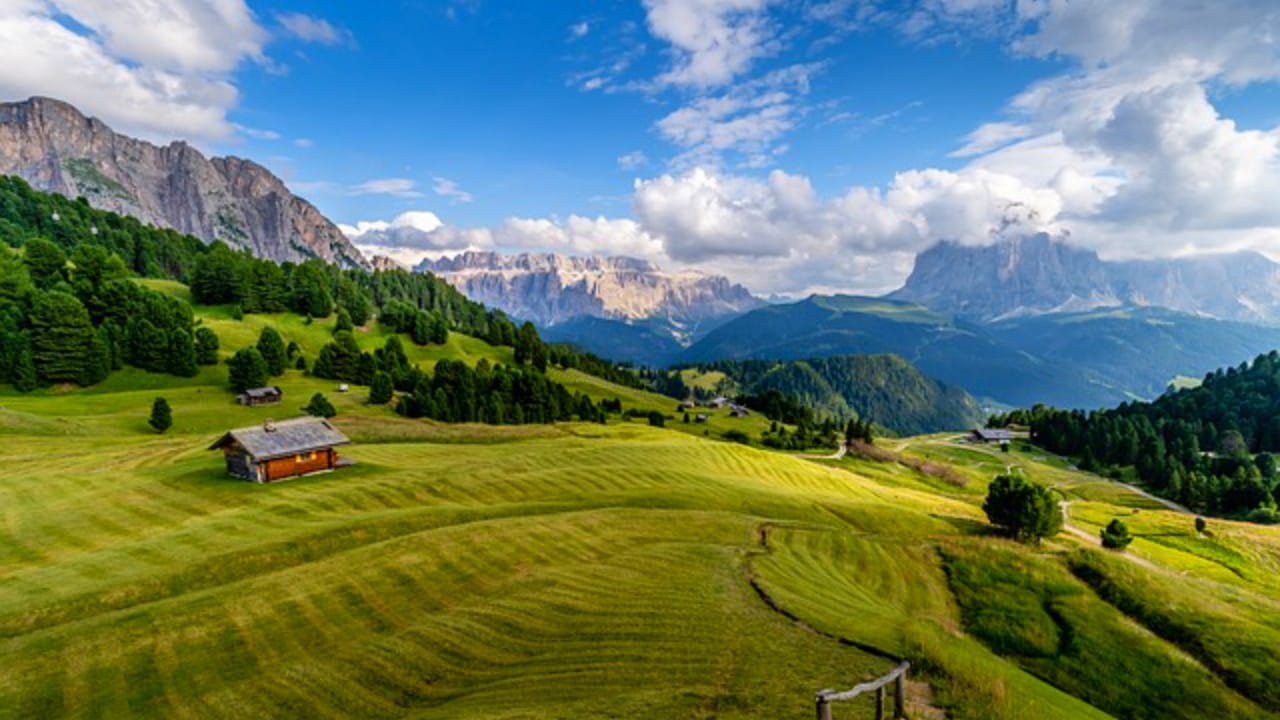
Venice gives you canals, gondolas, and centuries of marble and mosaic. The Dolomites give you jagged limestone spires, alpine lakes the color of glass, and air that smells like pine instead of saltwater. The strange, wonderful thing is that these two completely different worlds sit just a couple of hours apart close enough that a huge number of travelers try to squeeze both into a single trip, often on a single day.
Is it a good idea? Mostly yes, with a few honest caveats. This guide walks through exactly how far the Dolomites are from Venice, the fastest and most scenic ways to get there, which mountain towns and viewpoints actually fit into a day trip, and how to build an itinerary that doesn’t leave you feeling like you spent the whole day in a car.
Whether you’re renting a car, joining an organized tour, or trying to piece it together with trains and buses, everything you need is below.
How Far Are the Dolomites From Venice?
The short answer: it depends on exactly where in the Dolomites you’re headed, but most of the popular access points are roughly 120–200 km (75–125 miles) from Venice, translating to somewhere between 2 and 3.5 hours of driving each way.
Here’s a rough breakdown of driving times from Venice (or Venice-Mestre, which is the practical starting point since Venice’s historic center is car-free):
- Venice to Cortina d’Ampezzo: about 150 km, roughly 2 to 2.5 hours by car
- Venice to Lake Misurina: approximately 2 hours 15 minutes
- Venice to Tre Cime di Lavaredo (Auronzo hut parking): 2.5 to 3 hours, depending on traffic and the season
- Venice to Lago di Braies: around 190–200 km, roughly 3 to 3.5 hours
- Venice to Bolzano (western Dolomites gateway): about 2.5 hours
Those numbers matter because they define how the rest of your day works. If you’re driving 2.5 hours each way, you’re already committing 5 hours to transit before you’ve taken a single photo of a mountain. That’s the central trade-off of a Venice to Dolomites day trip: it’s absolutely doable, but you have to be realistic about how much actual time you’ll spend among the peaks versus in transit.
Venice to Dolomites Day Trip Worth It?
Yes – with the right expectations. A day trip won’t let you hike a full Alta Via route or linger for a sunset at every famous viewpoint, but it will give you a genuine, memorable taste of the Dolomites: a scenic mountain drive, one or two iconic stops, a proper alpine lunch, and views that look nothing like anything else in Italy.
Travelers who tend to enjoy this trip most are those staying in Venice for at least three or four nights, since sacrificing one full day for the mountains doesn’t feel like a huge loss. If you’re only in Venice for one or two nights, you may want to skip the Dolomites entirely and save them for a future trip with more time, since a rushed 12-hour round trip can feel more exhausting than magical if you’re already short on time in the city.
Families with small children, older travelers with mobility concerns, or anyone who dislikes long car rides should think carefully before committing to this itinerary. The reward is real, but so is the physical toll of an early wake-up call and a long day of driving on winding mountain roads.
How to Get From Venice to the Dolomites
There are three realistic ways to make this trip: self-driving, joining an organized tour, or using public transportation. Each has clear trade-offs.
Option 1: Self-Drive (Rental Car)
Driving yourself is the fastest and most flexible option, and it’s the one most independent travelers choose. Since central Venice is closed to cars, you’ll need to pick up your rental at Venice-Mestre train station or at Venice Marco Polo Airport Mestre is usually a bit cheaper for the same vehicle category.
The classic route north follows the A27 autostrada out of Mestre toward Belluno (about 55 minutes, with a small toll), then continues on the SS51 mountain road from Belluno up into the Boite Valley toward Cortina d’Ampezzo (roughly another 1 hour 15 minutes). This SS51 stretch is where the trip starts to feel like the Dolomites: the valley narrows, the peaks of Monte Pelmo and Antelao rise on either side, and small alpine villages appear along the road.
If you have more time, the return leg can be routed over the Passo Giau, one of the most celebrated mountain passes in the Dolomites, with hairpin turns and sweeping panoramic views from the pass itself (2,236 m). It adds time but is widely considered worth it for the scenery alone.
Pros: Total flexibility on timing and stops, no waiting for buses, ability to chase good weather or light, freedom to detour to a lake, pass, or viewpoint that catches your eye.
Cons: Mountain roads have switchbacks and can be tiring to drive, especially after an early start; parking at popular spots like Lago di Misurina or the Tre Cime trailhead fills up fast in summer; you’ll need a valid license, comfort with manual transmissions (most rentals in Italy are manual unless you request otherwise), and a head for narrow roads.
Option 2: Organized Day Tour
For travelers who don’t want to drive, a guided day tour is the most popular solution, and there are plenty of operators running trips from Venice, ranging from large group coach tours to small-group minivans to fully private cars with a driver-guide.
A typical tour departs Venice (often from Piazzale Roma) around 7:00–8:00 AM and returns between 8:00 and 9:00 PM, making for a long but complete day. Popular tour itineraries usually combine Cortina d’Ampezzo, Lake Misurina, and a stop with views of the Tre Cime di Lavaredo, sometimes swapping in Lago di Braies instead of Misurina depending on the operator.
Prices vary widely: shared group tours in a coach or minibus tend to run in a moderate mid-range price bracket per person, while private tours with a dedicated driver and vehicle cost considerably more but offer far greater flexibility on pacing, photo stops, and lunch choices.
Pros: No driving stress, a local guide who can explain the geology, history, and culture of the region, hotel or central pickup in some cases, ability to relax and actually look at the scenery instead of watching the road.
Cons: Fixed schedule and stops, less time at any single location, group tours can feel rushed if the group is large, cost is higher than self-driving for solo travelers or couples.
Option 3: Train and Bus (Public Transportation)
It’s technically possible to reach parts of the Dolomites by public transport, but it is genuinely the slowest and least flexible option, and it’s rarely recommended for a single day trip.
One common route involves taking a regional train from Venice Santa Lucia or Mestre toward Belluno or Calalzo di Cadore (roughly 2 to 3 hours with a transfer), then connecting to a local Dolomiti Bus service toward Cortina d’Ampezzo (about another hour).
Direct long-distance coach companies such as Cortina Express and FlixBus also run buses between Venice-Mestre and Cortina d’Ampezzo, taking around 2.5 hours with no stops, which is actually more efficient than the train-plus-bus combination.
Total one-way travel time by public transport typically runs 3 to 5 hours depending on connections, which eats deeply into the time you’d have on the ground. This option makes far more sense if you’re spending a night or two in the Dolomites rather than attempting a single-day round trip.
Pros: Budget-friendly, no need to drive on unfamiliar mountain roads, direct buses to Cortina are reasonably comfortable.
Cons: Long total travel time, limited schedules (especially on Sundays and off-season), no flexibility to stop at scenic viewpoints along the way, and once you arrive you’ll still need local transport (buses, taxis, or your own two feet) to reach lakes and viewpoints outside town.
The Best Stops for a Day Trip
Given the time constraints of a single day, it’s smart to pick one focused route rather than trying to see the entire Dolomite range. Below are the destinations that consistently work best for day-trippers from Venice, grouped by the two most popular route options.
Route A: Cortina, Lake Misurina, and Tre Cime di Lavaredo
This is the most classic and arguably most rewarding single-day route, combining an elegant alpine town, one of the most photogenic lakes in the Dolomites, and views of the region’s most iconic rock formation.
Cortina d’Ampezzo is often called the “Queen of the Dolomites.” Host of the 1956 Winter Olympics and set to host the 2026 Winter Games again, it’s a polished mountain resort town surrounded on all sides by dramatic peaks. Even a short walk through its pedestrian center lined with boutiques, cafés, and mountain-chic architecture gives you a real sense of Dolomite culture. It’s also a good base for lunch, with plenty of cafés and restaurants serving South Tyrolean and Venetian-influenced alpine dishes.
Lake Misurina sits about 30–40 minutes from Cortina and is one of the largest natural lakes in the Dolomites. Ringed by pine forest with the jagged Sorapiss massif reflected in its still water, it’s a classic photo stop and a pleasant place for a short lakeside walk.
Tre Cime di Lavaredo (the “Three Peaks of Lavaredo”) are the single most photographed rock formation in the entire Dolomite range three dramatic limestone towers rising abruptly from a high alpine plateau. From Lake Misurina, a scenic toll road climbs up to the Rifugio Auronzo parking area, from which a relatively easy walking trail (about 1.5-2 hours round trip) leads to close-up views of the peaks. Given a day trip’s time constraints, many visitors are satisfied simply admiring the formation from the parking area and the first stretch of trail rather than completing the full loop.
Route B: Lago di Braies (The “Pearl of the Dolomites”)
If a single unforgettable image matters more to you than variety, Lago di Braies is worth the extra driving time. This turquoise alpine lake, tucked beneath dramatic cliffs in the Val di Braies (South Tyrol), has become one of the most Instagrammed spots in Italy, and for good reason the color of the water genuinely looks otherworldly on a clear day.
The drive from Venice to Lago di Braies is longer (around 3 to 3.5 hours each way via Belluno, Cortina, and Dobbiaco), which makes it a more ambitious day trip. Many organized tours that include Braies also add a stop in Cortina along the way, effectively combining elements of both routes above, though this naturally reduces time at each location.
Once there, you can walk the flat, scenic lakeside path (about 3.5 km round trip) or rent one of the iconic wooden rowboats to paddle out onto the water. Note that during peak summer months (roughly mid-July to early September), the access road to the lake is restricted between 9:00 AM and 4:00 PM, and parking must often be booked in advance online; if you don’t reserve a spot, you may need to park lower in the valley and take a shuttle bus.
Other Worthwhile Add-Ons (If Time Allows)
- Cinque Torri: A striking group of five rock towers near Cortina, reachable via a short chairlift, with an open-air World War I museum among the surrounding trenches and fortifications.
- Passo Giau: A spectacular mountain pass with hairpin switchbacks and panoramic views, ideal as a scenic return route if you’re self-driving and have extra daylight.
- Alpe di Siusi: Europe’s largest high-altitude alpine meadow, but it sits further west near Bolzano and is genuinely difficult to combine with a Venice-based day trip better saved for a Dolomites trip based out of Bolzano or Val Gardena.
A Sample Hour-by-Hour Itinerary
Here’s how a realistic, well-paced day trip from Venice to the Dolomites (Route A) might unfold if you’re self-driving or on a private tour:
- 6:00–6:30 AM: Depart Venice-Mestre (early start is essential to maximize daylight)
- 8:00–8:30 AM: Arrive in Cortina d’Ampezzo; short walk, coffee, and pastry break
- 9:00 AM: Continue toward Lake Misurina (about 30–40 minutes)
- 9:30–10:15 AM: Photo stop and short walk at Lake Misurina
- 10:15–11:00 AM: Drive up the toll road to Rifugio Auronzo (Tre Cime access point)
- 11:00 AM–1:00 PM: Walk toward the Tre Cime viewpoint, enjoy the views, take photos
- 1:00–2:30 PM: Return to Cortina for a proper alpine lunch
- 2:30–3:30 PM: Free time to explore Cortina’s town center and shops
- 3:30 PM: Begin the return journey (via Passo Giau if time and daylight allow, otherwise directly via SS51/A27)
- 6:00–7:00 PM: Arrive back in Venice-Mestre
This schedule assumes an early departure and reasonably good weather and traffic conditions. If you’re using an organized tour, the operator will have their own fixed schedule, but it will likely follow a similar overall shape.
Practical Tips for a Smooth Trip
Leave early earlier than feels necessary: Nearly every successful account of this day trip emphasizes the same point: departing Venice by 6:00 or 7:00 AM at the latest is essential. Every hour you delay is an hour subtracted directly from your time in the mountains, not from your drive time.
Check the weather the night before and again in the morning: Mountain weather in the Dolomites changes quickly and can differ dramatically from conditions in Venice. Clear skies in the city don’t guarantee clear skies at 2,000 meters. If the forecast looks poor for visibility (heavy cloud, fog, or storms), consider rescheduling if your itinerary allows it, since the entire value of this trip is the scenery.
Dress in layers: Even in summer, temperatures at altitude especially near Tre Cime or Lago di Braies can be 15–20°C (25–35°F) cooler than Venice at sea level. Bring a light jacket, and comfortable, closed-toe walking shoes if you plan to do any of the short trails.
Book parking in advance where required: Lago di Braies enforces vehicle restrictions and paid parking reservations during peak summer months. The Tre Cime toll road (Rifugio Auronzo) also charges a per-vehicle fee and can fill its lots by mid-morning in July and August. Arriving early helps enormously.
Bring cash and a few euros in coins: Some mountain rifugios, toll booths, and smaller cafés in rural areas still prefer cash, and card readers can be unreliable at altitude.
Fuel up before you leave the highway: Fuel stations become sparser once you’re in the mountains, and prices tend to rise the higher you go.
Consider travel insurance if self-driving: Mountain roads, unfamiliar signage, and long driving days are a combination worth having covered, especially if you’re not used to driving in Italy.
Pick a season deliberately: Late June through September offers the most reliable weather and full accessibility to trails and rifugios, though it’s also the busiest and most crowded period. Late spring (May) and early autumn (late September-October) offer fewer crowds and often spectacular foliage, but some higher trails, cable cars, or mountain huts may have reduced hours or be closed. Winter access is far more limited and generally unsuitable for a casual day trip unless you’re specifically after snow scenery.
What to Pack for the Day
Because you’re moving from sea-level Venice to alpine altitudes in the same day, packing smart makes a real difference in comfort. Keep a small daypack with the following:
- A packable layer – a light fleece or windbreaker, even in July, since wind at altitude near Tre Cime or Lago di Braies can be sharp even when the sun is out.
- Comfortable walking shoes – sneakers or light hikers are enough for the short trails described above; you don’t need full hiking boots unless you’re planning a longer route.
- Sunglasses and sunscreen – UV exposure is stronger at altitude, and the light reflecting off limestone and lake water can be intense on clear days.
- A refillable water bottle – many rifugios and mountain huts have fountains, and staying hydrated matters more at altitude than you’d expect.
- Cash in small denominations – for parking machines, toll roads, and smaller alpine cafés.
- A camera or phone with a charged battery and spare power bank – cold mountain air can drain phone batteries faster than usual.
- Snacks – a granola bar or piece of fruit is useful insurance if lunch timing shifts.
If you’re self-driving, download offline maps for the mountain sections of your route in advance, since cell signal can be patchy in remote valleys.
Combining the Dolomites With Other Venice Day Trips
If the Dolomites feel too ambitious for your schedule, it helps to know how they compare to other popular Venice day trips. Closer alternatives like the Prosecco Hills around Valdobbiadene, the city of Verona, or the Venetian villas along the Brenta Canal require far less driving time.
The Dolomites are the most demanding of Venice’s classic day trips in terms of time and distance, but also the most transformative in scenery there’s nowhere else within reach of Venice that looks anything like it. Many travelers save the Dolomites, with its early start and long drive, for a day when they’re well rested.
FAQs
Can you do the Dolomites as a day trip from Venice?
Yes, it’s a popular and achievable day trip, typically running 10 to 14 hours round trip depending on your route and mode of transport. It won’t allow for extensive hiking, but it does allow for a genuine taste of the region’s scenery, including at least one or two headline stops like Cortina d’Ampezzo, Lake Misurina, or the Tre Cime di Lavaredo viewpoint.
How early should I leave Venice for a Dolomites day trip?
Aim to depart by 6:00–7:00 AM. Earlier departures directly translate into more usable daylight hours in the mountains and help you beat both traffic and the crowds at popular parking areas.
Do I need a car to visit the Dolomites from Venice?
Not necessarily. A rental car offers the most flexibility, but organized day tours (group or private) are a very popular and stress-free alternative, especially for travelers uncomfortable driving on mountain roads. Public transport is possible but is the slowest and least practical option for a single-day round trip.
Is it worth hiking during a Dolomites day trip?
Short walks such as the initial stretch of trail toward Tre Cime di Lavaredo, or the lakeside path around Lago di Braies fit comfortably into a day trip and are highly recommended. Full-day hikes or multi-hour routes (like sections of the Alta Via trails) are not realistic given the time constraints and are better suited to a multi-day Dolomites trip.
How much does a Dolomites day trip from Venice cost?
Costs vary significantly by option. Self-driving costs include a rental car, fuel, and tolls (highly variable depending on the vehicle and rental duration). Shared group tours are typically mid-range in price per person. Private guided tours with a dedicated vehicle and driver cost considerably more but offer the most personalized experience. Public transport is the cheapest option in pure cash terms but the most demanding in time.