If you’ve typed Rockefeller Center tree lighting 2026 into a search bar, you’re probably trying to plan a trip, book a hotel, or just settle a debate with a friend about whether it’s the last Wednesday of November or the first one in December. Either way, you’ve come to the right place.
The short answer: the 2026 Rockefeller Center Christmas Tree Lighting Ceremony is expected to take place on Wednesday, December 2, 2026, in keeping with the decades-long tradition of lighting the tree on the first Wednesday after Thanksgiving. Multiple event organizers, hospitality companies, and New York travel guides have already built their 2026 calendars around that date, though Rockefeller Center’s official press release which typically drops in October or early November will be the final word.
Below, we’ll walk through everything you need to know: the date and time, why the ceremony always falls when it does, what actually happens during the event, how to get a good view (for free), ticketed alternatives if you want to skip the crowds, what happens to the tree afterward, and a full FAQ section to answer the smaller questions that tend to come up once you start planning.
Rockefeller Center Tree Lighting 2026
Before we get into the details, here’s the cheat sheet:
- Expected date: Wednesday, December 2, 2026
- Expected ceremony time: Roughly 7:00 p.m. to 9:00 or 10:00 p.m. Eastern Time, with musical performances first and the actual lighting moment near the end
- Location: Rockefeller Plaza, between 5th and 6th Avenues, roughly West 48th to West 51st Street, Midtown Manhattan
- Cost to view: Free, if you’re standing in the general public viewing areas
- Broadcast: Historically shown live on NBC, with performances from well-known musical artists
- How long the tree stays lit: Daily from early morning until around midnight, typically through the second week of January 2027
- Tree species: Almost always a Norway spruce, usually between 70 and 90 feet tall
Now, let’s unpack each of these in more detail.
Why December 2, 2026? The Logic Behind the Date
Unlike a lot of holiday events that move around unpredictably, the Rockefeller Center tree lighting follows a fairly consistent rule: it happens on the first Wednesday after Thanksgiving. Thanksgiving in the United States always falls on the fourth Thursday of November, which in 2026 lands on November 26. Count forward to the next Wednesday, and you land on December 2 which is exactly the date that event planners, gala hosts, and travel bloggers have circled on their 2026 calendars.
This pattern isn’t a coincidence or a marketing gimmick. It reflects the practical reality of putting on a massive live event in the middle of Manhattan. The tree itself typically arrives in early November and gets hoisted into place with a crane in a much quieter, less publicized event. Then comes weeks of decorating: stringing more than 50,000 multi-colored LED lights across roughly five miles of wiring, and topping the whole thing off with the famous Swarovski crystal star, which weighs several hundred pounds and is covered in three million crystals.
Because all of that decorating work has to be finished, tested, and buttoned up before showtime, the ceremony can’t happen the same week as Thanksgiving there simply isn’t enough time to do the installation, run safety checks, and coordinate a live network broadcast around a major national holiday. Waiting until the Wednesday after gives crews breathing room while still keeping the event early enough in the season that families visiting for winter break in late December get to see the tree fully lit for weeks.
It’s also worth noting that in recent years, the date has landed anywhere between November 29 and December 4, depending entirely on where Thanksgiving falls that year. So if you’re trying to predict future years yourself, the trick is simple: find the fourth Thursday of November, then look at the following Wednesday.
What Time Does the Ceremony Actually Start?
The Rockefeller Center tree lighting isn’t a single quick moment it’s a full evening program, and most of it is musical performances rather than the lighting itself.
Based on the pattern from recent years, here’s roughly how the evening tends to unfold:
- Early evening (around 7:00 p.m.): The televised broadcast typically begins, featuring a lineup of musical guests performing holiday songs and hits on a stage set up in the plaza. In past years, performers have included major pop and country stars, Broadway casts, and legacy artists.
- Mid-evening: More performances, interviews, and segments recapping the history and traditions of the tree.
- Around 9:00 p.m. (sometimes closer to 8:30 or as late as 10:00 p.m.): The actual countdown and lighting moment. A local dignitary often the mayor of New York City, alongside NBC hosts and sometimes a celebrity guest leads a countdown, and the tree’s more than 50,000 lights switch on simultaneously.
- After the ceremony: The plaza generally stays open a bit longer for visitors, before closing for the night to be cleaned up. Reports suggest the plaza closes by around 11:00 p.m. on lighting night.
If your only goal is to see the lights actually turn on, you don’t need to arrive at 7:00 p.m. but you do need patience, because Rockefeller Center gets extremely crowded, and once the plaza reaches capacity, NYPD and event staff will close off access to new arrivals. That’s why so many locals recommend showing up hours early if you want a close-up view, or picking a strategy that doesn’t rely on being right next to the tree at all (more on that below).
Where Exactly Does It Happen?
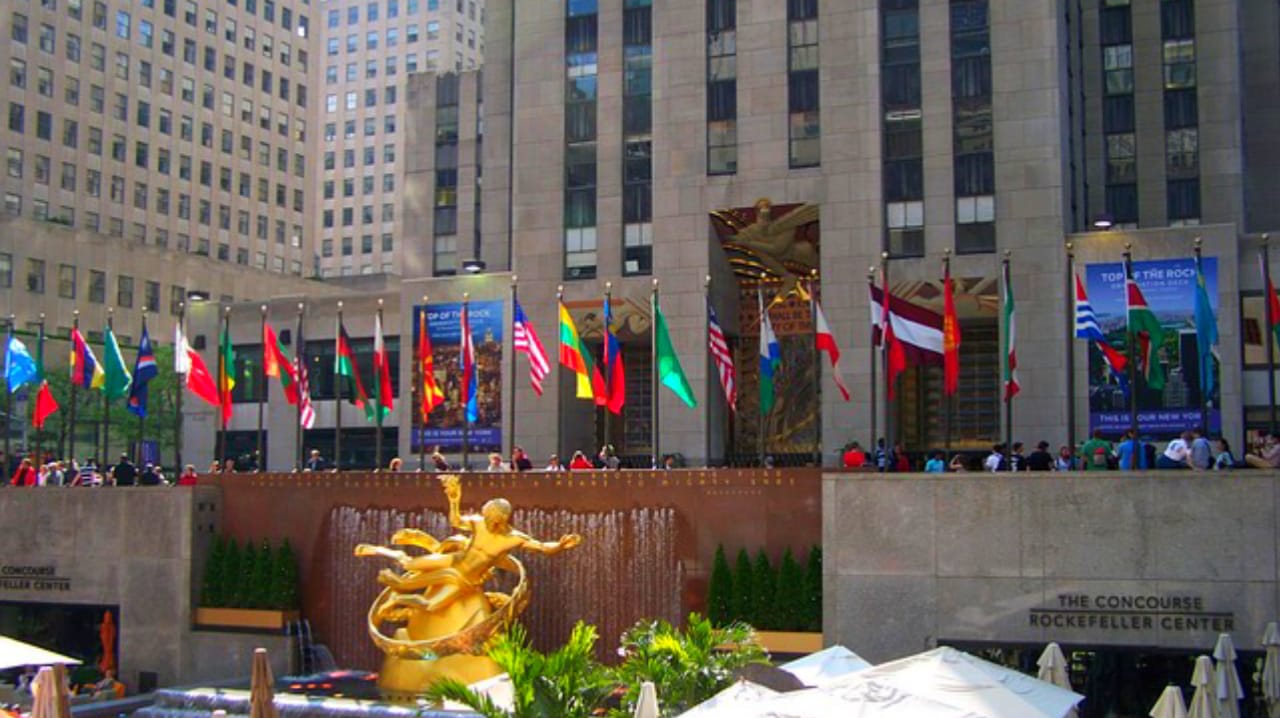
The ceremony takes place at Rockefeller Plaza, in the heart of Midtown Manhattan, spanning roughly from West 48th to West 51st Street, between Fifth and Sixth Avenues. The tree itself stands in the same spot it has occupied since 1933 directly above the ice-skating rink, in the sunken plaza area often called the “Channel Gardens” corridor, with the golden statue of Prometheus visible just below.
This location has been the site of the tree since the very first informal one appeared during the Great Depression, when construction workers on the Rockefeller Center site put up a small, undecorated tree as a show of camaraderie.
The first official, organized tree lighting ceremony followed in 1933, and it’s been a New York institution ever since nearly a century of unbroken tradition, aside from wartime blackout restrictions during World War II, when the tree wasn’t lit at all for a few years for safety reasons.
What Happens Before the Big Night
If you’re visiting New York in the weeks leading up to December 2, you may actually get to see some of the pre-show action, which is a treat in itself.
The tree’s arrival. Sometime in early November often around the first or second week the year’s chosen Norway spruce is transported to Manhattan on a flatbed truck, often escorted through the city in the early morning hours to minimize traffic disruption. A crane then hoists it into position in front of the rink. This whole process is a spectacle of its own, though it’s far less crowded than the lighting ceremony itself since it typically isn’t heavily advertised in advance.
Decorating. Over the following two to three weeks, crews string the lights, hang the star, and wrap the tree in protective netting or scaffolding while the work is finished.
Scaffolding removal. As Thanksgiving approaches, the scaffolding comes down, and the tree stands fully decorated just not illuminated for a few days. This is actually one of the best times to visit if you want an up-close look at the tree without massive crowds, since it isn’t lit yet and hasn’t drawn the big audiences that show up for the ceremony itself.
Selecting next year’s tree. Interestingly, the search for the following year’s tree often begins around this same time. Rockefeller Center’s head gardener and scouting team look at homeowner submissions and travel around the Northeast often New York, New Jersey, and Connecticut searching for a healthy, symmetrical Norway spruce of the right size, usually between 70 and 90 feet tall.
How to Watch
Watching in Person (Free)
The tree lighting is free to attend in the general viewing areas, but free doesn’t mean “easy.” Rockefeller Center is one of the most visited spots in the world during the holidays, and on lighting night specifically, the crowds multiply.
A few practical tips seasoned New Yorkers and repeat visitors tend to share:
- Arrive early as in, hours early. Serious tree-lighting veterans often recommend getting to the area by early afternoon if you want any real shot at a close view. By early evening, blocks around the plaza are often already at capacity, and police will start restricting entry to new arrivals to keep pedestrian flow safe.
- Consider a slightly elevated or offset vantage point. Some visitors have found decent partial views from nearby side streets, or from a restaurant or building with windows facing the plaza, rather than fighting for a spot directly in the roped-off area.
- Dress like you’re going to be standing outside in late-fall New York weather for hours. Layers, warm socks, hand warmers, and waterproof boots are not optional extras they’re the difference between an enjoyable night and a miserable one.
- Expect road closures. The blocks surrounding Rockefeller Center typically close to vehicle traffic for safety, and many nearby office buildings let employees leave early that day specifically because of the disruption.
- Public transit beats driving. Given the road closures and jammed sidewalks, the subway is by far the most practical way to get close to the area.
Watching on TV or Streaming
If standing in a crowd for hours in the cold isn’t your idea of a good time, the ceremony has historically been broadcast live on NBC, often with a companion stream available through NBC’s streaming platforms. This is a perfectly good way to see the performances and the lighting moment itself without the logistics of navigating Midtown Manhattan on one of its busiest nights of the year. Check local listings closer to the date, since exact channel and streaming details for 2026 will be confirmed as the event approaches.
Ticketed Viewing Options
For travelers who want a guaranteed, comfortable view without the standing-room scramble, a growing number of private hospitality companies now offer ticketed viewing experiences inside buildings overlooking the plaza. These typically include indoor seating with a direct view of the tree, food and drinks, and sometimes live music of their own.
It’s worth being aware that these are run by independent event companies not by Rockefeller Center, Tishman Speyer (the property’s owner), or NBCUniversal so read the fine print on what exactly you’re purchasing before committing. General public viewing of the tree itself remains free, and any company implying otherwise isn’t representing an official Rockefeller Center service.
What Kind of Tree Will It Be?
Nearly every year, the Rockefeller Center Christmas Tree is a Norway spruce (Picea abies) prized for its dense branches, classic conical shape, and its ability to hold thousands of lights and ornaments without the branches drooping. Trees are almost always sourced from within a few hundred miles of the city, most commonly New York State, New Jersey, or Connecticut, though occasionally trees have traveled from farther afield.
The selection process is surprisingly personal. Many past trees have come from homeowners who reached out directly, offering up a tree that had been growing in their yard for decades sometimes planted by a parent or grandparent after Rockefeller Center’s head gardener or a scouting team spotted it or received a submission. Selection criteria include:
- Height, generally between 70 and 90 feet, though the range can run from around 69 feet to over 100 feet in taller years
- A full, symmetrical shape with dense branching all the way around
- Good health, with no major gaps, disease, or storm damage
- The ability to survive the trip to Manhattan and the hoisting process without significant damage
Once chosen, the tree is topped with the three-dimensional Swarovski star, which has crowned the tree since 2018. The star weighs roughly 900 pounds, stands about 9 feet tall, and is covered in three million crystals arranged across 70 spikes an upgrade from the design used in prior years.
What Happens to the Tree Afterward?
One detail that surprises a lot of first-time visitors: the tree doesn’t just get thrown away in January. For years now, Rockefeller Center has partnered with Habitat for Humanity, milling the spruce into lumber that’s donated toward home-building projects for families in need. It’s a nice, practical bookend to a tree that spent weeks bringing joy to millions of visitors and TV viewers — its wood goes on to become part of someone’s actual home.
The tree typically stays lit daily, usually from around 5:00 a.m. to somewhere around midnight, through early-to-mid January of the following year, before being taken down, milled, and donated. So even if you can’t make it to New York for the lighting ceremony itself, there’s a roughly six-week window afterward when you can see the tree fully lit at your own pace, without the ceremony-night crowds.
Making the Most of a December Visit to Rockefeller Center
If your trip revolves around the tree, it’s worth building the rest of your day or weekend around nearby attractions, since Rockefeller Center sits in the middle of some of Manhattan’s most iconic holiday sights.
- The ice rink. Skating beneath the tree is one of the most photographed activities in the city each winter. Advance reservations are strongly recommended, especially during peak weeks.
- Top of the Rock. The observation deck atop 30 Rockefeller Plaza offers sweeping views of Manhattan, including a bird’s-eye look down at the tree and skating rink itself.
- Radio City Music Hall. Just a block away, this is home to the Christmas Spectacular and the Rockettes, a classic pairing with a Rockefeller Center visit.
- Fifth Avenue window displays. Several nearby department stores put together elaborate holiday window displays each year, worth a stroll if you have time.
- Saks Fifth Avenue light show. Just across the street from Rockefeller Center, Saks typically runs a projected light and music show on its building facade throughout the season.
Because so many of these attractions cluster within a few blocks of each other, many visitors plan an entire day around the area rather than treating the tree lighting as a single isolated event.
Best Spots for Photos (Without Fighting the Whole Crowd)
Getting a great photo of the tree doesn’t necessarily mean being pressed up against the barricades on lighting night. A few alternative vantage points tend to work well for visitors who’d rather not spend the entire evening standing in one spot:
- Fifth Avenue, looking down the Channel Gardens. This classic angle, looking west toward the tree with the Channel Gardens’ rows of flags and sculptures in the foreground, is one of the most photographed views in the city and is often accessible even when the plaza itself is packed.
- Top of the Rock, during the day or on a non-ceremony evening. Since the observation deck offers a bird’s-eye view straight down onto the tree and rink, it’s a good option if you’d rather see the whole scene from above than from ground level, and it avoids the ceremony-night bottleneck entirely.
- Early morning or late-night visits after the ceremony. Once the tree is lit, it stays lit daily for weeks. Visiting on a weekday morning or a quiet weeknight, rather than during peak weekend hours, is often the easiest way to get an unobstructed photo without shoving through crowds.
- Nearby cross streets. Some visitors have found partial but still striking views from the surrounding side streets, especially useful if the main plaza has already reached capacity.
If your main goal is a great photo rather than witnessing the actual lighting moment, it’s often far less stressful to visit a few days after the ceremony than to try to fight the opening-night crowds.
Planning Your Trip Around the Date
Because Rockefeller Center draws such enormous crowds specifically on lighting night, a lot of visitors especially those traveling from out of town choose to plan their trip for the days or weeks just after December 2 rather than for the ceremony itself. This has a few practical advantages worth considering:
- Hotel rates and availability. Rooms in Midtown Manhattan tend to be at their most expensive and hardest to book in the days immediately surrounding the ceremony. Visiting a week or two later, once the initial rush has passed, can make finding a reasonably priced room considerably easier.
- Shorter lines everywhere. Not just at the tree itself, but at Top of the Rock, the ice rink, and nearby attractions like Radio City Music Hall all of which see their heaviest crowds on and immediately after the lighting ceremony.
- A more relaxed pace. Once the initial ceremony buzz dies down, it’s much easier to simply stroll through the plaza, take photos, and enjoy the tree without needing to arrive hours early or contend with road closures.
That said, if being present for the actual countdown and lighting moment matters to you, there’s no substitute for being there on the night itself. It’s simply worth weighing the trade-off between witnessing that one specific moment versus having a calmer, more flexible visit later in the season.
A Brief History of the Tradition
The Rockefeller Center Christmas Tree tradition dates back to 1931, during the depths of the Great Depression, when construction workers building Rockefeller Center put up a small, undecorated balsam fir as a gesture of solidarity during a difficult time. Two years later, in 1933, the first official, organized tree lighting ceremony took place, marking the true start of what’s now one of the most recognizable holiday traditions in the United States.
The tradition has continued nearly every year since with one notable interruption. During parts of World War II, the tree wasn’t lit due to wartime blackout regulations, and in some of those years, three unlit trees were displayed instead, decorated with paper ornaments rather than electric lights, as a wartime substitute. Aside from that stretch, the ceremony has run continuously for nearly a century, evolving from a modest neighborhood gathering into a nationally televised event watched by millions.
In the years following the September 11, 2001 attacks, the tree was decorated in patriotic red, white, and blue as a mark of respect and remembrance a tradition that has occasionally been echoed in later years as well.
FAQs
Do I need a ticket to see the tree lighting?
No. General public viewing is free. Various private companies sell ticketed hospitality packages with indoor seating and food and drink service, but these are independent add-ons, not a requirement to see the tree or the ceremony.
How early should I arrive if I want to be close to the tree?
Many repeat visitors suggest arriving in the early afternoon, several hours before the evening broadcast begins, since the surrounding blocks fill up quickly and police may restrict access once capacity is reached.
Will the tree lighting be televised?
Historically, yes NBC has broadcast the ceremony live for years, typically with musical performances throughout the evening leading up to the lighting moment. Exact details for the 2026 broadcast will be confirmed closer to the date.
What happens to the tree after the holidays?
The wood is milled into lumber and donated to Habitat for Humanity, which uses it in home-building projects for families in need.
Can I visit the tree before it’s lit?
Yes, the tree is usually installed and mostly decorated well before the lighting ceremony, with scaffolding coming down close to Thanksgiving. Visiting in the few days between the scaffolding removal and the official lighting can be a nice way to see the tree up close with smaller crowds.