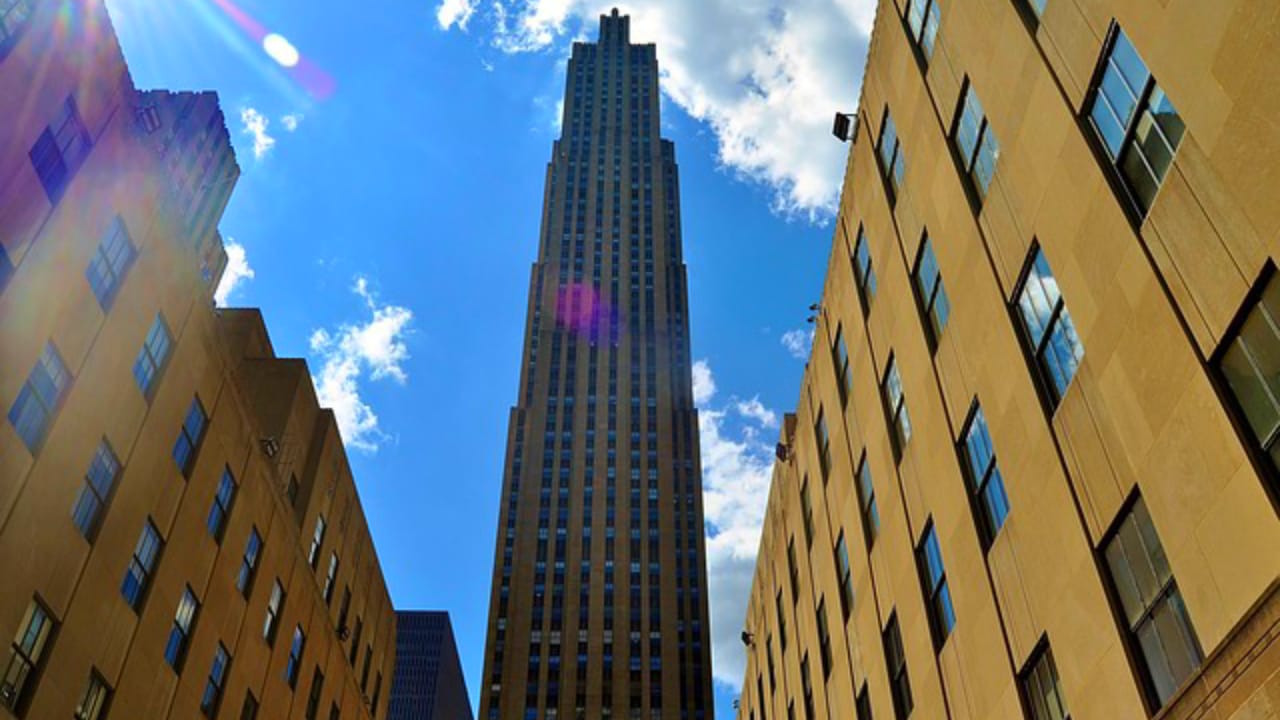
Few places on Earth pack as much history into 22 acres as Rockefeller Center. Millions of visitors pass through this Midtown Manhattan complex every year to skate beneath the golden statue of Prometheus, snap photos of the towering Christmas tree, or ride to the Top of the Rock for panoramic views of the skyline. But long before it became one of the most photographed spots in New York City, Rockefeller Center was a financial gamble so audacious that many of John D. Rockefeller Jr.’s own advisors thought it might bankrupt the family fortune.
The story of Rockefeller Center is really the story of one man’s refusal to abandon a half-finished dream during the darkest economic collapse in American history. It’s a tale of shifting blueprints, controversial murals, laid-off opera singers, 40,000 construction workers, and a business bet that eventually reshaped how cities around the world think about urban development. Here’s how it all happened.
A Dream That Started With an Opera House
Rockefeller Center’s origin story doesn’t actually begin with Rockefellers, radios, or skyscrapers. It begins with opera.
In the mid-1920s, the Metropolitan Opera Company was outgrowing its old home on Broadway and 39th Street. Opera patrons and board members wanted a grand new venue, one that would match the cultural ambitions of Jazz Age New York.
In 1928, John D. Rockefeller Jr. leased three square blocks of land in Midtown Manhattan from Columbia University, which had owned the property since the early 19th century, when it was donated as farmland. The lease ran an extraordinary 87 years, and it set the stage for what would eventually become the largest private building project in American history.
The original plan called for a new Metropolitan Opera House surrounded by commercial buildings that would help finance the venture. Architects Benjamin Wistar Morris and others sketched out early concepts for what was then referred to simply as Metropolitan Square. The idea was elegant on paper: build a grand civic and cultural space in the middle of Manhattan, anchored by one of the world’s premier opera companies, and let the surrounding retail and office space pay the bills.
Then came October 1929.
The Stock Market Crash Changes Everything
When Wall Street collapsed in the autumn of 1929, the Metropolitan Opera’s board got cold feet. Ticket sales and donations were drying up, and taking on the financial burden of a brand-new opera house suddenly looked reckless rather than visionary. Negotiations between Rockefeller and the Met dragged on, with the opera company unwilling to commit to lease terms that made financial sense for the broader development. By late 1929, the partnership had collapsed entirely.
This left John D. Rockefeller Jr. holding a long-term lease on prime Manhattan real estate, no opera company to anchor it, and a rapidly worsening economy. He faced a choice that would define the rest of his career: walk away and eat a substantial loss, or push forward and build something entirely different.
He chose to push forward.
Rockefeller pivoted the project into a mixed-use commercial complex, one built around the emerging mass-media industry rather than opera. He entered negotiations with the Radio Corporation of America, and RCA agreed to anchor the development along with its young subsidiary NBC.
The project was renamed Radio City, a name that survives today in Radio City Music Hall. A new plan was released in January 1930, refined further after Rockefeller secured additional leased land along Sixth Avenue, and the design that most closely resembles today’s complex was finalized in March 1931.
Building the Impossible During the Great Depression
What makes Rockefeller Center remarkable isn’t just its scale. It’s the timing. Rockefeller Center’s construction occurred during the Great Depression, transforming a blighted area into a vibrant urban space that’s now recognized as a model for urban development worldwide. While breadlines stretched around city blocks and unemployment soared past 25%, Rockefeller was pouring what would eventually total roughly $250 million into a brand-new commercial complex, financed almost entirely through his own personal lines of credit rather than outside investors.
Excavation began in April 1931, and construction on the first buildings started that September. Given the depth of the Depression, most developers would have scaled back or abandoned such an ambitious project entirely. Rockefeller did the opposite, in part because he recognized that construction jobs were desperately needed and that walking away from a project this size would have been a devastating blow to public confidence in Midtown Manhattan real estate.
The pace of construction was staggering. The construction project employed more than 40,000 people and was considered the largest private construction project at the time. Steelworkers, stonemasons, electricians, and laborers worked in shifts around the clock. The first building in the complex opened in September 1932, barely a year and a half after ground was broken, and RCA moved into its new headquarters shortly after.
One image from this era became one of the most iconic photographs in American history: eleven ironworkers casually eating lunch while perched on a steel beam hundreds of feet above the city streets, with no safety harnesses in sight. That 1932 photograph, known as Lunch Atop a Skyscraper, was staged as a publicity shot for the RCA Building, but it perfectly captured the fearless, blue-collar grit that built Rockefeller Center brick by brick, rivet by rivet, during the worst economic crisis the country had ever faced.
The construction schedule wasn’t just fast, it was record-setting. The International Building along Fifth Avenue had its steel superstructure erected in just 136 days, a pace that made headlines in the New York press at the time for both its speed and the quality of the finished product.
By May 1933, the first phase of the complex had opened its doors. The 22-acre complex opened in 1933 and grew to include 14 buildings by the 1940s, and when the doors opened, the team behind the project considered it an act of good citizenship.
Construction of the remaining structures continued through the decade, with the final three buildings completed between 1936 and 1940. Rockefeller Center was officially completed on November 2, 1939, when John D. Rockefeller Jr. himself placed the ceremonial final rivet, closing out roughly a decade of planning and building.
An Architectural Vision Built by Committee
Unlike many of New York’s iconic buildings, Rockefeller Center wasn’t the singular vision of one famous architect. Rockefeller Center was an idea conceived by John D. Rockefeller in the 1920s as a way to revitalize the Midtown Manhattan area, and he hired architect Raymond Hood, who designed the complex in the Art Deco style.
Hood led what became known as the Associated Architects, a collaborative team that included firms like Corbett, Harrison & MacMurray and Reinhard & Hofmeister, in addition to Hood’s own firm, Hood, Godley & Fouilhoux. This kind of design-by-committee approach was unusual for a project of this scale, but it produced a surprisingly cohesive architectural language across all the original buildings.
Every structure in the original complex was rendered in the Art Deco style that defined the era, all soaring vertical lines, geometric ornamentation, and dramatic setbacks that stepped the buildings back as they rose, a design technique partly born from New York’s 1916 zoning laws requiring upper floors to allow sunlight to reach street level. The buildings feature elegant components such as spires, sculptures, and the use of expensive materials, and the chief architect Raymond Hood took on the design for 30 Rockefeller Plaza while bringing in architect Wallace Harrison to design 10 Rockefeller Plaza and other firms for the remaining buildings.
The centerpiece of the whole complex, the RCA Building (later renamed the GE Building and now known as 30 Rockefeller Plaza, or simply “30 Rock”), rises 70 stories and was designed as a slab-like tower rather than the more common tapering skyscraper shape of the era. This design choice maximized the amount of usable office space that could receive natural light, a practical consideration that also happened to produce one of the most recognizable silhouettes in the Manhattan skyline.
Art, Controversy, and the Rivera Mural Scandal
Rockefeller Center was never meant to be just office space. From the beginning, the project incorporated public art on a massive scale, with murals, sculptures, and mosaics woven throughout the complex’s lobbies, facades, and plazas.
Two towering bronze sculptures still dominate the complex today. Paul Manship’s gilded statue of Prometheus overlooks the sunken plaza and ice rink, stealing bringing fire to humanity in a pose that has become one of the most photographed sculptures in the city. Lee Lawrie’s Atlas, straining under the weight of the heavens, stands across Fifth Avenue in front of the International Building.
Inside the buildings, the artistic program grew even more ambitious, and considerably more controversial. Rockefeller commissioned the famous Mexican muralist Diego Rivera to paint a large mural for the lobby of the RCA Building, titled Man at the Crossroads.
Rivera, a committed Marxist, included a prominent portrait of Vladimir Lenin in the finished work, a decision he had not disclosed in his original proposal. Rockefeller was displeased with his friend’s thematic choice, especially in a building created by and devoted to capitalism, and ordered Rivera to alter the mural. Rivera refused to remove Lenin’s image, and after a standoff that made national news, the mural was covered and eventually chiseled off the wall entirely in 1934.
It was replaced with a far less politically charged mural by Josep Maria Sert, one of the artists who also contributed extensive decorative work throughout the complex’s lobbies alongside British muralist Frank Brangwyn.
The Rivera controversy became one of the most famous art scandals of the 20th century, a vivid symbol of the tension between avant-garde artistic expression and corporate patronage, and it’s still taught in art history courses today as a case study in commissioned art gone spectacularly sideways.
Struggling to Fill the Buildings
Despite the architectural triumph, Rockefeller Center faced a genuine business crisis in its early years. The Great Depression didn’t end when the buildings opened, and finding tenants willing to sign leases for brand-new office space proved far harder than anyone had anticipated.
By the mid-1930s, Rockefeller Center was operating at an annual loss of approximately $4 million, and the buildings were mortgaged for $44.3 million, at the time the largest mortgage in the world. To keep the complex afloat, management resorted to aggressive tactics that would raise eyebrows even today. The center’s board of directors offered rents below market rate and even offered to pay off the current leases of potential tenants if they would move into the center immediately.
This aggressive undercutting of the local market didn’t sit well with competitors. In 1934, the owner of a competing office building, August Heckscher, sued the board, including John D. Rockefeller Jr. and his sons Nelson and John III, though the case was dropped before it reached court.
Slowly, the strategy worked. Major companies signed on, drawn by the prestige of the address and the genuinely below-market rents. By 1939, Rockefeller Center had more than 125,000 visitors per day, and the complex had transformed from a financial liability into one of the most desirable commercial addresses in the country.
Radio City Music Hall and the Rainbow Room
Two of the complex’s most celebrated venues opened during this early period and remain beloved New York institutions today.
Radio City Music Hall opened its doors on December 27, 1932, as the largest indoor theater in the world at the time, with nearly 6,000 seats beneath an enormous Art Deco proscenium arch designed to evoke a setting sun. It became the home of the Rockettes, the precision dance company whose kickline routines have become synonymous with New York holiday tradition, and it has hosted everything from first-run movie premieres to the Grammy Awards over its nine-decade history.
The Rainbow Room, one of New York’s finest restaurants, opened on October 3, 1934, located on the 65th floor, and at the time was the highest-elevated restaurant in the entire country. With sweeping views of the city and a rotating dance floor, it quickly became a favorite haunt of celebrities, dignitaries, and business elites throughout the mid-20th century, a reputation it has largely maintained through various closures and reopenings over the decades.
A Christmas Tradition Is Born
Perhaps no Rockefeller Center tradition is more famous today than its Christmas tree. The Christmas Tree tradition started in 1931, even before construction had finished, when a group of construction workers pooled their money to buy a small tree and decorated it with strings of cranberries, paper garlands, and a few tin cans, as a small gesture of hope in the middle of the Depression and while the site was still an active construction pit.
The tradition grew steadily more elaborate over the following decades. Today, the Rockefeller Center Christmas Tree, typically a Norway spruce standing anywhere from 70 to 100 feet tall, is lit each year in a televised ceremony that draws enormous crowds and a national television audience.
The tree lighting has become an unofficial marker of the start of the holiday season for millions of Americans, and after the holidays, the tree’s wood is traditionally donated to Habitat for Humanity for use in home construction, giving the tradition a quiet second act rooted in the same civic-minded spirit that inspired those original construction workers.
The skating rink was added to the complex in 1936, built into the sunken plaza beneath the Prometheus statue. Initially conceived as a temporary attraction to help lease out the surrounding retail space, the rink proved so popular that it became a permanent fixture and remains one of the most recognizable images of the New York holiday season, packed with skaters every winter beneath the golden statue and towering tree.
World War II and the Cold War Years
Rockefeller Center’s role in American life didn’t end with its 1939 completion. During World War II, the complex became an important hub for wartime broadcasting, as NBC’s studios within the RCA Building carried war news and government broadcasts to households across the country.
The complex’s significance took on a different character during the Cold War. A shelter program was launched during the Cold War, and supplies were stocked in Rockefeller Center’s basements, part of the broader civil defense infrastructure built into major American buildings during the era of nuclear anxiety in the 1960s. While thankfully never put to real use, these preparations reflected just how central Rockefeller Center had become to the fabric of the city and the country by the mid-20th century.
Expansion Beyond the Original Complex
The original 14-building complex wasn’t the end of Rockefeller Center’s physical growth. An additional building at 75 Rockefeller Plaza was constructed in 1947, while another at 600 Fifth Avenue was constructed in 1952. These additions extended the footprint of the development while maintaining a design language sympathetic to the original Art Deco buildings.
The most significant later expansion came in the 1960s and 1970s. Four towers were built along the west side of Sixth Avenue during this period, marking the most recent major expansion of Rockefeller Center. These later buildings adopted the more minimalist International Style that had come to dominate American commercial architecture by that point, giving them a noticeably different look from their limestone Art Deco predecessors just a block away, though they were built on land that had always been part of the broader Rockefeller Center development plan.
From Family Ownership to Corporate Hands
For more than six decades, Rockefeller Center remained under the direct financial control of the Rockefeller family, but by the late 1980s, the family began stepping back from active ownership. In 1989, Mitsubishi Estate Company, a Japanese real estate firm, acquired a majority stake in Rockefeller Group, the entity controlling the complex, in a deal that made international headlines and stirred no small amount of anxiety in the American press about foreign ownership of an iconic national landmark.
The arrangement didn’t last. The complex’s finances soured during the early 1990s real estate downturn, and the holding company controlling Rockefeller Center filed for bankruptcy in 1995. Four well-known private investors and Tishman Speyer acquired Rockefeller Center in 1996 as it struggled with bankruptcy, before Tishman Speyer, alongside partners, ultimately took full control.
The complex and associated land has been controlled since 2000 by Tishman Speyer, which bought the property for $1.85 billion, a deal that finally gave the complex stable, long-term ownership after a turbulent decade of financial uncertainty.
Landmark Recognition
By the 1980s, Rockefeller Center’s cultural and architectural significance had become impossible to ignore, and formal recognition soon followed. During the 1930s, in the midst of the Great Depression, John D. Rockefeller Jr. financed the construction of the complex, originally consisting of 14 Art Deco buildings, and half a century later, that achievement earned official landmark protections.
The complex was designated a New York City Landmark in April 1985, protecting its distinctive facades and public spaces from future alteration. Just two years later, in December 1987, Rockefeller Center was designated a National Historic Landmark and simultaneously added to the National Register of Historic Places, cementing its status as one of the most architecturally and culturally significant sites in the entire country.
Rockefeller Center Today
Modern Rockefeller Center bears little resemblance to the half-finished construction pit of the early 1930s, yet it has never lost the sense of civic ambition that drove its creation. The complex remains home to NBC’s television studios, where Saturday Night Live, the Today Show, and various late-night programs have broadcast for decades, continuing the media legacy that began when RCA first anchored the development nearly a century ago.
The observation deck at 30 Rockefeller Plaza, known today as Top of the Rock, has an especially interesting modern history of its own. It originally opened to the public back in 1933 as one of the complex’s earliest attractions, but it closed to visitors decades later.
The Top of the Rock Observation Deck reopened after two decades on November 1, 2005, following an extensive renovation, and it has since become one of the most popular tourist attractions in New York City, offering unobstructed views of the Empire State Building and the rest of the Manhattan skyline that its rival observation decks simply can’t match, thanks to its central Midtown location.
Today, Rockefeller Center spans 19 buildings across its original footprint and later additions, drawing millions of tourists, office workers, shoppers, and skaters through its plazas every year. The annual Christmas tree lighting remains a nationally televised event. The ice rink still draws crowds every winter beneath Prometheus’s golden gaze. And the Art Deco facades that Raymond Hood and his fellow architects designed nearly a century ago still stand as a testament to one man’s refusal to let the Great Depression bury his vision.
A Magnet for Culture and Commerce
Part of what has kept Rockefeller Center relevant for nearly a century is how deliberately it was designed to be more than office space. From its earliest years, the complex courted tenants that added cultural cachet alongside commercial tenants, from bookstores and news outlets to foreign consulates housed in the International Building. That mix of media companies, retail storefronts, restaurants, and public plazas gave the complex a round-the-clock vibrancy that most single-purpose office towers of the era simply couldn’t replicate.
That same instinct carried into the television age. As NBC grew from a radio subsidiary into a broadcasting powerhouse, its studios inside 30 Rockefeller Plaza turned the building into a pilgrimage site for tourists hoping to catch a glimpse of a live taping or spot a celebrity heading into 30 Rock’s lobby. Studio 8H, home to Saturday Night Live since 1975, sits inside the very tower that Raymond Hood designed as the crown jewel of the original complex, linking the building’s Depression-era origins directly to its modern pop-culture identity.
Generations of New Yorkers and visitors alike have grown up associating Rockefeller Center as much with television history as with its Art Deco architecture, a testament to how thoroughly the complex’s original “city within a city” concept has endured.
The retail concourse running beneath the plaza has evolved considerably too, expanding over the decades into an underground network of shops and restaurants that connects several of the complex’s buildings, allowing office workers and tourists to move between them without ever stepping outside, a practical convenience during New York’s harsher winter months and one more small example of Rockefeller Center anticipating urban planning trends decades before they became commonplace elsewhere.
Why Rockefeller Center Still Matters
What makes Rockefeller Center such an enduring case study, for architects, urban planners, and historians alike, isn’t just its scale or its artistic flourishes. It’s the fact that it was built at all. In an era when confidence in American capitalism had collapsed almost as thoroughly as the stock market itself, John D. Rockefeller Jr. bet an enormous personal fortune on the idea that Midtown Manhattan needed a bold, mixed-use commercial and cultural hub, and that betting against the country’s economic future was worse than betting on its recovery.
That bet paid off in ways that extended far beyond real estate returns. Rockefeller Center pioneered the concept of the mixed-use urban development, blending office towers, retail concourses, public art, entertainment venues, and open plazas into a single, cohesive complex, a model that developers have tried to replicate in cities around the world ever since, from London’s Canary Wharf to countless downtown revitalization projects across the United States.
Nearly a century after ground was first broken, Rockefeller Center remains what it was always meant to be: a city within a city, built by tens of thousands of laborers during the country’s hardest economic decade, decorated by some of the era’s most celebrated (and occasionally controversial) artists, and sustained ever since by the same civic ambition that inspired those first construction workers to string cranberries around a small pine tree in the middle of a construction site back in 1931.