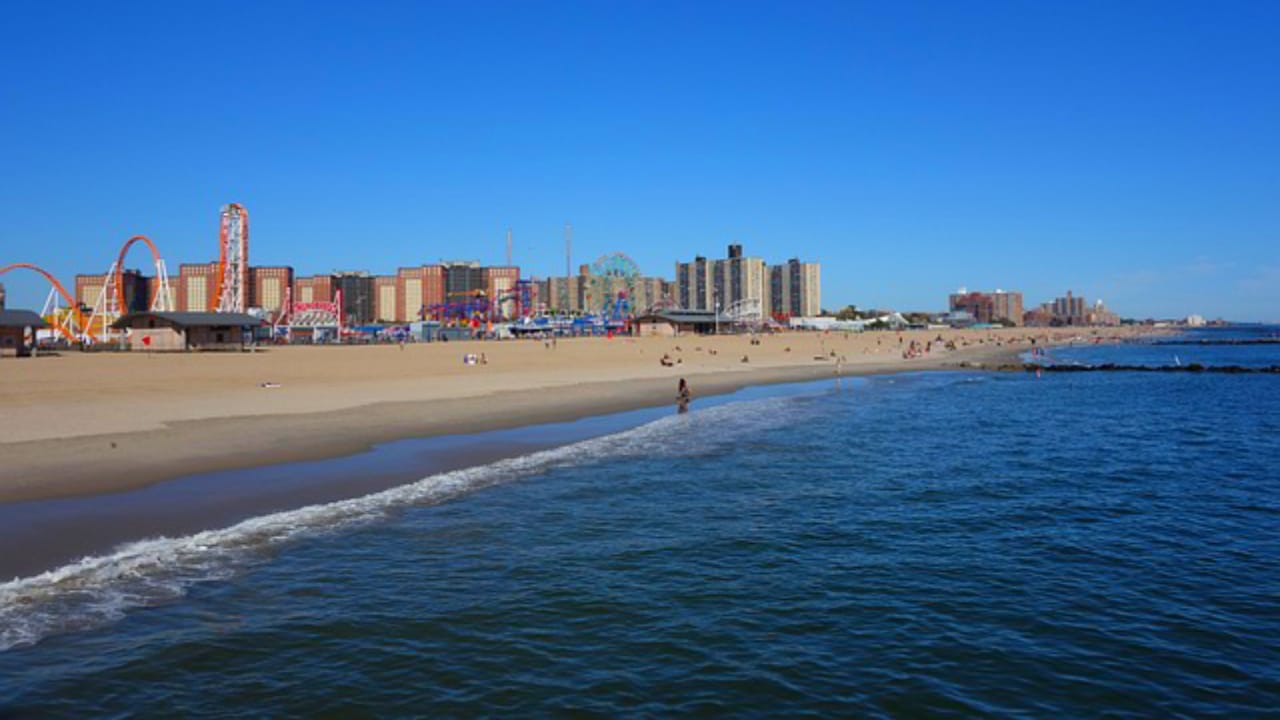
Coney Island History: Few places in the United States carry the mythic weight of Coney Island. Mention the name and most people instantly picture a wooden roller coaster clattering along the shoreline, the smell of hot dogs drifting off a boardwalk grill, and the salty tang of the Atlantic mixing with the sugary scent of cotton candy. But Coney Island’s story is far richer and stranger than its postcard image suggests.
Over the course of more than two centuries, this narrow strip of land at the southern tip of Brooklyn transformed from a quiet, wind-swept barrier island into the most famous amusement destination on Earth and then, remarkably, reinvented itself all over again.
Coney Island History
How it got its name, how it became America’s Playground, why it fell into decline, and how it has clawed its way back into cultural relevance in the 21st century.
Where the Name Coney Island Comes From
Before amusement parks, roller coasters, or boardwalks ever existed, Coney Island was simply a barrier island off the coast of Brooklyn, separated from the mainland by Coney Island Creek. The area was originally inhabited by the Lenape people, who used the region for fishing and seasonal gathering long before European settlers arrived.
The most widely accepted explanation for the name “Coney Island” traces back to Dutch settlers in the 17th century. The Dutch word konijn means rabbit, and early colonial records suggest the island was overrun with wild rabbits, leading settlers to call it Conyne Eylandt, or Rabbit Island.
Over time, this evolved into the English “Coney Island.” Some historians dispute this origin story, offering alternative theories involving early landowners or indigenous names, but the rabbit explanation remains the most commonly cited.
For nearly two hundred years after Dutch and English colonization, Coney Island stayed relatively undeveloped. It was marshy, remote, and difficult to access, which kept it largely ignored by the growing city of New York just across the water.
The Birth of a Seaside Resort
Coney Island’s transformation began in the early-to-mid 1800s, when wealthy New Yorkers started seeking escape from the crowded, increasingly industrial streets of Manhattan and Brooklyn. The island’s wide beaches and ocean breezes made it an appealing retreat, and by the 1830s and 1840s, the first hotels began appearing along the shore.
The real turning point came after the Civil War, when transportation improvements made Coney Island dramatically more accessible. Rail lines and steamship routes connected the island to Brooklyn and Manhattan, and suddenly a trip that once took hours by carriage could be completed in a fraction of the time. This accessibility democratized the beach. What had once been a retreat for the wealthy quickly became a destination for the working and middle classes as well.
By the 1870s and 1880s, Coney Island had developed distinct social zones. The western end, known as Norton’s Point (and later associated with the notorious Gut and Coney Island’s rougher gambling dens), catered to a rowdier crowd.
The eastern sections, including Manhattan Beach and Brighton Beach, developed grand hotels aimed at wealthy vacationers. In between sat West Brighton, the area that would eventually host the great amusement parks and become synonymous with the Coney Island name we know today.
This period also saw the rise of horse racing tracks, elaborate hotels like the Manhattan Beach Hotel and the Oriental Hotel, and early amusement attractions. Coney Island was quickly becoming known not just as a beach, but as a place for spectacle, entertainment, and escape from everyday life.
The Golden Age
The period between 1895 and 1915 is often considered Coney Island’s golden age — the era that cemented its reputation as America’s Playground. During these two decades, three massive amusement parks opened along the shore, each competing to offer visitors more spectacle, more thrills, and more wonder than the last.
Sea Lion Park
Sea Lion Park, opened in 1895 by Paul Boyton, is generally credited as the first enclosed amusement park in the United States. Unlike earlier attractions that were scattered and independently operated, Sea Lion Park charged a single admission fee and offered a curated collection of rides and attractions within a fenced perimeter.
This model a self-contained park with a single ticket would become the template for every amusement park that followed, including Disneyland more than half a century later.
Sea Lion Park featured trained sea lions, a water slide called Shoot-the-Chutes, and other novel attractions. Although it only operated for a few years before being replaced, its influence on the amusement industry was profound.
Steeplechase Park
In 1897, George C. Tilyou opened Steeplechase Park on the site of the old Sea Lion Park grounds. Tilyou’s park was built around the idea of controlled, family-friendly mechanical thrills. Its signature attraction was the Steeplechase Horses, a mechanical horse race ride that sent riders along undulating steel tracks in a simulated race.
Steeplechase Park’s mascot, a wide, leering, funhouse-style grinning face, became one of the most recognizable symbols of Coney Island itself. Tilyou’s genius was in understanding that people wanted to feel a rush of excitement and mild danger, but in a safe, socially acceptable environment. Steeplechase Park would remain open, in various forms, until 1964, making it the longest-running of Coney Island’s original three great parks.
Luna Park
Luna Park opened in 1903, founded by Frederic Thompson and Elmer Skip Dundy. If Steeplechase Park was about mechanical thrills, Luna Park was about pure fantasy and visual spectacle. The park was designed as a dreamlike architectural wonderland, covered in nearly a million electric lights an almost unimaginable sight in an era when electric lighting was still a novelty for most Americans.
Luna Park’s design drew inspiration from Middle Eastern and Asian architectural motifs, minarets, towers, and domes, creating an exotic fantasy landscape unlike anything visitors had seen before. Attractions included simulated trips to the moon, recreations of famous disasters like the Johnstown Flood, and elaborate theatrical spectacles.
At night, illuminated by its enormous lighting displays, Luna Park looked less like an amusement park and more like a shimmering city from a dream which was precisely the point.
Dreamland
Not to be outdone, developer William H. Reynolds opened Dreamland in 1904, directly competing with Luna Park. Dreamland was even more ambitious in scale, featuring towering white architecture illuminated by over a million lights, designed to evoke a sense of grandeur and even religious awe rather than the exotic fantasy of Luna Park.
Dreamland featured a recreation of Venice complete with gondolas, a miniature city populated by little people called Lilliputia, an incubator exhibit that displayed premature infants in early medical incubator technology, and elaborate simulated disaster shows depicting fires and floods. Ironically, Dreamland itself was destroyed by a real fire in 1911, just seven years after it opened. The blaze started in one of the park’s attractions and quickly spread, ultimately destroying the entire park. It was never rebuilt.
Together, these three parks Sea Lion Park, Steeplechase Park, Luna Park, and Dreamland transformed Coney Island from a beach resort into a genuine amusement capital, drawing visitors not just from New York but from across the country and even internationally.
The Nickel Empire
Following World War I and into the 1920s, Coney Island entered what became known as the “Nickel Empire” era. The nickname reflected the fact that most rides, attractions, and food items cost just five cents, making Coney Island one of the few luxuries genuinely accessible to working-class New Yorkers.
This era saw the construction of two icons that remain standing to this day: the Wonder Wheel and the Cyclone.
The Wonder Wheel, built in 1920, is a 150-foot-tall Ferris wheel featuring both stationary and swinging cars, the latter of which slide along curved tracks as the wheel rotates, creating a more thrilling ride than a standard Ferris wheel. It remains operational today and is recognized as a New York City landmark.
The Cyclone, opened in 1927, quickly became one of the most famous wooden roller coasters in the world. With its steep drops and tight turns, the Cyclone was considered a marvel of engineering, and riders traveled from across the country specifically to experience it.
Famous visitors reportedly included aviator Charles Lindbergh, who supposedly said the Cyclone was more thrilling than flying an airplane. Like the Wonder Wheel, the Cyclone still operates today and has been designated a New York City landmark and a National Historic Landmark.
The 1920s also brought the construction of the Riegelmann Boardwalk, completed in 1923, which formalized and expanded the wooden walkway along the beach that remains a defining feature of Coney Island’s landscape.
Subway expansion during this period also made Coney Island more accessible than ever, with new lines bringing the beach within a five-cent subway fare of nearly all New York City residents. On peak summer days during this era, Coney Island’s beaches and parks could draw well over a million visitors.
Robert Moses and the Reshaping of Coney Island
The mid-20th century brought sweeping changes to Coney Island, many driven by the influential and controversial urban planner Robert Moses. Moses viewed Coney Island’s amusement district with skepticism, favoring public housing, parks, and infrastructure over commercial amusement attractions.
Under Moses’s influence and broader postwar urban planning trends, large sections of Coney Island were rezoned. Steeplechase Park, which had survived since 1897, finally closed in 1964 after changing economic conditions made it increasingly difficult to operate profitably. Its closure symbolized the end of an era.
Simultaneously, the rise of the automobile and suburban living changed American leisure habits. Families who once took the subway to Coney Island for a day at the beach now had the option of driving to newer, more modern attractions, including a young amusement park in California called Disneyland, which opened in 1955 and offered a cleaner, more controlled version of what Coney Island had pioneered decades earlier.
Public housing developments began replacing amusement areas throughout the 1950s, 60s, and 70s. Combined with broader economic decline affecting New York City during this period, Coney Island entered a long period of deterioration. Crime rates rose, many attractions closed permanently, and the neighborhood’s reputation shifted from America’s Playground to a symbol of urban decay.
Astroland and the Survival Years
Despite the broader decline, Coney Island never fully disappeared. In 1962, Astroland amusement park opened on part of the former Feltman’s property, embracing a space-age aesthetic fitting for the era of the Space Race. Astroland became the anchor amusement park for Coney Island for the next several decades, hosting the historic Cyclone roller coaster within its grounds and keeping the spirit of the amusement district alive even as much of the surrounding area struggled.
Throughout the 1970s, 80s, and 90s, Coney Island persisted in a kind of suspended animation never fully thriving, but never entirely disappearing either. Local institutions like Nathan’s Famous, the hot dog stand founded by Nathan Handwerker in 1916, continued operating and became internationally famous, particularly after the launch of the Nathan’s Hot Dog Eating Contest, which grew into a major televised sporting spectacle held every Fourth of July.
The Coney Island Sideshow, carrying on the tradition of the old boardwalk sideshows featuring performers like sword swallowers and fire eaters, also managed to survive through this period, preserving a link to the neighborhood’s carnival roots.
The Mermaid Parade, an annual art parade celebrating Coney Island’s mythology, launched in 1983 and became a beloved summer tradition that continues to draw thousands of costumed participants and spectators each June.
Astroland Closes and a New Era Begins
Astroland closed in 2008 after its owners sold the land to developer Joseph Sitt’s Thor Equities, a move that generated significant controversy and concern about the future of Coney Island’s amusement district. For a period, the future of the historic amusement area seemed genuinely uncertain, with fears that the entire district might be redeveloped into condominiums or retail space, erasing more than a century of history.
However, New York City intervened, and in 2009 the city rezoned a significant portion of Coney Island specifically to preserve it as an amusement district, limiting the extent to which the land could be converted to other uses. This was a pivotal moment that ensured Coney Island’s amusement heritage would continue rather than being paved over entirely.
In 2010, Luna Park reopened under new ownership the Zamperla family, an Italian company with deep roots in the amusement ride industry reviving the historic name after nearly a century. This new Luna Park, distinct from the original 1903 park but honoring its legacy, brought fresh investment and modern rides to the area while anchoring a broader revitalization effort.
Coney Island in the 21st Century
Today’s Coney Island represents a fascinating blend of preservation and reinvention. The Cyclone and Wonder Wheel, both now nearly a century old, continue operating as beloved historic landmarks, drawing visitors who want to experience rides largely unchanged from their original mechanics. The Riegelmann Boardwalk remains a defining public space, recently rebuilt in sections using more durable, weather-resistant materials while retaining its historic character.
The neighborhood has seen substantial new investment in the 2010s and 2020s, including renovated subway stations, new residential development in surrounding areas, and continued expansion of Luna Park’s ride offerings.
The New York Aquarium, which has operated in Coney Island since 1957, remains one of the borough’s major cultural attractions and underwent significant renovation following damage from Hurricane Sandy in 2012, which caused extensive flooding throughout the neighborhood.
Coney Island’s cultural institutions have also persisted and evolved. The Mermaid Parade continues annually, the Coney Island History Project operates a small museum dedicated to preserving the neighborhood’s stories and artifacts, and the Coney Island USA organization keeps the sideshow tradition alive while also running the Coney Island Museum. Nathan’s Famous remains a global brand, its annual hot dog eating contest broadcast to audiences far beyond New York.
Modern Coney Island still faces real challenges. Economic pressures, seasonal operating limitations, and the long shadow of decades of disinvestment mean the neighborhood’s revival remains a work in progress rather than a finished story. But compared to the depths of its mid-century decline, Coney Island’s trajectory over the past two decades has been unmistakably positive.
Why Coney Island Still Matters
Coney Island’s significance extends well beyond its rides and attractions. It represents something distinctly American: the democratization of leisure. In an era when European aristocracy still largely controlled access to grand entertainment and recreation, Coney Island offered spectacle, thrills, and escape to anyone who could afford a nickel subway fare. It was, in many ways, one of the first truly democratic entertainment spaces in American history.
The amusement park industry itself owes an enormous debt to Coney Island’s innovations. The concept of the enclosed, single-admission amusement park pioneered at Sea Lion Park became the template for Steeplechase Park, Luna Park, Dreamland, and eventually every modern amusement park and theme park.
Including Disneyland and its many successors. Techniques of crowd management, ride engineering, thematic design, and even electric lighting displays were pioneered or popularized on Coney Island’s boardwalk.
Coney Island also occupies an enduring place in American popular culture. It has been referenced and depicted in countless films, novels, songs, and works of art, from early Coney Island itself, and continues to serve as visual shorthand for a particular kind of nostalgic, gritty, joyful Americana.
Visiting Coney Island Today
For visitors interested in experiencing this layered history firsthand, Coney Island remains easily accessible via the New York City subway, with several lines terminating at or near Stillwell Avenue. The beach and boardwalk are free to access, while Luna Park charges admission or pay-per-ride pricing for its attractions, including the historic Cyclone and Wonder Wheel.
Summer remains the peak season, with the neighborhood hosting the Mermaid Parade in June, ongoing sideshow performances throughout the warmer months, and the Fourth of July hot dog eating contest at Nathan’s Famous drawing crowds and media attention each year.
The Coney Island History Project’s small museum, located beneath the Cyclone, offers visitors a deeper look into the neighborhood’s past through photographs, oral histories, and artifacts collected from over a century of operation.