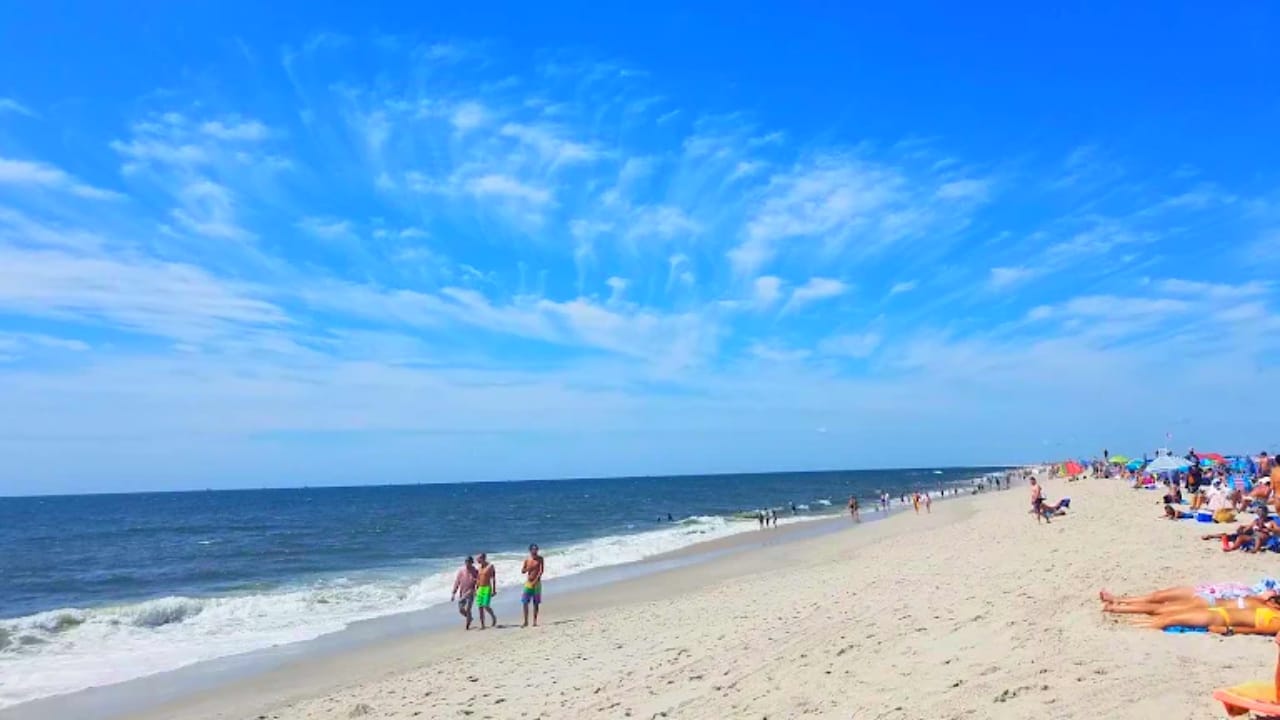
If you’ve ever driven down the Wantagh State Parkway on a summer morning, windows down, watching that Art Deco water tower rise up out of the marsh grass like a lighthouse for the soul, you already know Jones Beach is more than just a strip of sand. It’s one of the most ambitious public works projects in American history, and its story is tangled up with pirates, presidents, engineering marvels, and one of the most controversial figures in New York history.
Jones Beach State Park, on the South Shore of Long Island in Nassau County, New York, opened to the public on August 4, 1929. Nearly a century later, it still draws millions of visitors every year to swim, sunbathe, fish, and catch a concert at its famous outdoor theater. But long before the boardwalks and bathhouses, this stretch of barrier island was barely land at all a windswept, mosquito-plagued sandbar that most people had never heard of.
This is the full story of how Jones Beach came to be: who it’s named after, who built it, why it looks the way it does, and how it became a cultural landmark that shaped the way an entire country thinks about public recreation.
Who Was Jones?
Every great American landmark needs an origin story with a little swagger, and Jones Beach delivers one involving a 17th-century pirate.
The park takes its name from Major Thomas Jones, who, according to local legend, arrived on Long Island around 1692 with a background as a privateer essentially a state-sanctioned pirate. Jones settled near what is now Massapequa, where he built the first brick house on Long Island, and over time accumulated roughly 6,000 acres of land.
Around the year 1700, he established a whaling station on the outer barrier beach that would eventually bear his name. Jones died in 1713, but the land he and his wife, Freelove, had acquired stayed in local memory long after enough that when the state began assembling parcels for a public park in the 1920s, “Jones Beach” was the name that stuck.
For more than two centuries after Major Jones’s death, the barrier island that carries his name remained largely untouched: a narrow, shifting strip of sand and dune grass separated from the Long Island mainland by the Great South Bay, accessible mainly by boat and popular with duck hunters, fishermen, and a scattering of small beach communities.
Before the Park
Before Robert Moses and the state of New York ever got involved, a small community called High Hill Beach existed on the barrier island that would become Jones Beach. It was a modest cluster of cottages and bungalows, the kind of informal beach village that dotted much of Long Island’s South Shore in the early 20th century.
When plans for the new state park took shape, High Hill Beach was displaced. It’s a part of the story that doesn’t make it into most tourist brochures, but it’s an important one: many homeowners didn’t simply lose their properties.
Instead, they loaded their cottages onto barges and floated them east to what is now West Gilgo Beach, where several of those relocated homes reportedly still stand today. It’s a small but remarkable detail a literal community set adrift and rebuilt elsewhere to make way for what would become one of the most visited public spaces on the East Coast.
Enter Robert Moses
To understand Jones Beach, you have to understand Robert Moses the man historian Robert Caro would later famously dub the Power Broker.
Before he became the most powerful unelected official in New York State history, before the expressways and the bridges and the decades of controversy, Moses was a young, idealistic public servant working under Governor Al Smith. In 1924, he was named president of the Long Island State Park Commission, tasked with a mission that sounds almost quaint today: creating new state parks for public enjoyment and preserving the natural beauty of the region.
Moses became fixated on the barrier islands off Long Island’s South Shore, and Jones Beach in particular. According to accounts of the period, he would take small boats across the bay to explore the isolated strip of sand, developing what became something close to an obsession with its potential.
As the story goes, standing on that sandbar sometime in the mid-1920s, Moses grabbed the back of an envelope and sketched out his vision by hand: two large bathhouses connected by a sweeping boardwalk, an Ocean Parkway linking them, and a traffic circle feeding into parking fields big enough for 10,000 cars.
It sounds almost too tidy to be true the great urban planner scribbling his masterpiece on scrap paper but it captures something real about how audaciously Moses thought. He wasn’t planning a beach. He was planning a self-contained recreational city, built from nothing, for people who had never had anywhere like it to go.
Getting there was another matter entirely. Long Island in the 1920s was largely controlled by wealthy landowners who had no interest in ceding their private estates to a public park system. Moses spent years fighting entrenched interests, creatively interpreting and later reshaping state law to acquire land and rights of way. It was, by every account, a bruising, years-long political battle before a single grain of sand was moved.
Building Jones Beach
Here’s the detail that tends to surprise people most: Jones Beach, as it exists today, is largely artificial.
When construction began, the barrier island was swampy, low-lying, and barely above sea level nowhere close to suitable for the grand public park Moses had envisioned. To make it work, engineers brought in dredging equipment to pull sand from the bottom of Great South Bay and pump it onto the island, gradually raising significant portions of the site to roughly 12 feet above sea level.
Newly planted beach grass was used to anchor the dredged sand and stabilize the dunes against erosion a process that essentially built new, engineered coastline rather than simply developing what nature had provided.
This wasn’t a modest landscaping job. It was a massive civil engineering undertaking: millions of cubic yards of sand moved, an entire barrier island reshaped, and a network of causeways and parkways constructed to connect an isolated sandbar to the Long Island mainland. The Wantagh Causeway and Parkway, along with the park’s East Bathhouse and its parking fields, were among the first major pieces completed.
Moses didn’t skimp on the architecture, either. He brought in talented designers including architect Aymar Embury II, who would go on to help shape parks across New York City and reportedly spent far more on the bathhouses and support buildings than such structures would typically have cost at the time. The goal wasn’t just function. It was grandeur, on a scale no public beach anywhere had attempted before.
Opening Day, 1929
Jones Beach State Park officially opened to the public on August 4, 1929 and nature nearly stole the show. According to contemporary accounts, the dedication took place during a fierce sandstorm, with wind whipping across the newly built dunes as dignitaries tried to deliver their remarks.
The park opened as part of the New York State Park System through the dedication from Governor Franklin D. Roosevelt, alongside former governor Alfred E. Smith and Robert Moses himself, all of whom spoke about what the new park would mean for the region. Despite the weather, the crowd’s enthusiasm was obvious from day one.
And it kept growing. In its first month of operation, roughly 350,000 people visited the new park a staggering number for a facility that had not existed twelve months earlier. By 1930, Jones Beach’s first full year of operation, attendance had climbed to about 1.5 million visitors. Traffic quickly became a problem of its own: the two-lane Wantagh Causeway, the park’s only road access at the time, was soon overwhelmed every Sunday, with cars backed up for miles trying to reach the beach.
That congestion problem led directly to further expansion. In November 1931, the Town of Hempstead voted to convey Short Beach the stretch of land between the park and Jones Inlet to New York State, along with the rights needed for a second access route. Funding delays during the Depression slowed things down, but the project eventually became the Meadowbrook State Parkway, giving visitors a second way onto the island and easing some of the worst bottlenecks.
The Architecture
Part of what makes Jones Beach instantly recognizable, even in old black-and-white photographs, is its distinctive design language. Moses and his design team didn’t want the park to feel like a boardwalk carnival a deliberate rejection of the rundown commercial amusement piers that dominated most public beaches of the era, places like Coney Island with their rickety rides and honky-tonk concessions.
No roller coasters, no midway games. Instead, Jones Beach was laid out on a formal Beaux-Arts plan, with symmetry and hierarchy used to create a sense of order, elegance, and civic pride something closer to a grand European seaside resort than an American boardwalk.
The nautical theme runs through nearly every design detail. Buildings echoed the look of ocean liners; garbage cans were shaped like ship ventilation shafts; even the games available to visitors, like shuffleboard, evoked life aboard a luxury cruise. Even staff uniforms were designed with a maritime flair, reinforcing the sense that a day at Jones Beach was meant to feel like an escape to somewhere far grander than a public beach.
The park’s most iconic structure is its central water tower an Italianate campanile built from Ohio sandstone and Barbizon brick, standing at the terminus of the Wantagh Parkway’s traffic circle. It’s a functioning water tower, but it was designed to look like something you’d find overlooking a Mediterranean piazza, not doing utility work at a public beach. Nearly a century later, it remains the park’s most photographed landmark and, for generations of Long Islanders, the visual signal that you’ve officially arrived.
The scale of Jones Beach’s original amenities was staggering for the time: sweeping bathhouses with swimming and diving pools (the West Bathhouse opened in July 1931), a two-mile boardwalk, six miles of oceanfront beach, and additional bay-side swimming at Zachs Bay for those who preferred calmer, still water. It was designed, in the words of one contemporary description, as a people’s country club resort-caliber amenities, but free and open to the public.
The Difficult Jones Beach History
No honest account of Jones Beach’s history can skip over one of its most controversial legacies: the question of who the park was actually built for, and who was quietly kept out.
As Moses developed the network of parkways connecting Jones Beach to the rest of Long Island in the mid-to-late 1920s and 1930s, many of the overpass bridges along those routes particularly on the Southern State Parkway were built with unusually low clearance. A standard municipal bus of the era needed roughly 9 feet, 11 inches of clearance to pass safely beneath a bridge. Numerous overpasses on the roads leading to Jones Beach were built at around 9 feet, with some measuring even lower.
According to Robert Caro’s Pulitzer Prize-winning biography of Moses, The Power Broker, this was not an engineering coincidence. Caro’s research and interviews with people who worked alongside Moses concluded that the low bridges were a deliberate design choice intended to prevent public buses and by extension, the low-income and minority New Yorkers who depended on public transit from easily reaching Jones Beach.
Car ownership in the 1920s and ’30s skewed heavily toward white, middle- and upper-class families, meaning a park technically open to everyone was, in practice, far more accessible to some New Yorkers than others.
It’s worth noting that some historians have since pushed back on aspects of Caro’s interpretation, questioning how much of the bridge height decision was really about exclusion versus other design and cost considerations of the period. But regardless of where you land on that debate, the low bridges of the Moses-era parkways remain one of the most frequently cited case studies in urban planning courses on how physical infrastructure can be used intentionally or not to shape who does and doesn’t get access to public space.
It’s an uncomfortable chapter, but an important one. Jones Beach was marketed, and in many ways genuinely functioned, as a democratizing project a people’s beach built for ordinary New Yorkers rather than the wealthy few who had always had private shorefront access. The reality of who could actually get there tells a more complicated story, and it’s one that historians and Long Islanders continue to grapple with today.
Jones Beach Theater
If Jones Beach’s daytime identity is defined by sand and surf, its evening identity for the last seven decades has been defined by live music.
Construction on what would become Jones Beach Theater began in October 1949, and the venue opened on June 26, 1952, initially known as the New Jones Beach Marine Stadium. The name changed to Jones Beach Marine Theater in 1954, a name it would carry for the next four decades. Designed to specifications laid out by Moses himself, the theater’s original construction cost about $4 million a substantial sum at the time, equivalent to roughly $54 million in today’s dollars.
The venue has gone through a long list of names over the years as sponsorship deals came and went: Jones Beach Amphitheater in the 1990s, Jones Beach Theater in the early 2000s, then sponsored eras as Tommy Hilfiger at Jones Beach Theater, Nikon at Jones Beach Theater, and Northwell Health at Jones Beach Theater. Through every rebrand, Long Islanders have mostly just kept calling it Jones Beach Theater some things don’t need a corporate name to stick.
With a capacity of around 15,000, it’s long been ranked among the premier outdoor concert venues in the New York metropolitan area, alongside spots like Forest Hills Stadium in Queens and the PNC Bank Arts Center in New Jersey. Over the decades it’s hosted an enormous range of performers, and in recent summers alone the lineup has included everyone from Dave Matthews Band and Foo Fighters to Lynyrd Skynyrd, Chris Rock, and the B-52s.
The theater has been renovated and expanded repeatedly to keep pace with modern concertgoing expectations updates in 1992, 1998, 2009, 2013, and again in 2017. Most recently, a multi-year, multimillion-dollar renovation led by Live Nation Entertainment (announced by Governor Kathy Hochul in 2022) delivered a new welcome plaza.
Upgraded restrooms, expanded food and beverage areas, and storm-resiliency improvements like new seawalls a nod to the fact that even a beloved historic venue on a barrier island has to keep adapting to rising seas and changing storm patterns.
Jones Beach Through the Decades
Jones Beach’s cultural footprint extends well beyond swimming and concerts. For twenty years, the park was home to the Jones Beach Indian Village, an attraction directed by Rosebud Yellow Robe, a Lakota educator and performer who ran the program until her retirement in 1950 one of the more complicated pieces of the park’s mid-century entertainment history, reflecting both the era’s fascination with and frequent mishandling of Native American culture in public spaces.
The park’s ownership and oversight structure also evolved over time. Robert Moses served concurrently as president of the Long Island State Park Commission, the Jones Beach State Parkway Authority, and the Bethpage Park Authority until his resignation from those posts took effect in January 1963 decades after he’d already reshaped much of New York City through his other roles as parks commissioner and head of various public authorities.
In 2005, recognizing its significance to American recreation, architecture, and planning history, the Jones Beach State Park, Causeway, and Parkway System was added to the National Register of Historic Places. The designated historic district is enormous more than 10,000 acres and encompasses not just the park itself.
But the causeways and parkways Moses built to connect it to the rest of Long Island, including portions of the Meadowbrook and Wantagh State Parkways, the Ocean Parkway, and the Loop Parkway. In total, the historic district includes 22 buildings and 33 structures recognized for their contribution to American landscape architecture.
Jones Beach Today
Nearly a century after that sandstorm-swept opening day, Jones Beach remains one of the most heavily visited state parks in the country, drawing well over eight million visitors in a typical year. Its enduring features read like a checklist of only-at-Jones-Beach experiences: the fishing pier at Field 10, popular with anglers and surfcasters from across Long Island; a busy summer schedule at the amphitheater; an annual Memorial Day weekend air show featuring the Blue Angels; Fourth of July fireworks that draw enormous crowds; and, in recent years, a holiday light show that’s extended the park’s appeal well past beach season.
The bones of Moses’s original 1929 design are still very much intact the water tower still marks the entrance, the boardwalk still stretches along the shoreline, and the athletic fields and courts he insisted on including instead of carnival rides are still in daily use. It’s a rare thing for a nearly hundred-year-old public works project to remain not just functional but genuinely beloved, generation after generation.
Why Jones Beach Still Matters
Jones Beach is, in some ways, a perfect microcosm of Robert Moses’s entire career: visionary in scale, unmatched in ambition, genuinely transformative for millions of ordinary people and inseparable from a history of exclusion that shaped who got to benefit from that vision. It’s a park built from nothing, quite literally dredged up out of the bay floor, that became a symbol of public recreation done at a scale almost nobody had attempted before.
It’s also, simply, still a great beach. Strip away the history, the politics, and the nearly mythical stories about envelopes sketched on sandbars, and Jones Beach remains what it was always meant to be on the surface: six miles of Atlantic oceanfront, open to whoever can make the drive, exactly as free today as it was on that windswept morning in August 1929.
Whether you’re there for the fishing pier at sunrise, a summer concert under the lights, or just an afternoon on the sand within sight of that unmistakable water tower, you’re taking part in a story that stretches back through a Depression-era engineering marvel, a 20th-century pirate legend, and one of the most consequential and contested figures in American urban planning history.
How Jones Beach Changed Public Parks Nationwide
It’s hard to overstate how influential Jones Beach became once other planners and city officials saw what Moses had pulled off. The park’s success didn’t just cement Moses’s reputation it gave him the political capital to reshape parks across all of New York City for the next three decades.
In 1934, Mayor Fiorello La Guardia dissolved New York City’s five separate borough parks departments and appointed Moses as the sole commissioner of a newly unified city parks system, all while Moses kept his state park titles and additional roles heading the Triborough Bridge Authority and other public works agencies.
At the Arsenal, the parks department’s headquarters, Moses assembled a design and construction operation of roughly 1,800 architects, engineers, and designers. Many of the design principles first tested at Jones Beach the nautical detailing, the emphasis on order and cleanliness, the rejection of honky-tonk amusements were carried directly into later projects like Orchard Beach in the Bronx, Jacob Riis Park in Queens, and improvements to the Rockaway boardwalk.
That influence extended well past New York, too. Jones Beach became a reference point for planners across the country grappling with a new problem: how do you build recreational infrastructure for a rapidly growing, increasingly car-owning middle class? The answer Moses had landed on dedicated parkways, generous parking, resort-style amenities, and strict design control became a template that echoed through American parks and public works projects for a generation.
FAQs
How old is Jones Beach State Park?
Jones Beach opened to the public on August 4, 1929, making it nearly a century old. It remains one of the oldest continuously operating state parks of its scale in the country.
Who built Jones Beach?
The park was built under the direction of Robert Moses, then president of the Long Island State Park Commission, with architectural design led by Aymar Embury II and a large team of state engineers, landscape architects, and construction crews.
Why is it called Jones Beach?
The park is named for Major Thomas Jones, a former privateer who settled on Long Island around 1692 and established a whaling station on the barrier island in the early 1700s. His name stuck to the land for more than two centuries before the state park was built.
Is Jones Beach a natural or man-made beach?
Both, in a sense. The barrier island existed naturally long before the park, but much of its current elevation and shape came from an extensive dredging project that pumped sand up from the floor of Great South Bay, raising large sections of the island to around 12 feet above sea level.
When did Jones Beach Theater open?
Construction began in October 1949, and the venue originally called the New Jones Beach Marine Stadium opened on June 26, 1952. It has operated continuously as a concert venue ever since, under a series of different sponsored names.
Is Jones Beach on the National Register of Historic Places?
Yes. The Jones Beach State Park, Causeway, and Parkway System was added to the National Register of Historic Places in 2005, covering more than 10,000 acres and 55 contributing buildings and structures.