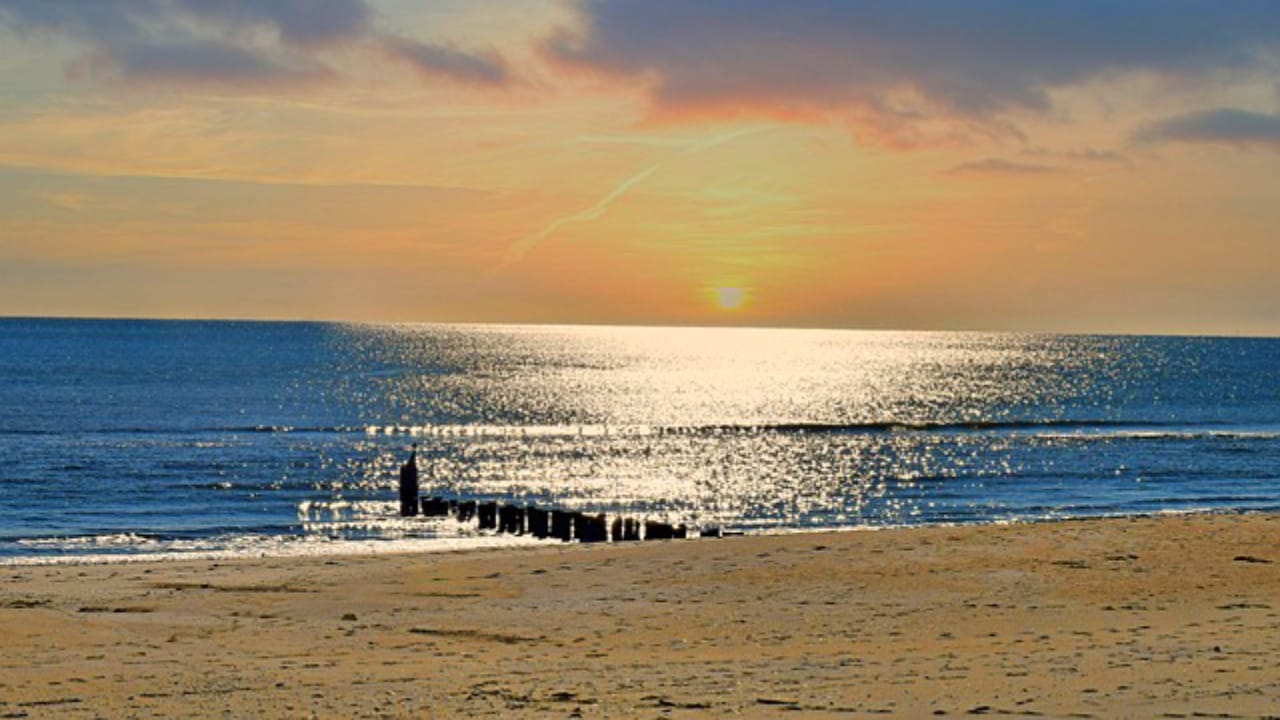
If you’ve ever ridden the A train all the way to the end of the line and stepped out onto a boardwalk with the Atlantic Ocean stretching in front of you, you already know Rockaway Beach feels like nowhere else in New York City. It’s a place where subway cars rattle past sand dunes, where century-old bungalows sit blocks from surf breaks, and where the Manhattan skyline feels like a distant rumor rather than a daily reality.
But Rockaway Beach wasn’t always a quiet seaside escape wedged onto a barrier peninsula in Queens. At various points in its history, it was a Native fishing ground, a Gilded Age resort for the ultra-wealthy, New York’s Playground for the working class, a roaring amusement district that rivaled Coney Island, a mid-century public housing experiment, a neighborhood nearly erased by a hurricane, and most recently one of the trendiest surf towns on the East Coast.
This is the story of how a narrow strip of sand at the edge of New York City became one of the most storied, resilient beach communities in America.
Where Rockaway Beach Is
Rockaway Beach sits on the Rockaway Peninsula, a long, narrow barrier island in the New York City borough of Queens, with the Atlantic Ocean along its southern shore and Jamaica Bay to the north. Today, the specific neighborhood called Rockaway Beach occupies the central stretch of the peninsula, generally between Beach 73rd Street and Beach 108th Street, though the broader area known as “The Rockaways” stretches much further, from Far Rockaway in the east to Breezy Point and Jacob Riis Park in the west.
That geography a slender sandbar squeezed between ocean and bay has shaped nearly everything about the area’s history. It made Rockaway remote and hard to reach for centuries, which is part of why it stayed undeveloped so long, and it made the peninsula vulnerable to the sea in ways that would eventually prove costly. It’s also the same geography that gives Rockaway Beach today its unusual identity: a beach town technically part of the largest city in the United States, reachable by public transit, yet miles removed from it in feeling.
The Land Before Rockaway
Long before Dutch sailing ships appeared on the horizon, the Rockaway Peninsula was used by the Lenape people, part of the broader Canarsie group that lived throughout what is now Brooklyn and Queens. For generations, the Lenape fished and gathered shellfish along the peninsula’s tidal inlets, drawn by rich shellfish beds and protected waters even if the land wasn’t permanently settled.
The name “Rockaway” is believed to descend from an Algonquian word, often rendered as Reckowacky or Reckonwacky, generally translated as place of sands or lonely place. Other historical interpretations point to related meanings tied to sand or to a fork or branch in the land, both of which line up neatly with the peninsula’s sandy, isolated character.
European colonization began reshaping the peninsula’s ownership in the late 17th century. Local histories recount that the Canarsie sold the mostly barren land to an Englishman, Captain Palmer, under a deed granted by New York’s colonial governor in 1685.
Palmer wasn’t thrilled with his purchase, however, and sold it two years later to a prominent Long Island iron master named Richard Cornell an ancestor of Ezra Cornell, who would go on to found Cornell University in 1865.
The Cornell family held the peninsula for over a century, until a partition lawsuit in 1808 split the property into dozens of parcels sold off to outside buyers. For much of this period, Rockaway remained sparsely populated farmland and marsh a far cry from the resort strip it would soon become.
The Birth of a Resort
Rockaway’s transformation from quiet farmland into a fashionable getaway began in earnest in the 1830s, driven by a trend sweeping the wealthy classes of the Northeast: sea bathing. In an era before air conditioning, escaping to the ocean during a sweltering New York summer was as much a health prescription as a leisure activity, and Rockaway’s undeveloped beaches were perfectly positioned to catch the wave.
A group calling itself the Rockaway Association, made up of well-off New Yorkers, bought up much of the peninsula’s property starting in 1833 and began building exclusive resorts. The centerpiece of this early boom was the Marine Pavilion, a grand, spa-like hotel widely credited as the true starting point of Rockaway’s identity as a destination. Its arrival introduced sea bathing to fashionable New York society and drew notable writers and performers of the day, giving Rockaway a cultural cachet that rivaled other Atlantic coast resorts.
The Marine Pavilion’s success set off a wave of imitators. Over the following decades, hotels multiplied along the peninsula, and by the mid-to-late 19th century Rockaway Beach was dotted with dozens of hotels and thousands of daytrippers. Visitors bathed using bathing machines small wheeled changing rooms rolled into the surf, letting modest Victorian-era swimmers enter the water without changing in the open.
The Hotel Era
By the 1870s and 1880s, Rockaway’s hotel scene had become a genuine arms race of scale and spectacle. The most audacious entry was the Rockaway Beach Hotel, also known as the Hotel Imperial, built by the Rockaway Improvement Company. Stretching from present-day Beach 110th Street to Beach 116th Street, the hotel was promoted as the biggest hotel in the world, running 1,184 feet long and 250 feet wide a monument to the same Gilded Age appetite for superlatives that, around the same time, was producing the Brooklyn Bridge just across the harbor.
Two land developers in particular are remembered as the architects of Rockaway’s boom years: James S. “Uncle Jim” Remsen and William Wainwright. Remsen, who also developed Canarsie and East New York in Brooklyn, is credited with turning much of the peninsula into a functioning amusement district.
He understood that a resort was only as good as the transportation that could get people there, and he championed a rail and ferry route connecting Brooklyn passengers to Rockaway Beach. In 1876, he brought on a young partner, William Wainwright, who went on to become one of Rockaway’s most prominent developers in his own right part of a pattern in which transportation access, more than any other single factor, dictated the peninsula’s fortunes for the next century.
Incorporation and Becoming Part of New York City
As the 19th century wound down, Rockaway’s scattered settlements consolidated into more formal municipal identities. Two central communities known as Hammels (named for landowner Louis Hammels) and Hollands merged in June 1897 to officially form the Village of Rockaway Beach. That independence was short-lived: just a year later, the village was absorbed into the newly formed City of Greater New York as part of the new borough of Queens.
Not everyone was thrilled about the merger. Locals repeatedly tried to break away and reclaim independent town status, and bills allowing Rockaway Beach to secede actually passed the state legislature in both 1915 and 1917 only to be vetoed by New York City’s mayor at the time.
Rockaway Beach has remained part of the city ever since, though that early streak of independent-mindedness is something longtime residents will still tell you lives on in the neighborhood’s character. Nearby Rockaway Park went through a similar incorporation in 1898, around the same time the broader five-borough consolidation was finalized.
New York’s Playground
If there’s a single phrase that captures Rockaway Beach’s identity at the turn of the 20th century, it’s “New York’s Playground.” The arrival of rail service transformed the peninsula from an exclusive retreat for the wealthy into a democratic escape valve for the entire city.
Once the new train station made the beach easy to reach for everyone, not just the rich, fun parks, shops, and hotels opened rapidly, and people from across the city came to visit for a day or an entire summer. It’s during this stretch that Rockaway also picked up its enduring nickname, the Irish Riviera, a nod to the large Irish American community that settled and summered there.
This was also the era when Rockaway built its amusement-park credentials. In 1900, George Tilyou — owner of Steeplechase Park at Coney Island purchased land in Rockaway’s Seaside neighborhood and named it Steeplechase Park.
A year later, an even more consequential figure arrived: LaMarcus Adna Thompson, the pioneering roller coaster designer behind the Switchback Railway concept, bought two acres of land from Tilyou himself. Thompson’s amusement park opened around 1902 and would eventually become known as Rockaways’ Playland.
Playland’s rise wasn’t instant, but once it hit its stride, it became a genuine institution. By 1903, a nearby ferry dock made it more convenient to reach from almost anywhere in the city than some of its competitors. Ownership changed hands more than once sold in 1927 to Robert Katlin, who added a gym and swimming pool, then in 1928 to A. Joseph Geist, who achieved even greater success but its popularity only grew. At its peak, between 1928 and 1970, Rockaways’ Playland drew an estimated 175 million visitors.
Coney Island may have opened the world’s first fully enclosed amusement park, but Rockaway didn’t lag far behind in ambition, building its own Steeplechase in 1901. For much of the early-to-mid 20th century, the two beach communities existed almost as sibling rivals, each drawing crowds with roller coasters, boardwalk games, and salt air.
Not every chapter of this golden age was triumphant. Fire and storm both took their toll on the peninsula more than once: the entire Seaside section, from roughly Beach 102nd to Beach 106th Street, burned from beach to bay in 1882, and a powerful 1883 hurricane hit the Rockaways hard enough to wipe an entire landmass called Hog Island off the map an incident locals still sometimes call New York’s own miniature Atlantis.
Building the Boardwalk
No feature defines the physical experience of Rockaway Beach quite like its boardwalk, and its construction was a decades-long project rather than a single event. Individual sections were built piecemeal by private developers throughout the late 19th century, but the unified, city-owned boardwalk that visitors walk today didn’t come together until well into the 20th century.
The first section of city-owned boardwalk, between Beach 109th and 126th Streets, was completed in 1923, and the city soon announced plans for a much longer boardwalk stretching across most of the peninsula’s southern shore. The sections between Beach 19th and 109th Streets followed in three phases between 1928 and 1930, and the final stretch, from Beach 9th to Beach 19th Street, wasn’t finished until 1963.
Today, that historic boardwalk now largely rebuilt in concrete remains one of the longest in the country, running roughly five and a half miles along a beach that stretches a full seven miles from Far Rockaway to Neponsit. Rockaway’s street numbering carries its own quirk that trips up first-time visitors: it progresses from east to west, the reverse of typical Queens numbering.
Robert Moses, the Bridges, and the Mid-Century Transformation
No single figure looms larger over 20th-century Rockaway than Robert Moses, the powerful and controversial New York City parks commissioner and master builder. Under his direction in the 1930s, the completion of two major bridges the Marine Parkway Bridge in 1937 and the Cross Bay Bridge in 1939 finally linked Rockaway to mainland Queens and Brooklyn. Alongside these bridges, continued improvements to rail service and the elevated subway allowed for a scale of access the old ferry-and-rail system of the 19th century never could have supported.
This new infrastructure fundamentally reshaped Rockaway’s character. What had been primarily a seasonal resort — packed in summer, largely emptied out come Labor Day increasingly became a place where people lived year-round. Moses’s broader urban-renewal ambitions also brought a wave of large-scale public and cooperative housing in the postwar decades.
Some of it produced lasting community assets; other parts, like an ambitious 1960s redevelopment effort in the Arverne section that demolished large swaths of housing for a project that never fully materialized, left long-lasting scars on certain neighborhoods.
One of the most significant mid-century housing projects arrived toward the end of this period: the Dayton Beach Park Cooperative, a set of tall, rectangular apartment towers placed close to the beach and finished by the end of the 1960s. Similar large residential buildings rose along other stretches of the peninsula around the same time, permanently altering Rockaway’s skyline from a landscape of wooden hotels and bungalows to one increasingly dominated by high-rises.
The Rockaway Beach Branch
While the bridges Moses championed thrived, the older rail infrastructure that had originally put Rockaway on the map didn’t fare nearly as well. The Long Island Rail Road’s Rockaway Beach Branch had once been the primary artery connecting the peninsula to the rest of the city, running from Elmhurst all the way to Rockaway Park.
But by the mid-20th century the line was in serious financial trouble, and when the LIRR itself went bankrupt and was absorbed into the newly formed Metropolitan Transportation Authority in 1962, part of the old route was folded into the subway system while other sections were simply abandoned and left to grow over.
Today, the tracks along the defunct branch form a makeshift, overgrown park choked with tall grasses and vines, and community advocacy groups have spent years pushing proposals to convert the corridor into either a linear park (in the style of Manhattan’s High Line) or a restored transit line an ongoing debate that continues to shape conversations about Rockaway’s transportation future.
Up and down the peninsula, these ghost stations and forgotten rights-of-way are quiet reminders of how central the railroad once was to Rockaway’s identity, and how completely the automobile and bridge era eclipsed it.
Public Health and the Neponsit Story
Rockaway’s history isn’t only a story of leisure and transit it’s also intertwined with New York City’s public health infrastructure. On the western end of the peninsula, near Jacob Riis Park, the city operated a municipal tuberculosis sanatorium reflecting an entirely different side of Rockaway’s role in the 20th century.
Neponsit Beach Hospital opened in 1915, originally oriented toward treating children, and later treated military veterans during and after World War II before closing in 1955 as the need for dedicated tuberculosis hospitals declined nationally. The building found new purpose afterward, reopening as a nursing home in 1961 and operating in that capacity until 1998, before eventually falling into disrepair.
Bungalow Culture and the Everyday Rockaway
Alongside the grand hotels and amusement parks, a more modest and in many ways more enduring form of housing took root across the peninsula: the beach bungalow. These small, affordable summer cottages became the backbone of working- and middle-class Rockaway life for generations, and several bungalow enclaves survive today as protected historic districts.
In Far Rockaway, one especially well-preserved cluster reflects this history. The Far Rockaway Beach Bungalow Historic District includes summer cottages built in 1921 using pattern-book designs with uniform facades, compact interiors, and exposed rafters.
Their architect, Henry Hohauser, would later become far better known as a designer of Art Deco hotels in Miami Beach. The district earned a spot on the National Register of Historic Places in 2013 and, notably, survived Hurricane Sandy the year before without major damage.
Similar bungalow blocks survive elsewhere on the peninsula, standing in stark visual contrast to the high-rise cooperative towers built just decades later a few blocks away together forming a kind of physical timeline of Rockaway’s changing housing priorities across the 20th century.
The Long Decline
Every great American resort seems to go through a fallow period, and Rockaway was no exception. By the mid-to-late 20th century, cheaper air travel, the rise of car-accessible suburban leisure destinations, and the general decline of the classic urban boardwalk resort model all chipped away at Rockaway’s status as a must-visit summer destination.
Rockaways’ Playland, the amusement park that had once pulled in 175 million visitors over four decades, finally succumbed to those economic pressures, closing in the mid-1980s amid a sharp rise in insurance costs. For years afterward, the old Playland site sat as an empty lot, its former grandeur reduced to a subway stop that still, somewhat wistfully, carries the old name the MTA continues to mark the Beach 98th Street station as “Playland,” decades after the park itself vanished.
The broader neighborhood around the old amusement district cooled in a similar way. Bungalow colonies that had once buzzed every summer weekend saw occupancy dwindle, and for a stretch of decades Rockaway earned a reputation in the wider city as an overlooked, somewhat forgotten corner of Queens geographically part of New York, but culturally and economically adrift from it.
Hurricane Sandy
If there’s a single event that tested Rockaway Beach more than any other in its long history, it’s Hurricane Sandy in October 2012. As a low-lying barrier peninsula exposed directly to the open Atlantic, Rockaway was almost uniquely vulnerable to the storm surge Sandy brought, and the damage was catastrophic.
The peninsula bore the brunt of a 14-foot tidal surge topped by waves several stories high. Because of flood-damaged electrical panels and wiring, restoration of power took weeks in some areas, and many residents and businesses went without electricity for nearly the entire harsh winter that followed. Entire blocks of homes were destroyed, in some cases by fire as well as flooding, compounding an already dire situation for residents.
The physical toll on the neighborhood’s signature boardwalk was total. Storm surge tore up long stretches of the wooden esplanade, some sections of which had stood since the 1920s. Rebuilding took years, and the city ultimately chose resilience over nostalgia: nearly five years after the storm, the boardwalk was finally rebuilt in concrete rather than wood, running from Beach 9th to Beach 126th Streets, with millions of cubic yards of new sand and reinforced walls beneath it to help anchor the dunes in place.
What emerged from the recovery effort, though, wasn’t just infrastructure it was community. Longtime residents, many of them surfers, organized grassroots relief networks in the storm’s immediate aftermath, coordinating supply drops, generator loans, and rebuilding labor for neighbors who had lost everything, an instinct toward mutual aid that would go on to shape the neighborhood’s identity for the following decade.
Surfing, Newcomers, and Rockaway’s 21st-Century Renaissance
In one of the more unexpected twists in its long history, Rockaway Beach spent the 2000s and 2010s becoming something it had never quite been before: cool. A new generation of New Yorkers, priced out of or simply uninterested in more crowded beach options, discovered that the Rockaway Peninsula offered something genuinely rare legitimate, rideable surf, reachable directly by subway from Manhattan.
That subway-to-surf-break connection is part of what makes Rockaway unusual among American surfing destinations; longtime local surfers and advocates have described it as the only place where someone can ride the subway straight to a surf break.
Media coverage from the early 2010s captured this shift in real time, describing how the Rockaways had become an increasingly popular beach spot among young creative professionals and transplants who flocked to the formerly neglected beaches for surfing, outdoor concerts, and boardwalk food.
This cultural renaissance brought new energy and new investment to a peninsula that had spent decades feeling forgotten. Boardwalk concession stands began serving upscale versions of beach food, boutique hotels opened near the oceanfront, and Rockaway’s surf culture became genuinely diverse and community-driven, with groups like the New York City chapter of the Black Surfing Association highlighting the area’s often-overlooked history of Black surfers and beachgoers.
Modern Rockaway’s leisure landscape reflects this blend of old and new. Surfers flock to Rockaway Beach year-round for its two designated surf beaches, while nearby Jacob Riis Park home to a restored Art Deco bathhouse, a pitch-and-putt golf course, and a mile-long stretch of swimmable ocean remains one of the city’s most popular beaches.
Rockaway’s cultural cachet has also drawn creative figures who’ve written about the neighborhood directly, including musician and poet Patti Smith, and the peninsula has produced its own homegrown cultural figures over the decades, from early New York graffiti artists to visual artists who grew up along its streets.
Challenges That Remain
For all its comeback-story momentum, Rockaway Beach’s relationship with the ocean that made it famous remains genuinely complicated. Coastal erosion, worsened by both storms and shifting sand dynamics around the peninsula’s western end, continues to pose real challenges for beach management and public safety.
As recently as 2025, officials were forced to take drastic action along part of the coastline: despite years and millions of dollars of beach replenishment, erosion and dangerous conditions persisted, and after several fatalities, federal park authorities prohibited surfing and swimming along that section for the season.
The underlying cause traces back to the same forces that have shaped this coastline for centuries shifting sands driven by hurricanes and development have exposed old pilings, jetties, and concrete walls, creating hazards that periodic sand replenishment hasn’t fully corrected.
It’s a fitting, if sobering, reminder that Rockaway’s relationship with the Atlantic has never been simple. The same ocean that built the peninsula’s resort economy, drew generations of bathers and surfers, and continues to define its identity today is also the force that periodically reshapes, damages, and endangers the very shoreline people come to enjoy.
Rockaway Beach Today
Walk the boardwalk at Rockaway Beach today, and you’re walking across roughly four centuries of layered history Native fishing grounds, Gilded Age hotel row, working-class summer paradise, mid-century high-rise experiment, storm-battered survivor, and surf-town renaissance, all compressed into a few miles of sand.
Few New York City neighborhoods carry this range of identities, and fewer still have proven this resilient bouncing back from economic decline, fire, hurricanes, and the slow abandonment of the rail line that once put the place on the map.
Rockaway Beach has weathered all of it, repeatedly reinventing itself while still holding onto physical traces of every era it’s passed through: a bungalow here, an old rail bed there, a subway stop still bearing the name of a park that closed nearly forty years ago.
That’s ultimately what makes Rockaway Beach’s history worth knowing not just as a footnote to New York City’s story, but as a genuinely singular American beach town, one that happens to sit at the end of a subway line rather than at the end of a highway exit. The waves, the bungalows, and the boardwalk are still there. So, remarkably, is the sense of Rockaway as somewhere apart New York’s playground, then and now.