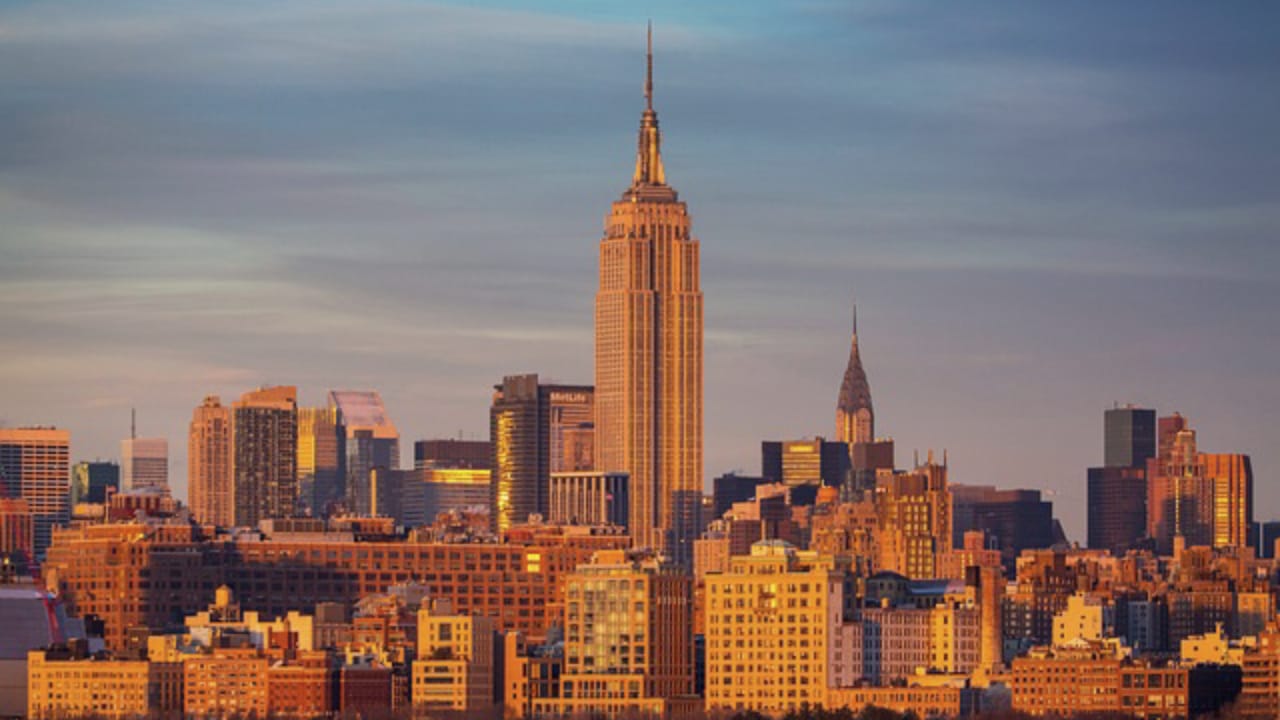
For nearly a century, the Empire State Building has stood as one of the most recognizable structures on Earth a symbol of American ambition, Art Deco elegance, and the sheer will to build something extraordinary in the face of economic collapse.
Rising 102 stories above Midtown Manhattan, it has starred in blockbuster films, hosted royalty and presidents, and welcomed well over 100 million visitors to its observation decks since opening its doors in 1931. This is the story of how the Empire State Building came to be, the records it broke, and why it remains one of the most beloved landmarks in the world.
The Land Before the Skyscraper
Long before steel beams ever touched the site at 350 Fifth Avenue, the land at the corner of West 34th Street was home to one of New York’s grandest hotels. The property had roots in the Astor family, one of the wealthiest dynasties in American history.
In the late 19th century, a member of the Astor family built the Waldorf Hotel on the site, and a relative later constructed the adjoining Astoria Hotel next door. Together, the combined Waldorf-Astoria became the largest hotel in the world at the time, with more than a thousand rooms hosting the city’s elite.
By the 1920s, however, New York’s social scene had shifted uptown, and the Waldorf-Astoria began to feel outdated. The Astor family eventually sold the property, and in 1928 it was purchased by the Bethlehem Engineering Corporation, which originally planned a modest 25-story office building for the site. That plan would soon be abandoned in favor of something far more audacious.
The Race for the Sky
The late 1920s were the golden age of the skyscraper race. Architects and developers across Manhattan competed fiercely for the title of “world’s tallest building,” and few rivalries captured the public imagination like the one between 40 Wall Street and the Chrysler Building.
Into this contest stepped John J. Raskob, a former General Motors executive and financial powerhouse, alongside Alfred E. Smith, a former Democratic governor of New York who had recently lost his bid for the presidency.
Raskob and Smith formed Empire State Inc. and secured financing, including a crucial infusion of capital from the Metropolitan Life Insurance Company, to fund what would become the tallest building on the planet.
They hired the architectural firm Shreve, Lamb & Harmon to design the structure and brought in Starrett Bros. & Eken as the general contractors. Engineer Homer G. Balcom oversaw the structural design, which went through more than a dozen revisions to balance ambition with a fixed budget.
The building’s name paid tribute to New York’s nickname, “The Empire State,” a moniker believed to have originated with George Washington, who once described the state’s potential for wealth and growth.
Racing Against the Depression
Construction plans moved forward even as the country’s economic outlook darkened. The stock market crashed in October 1929, ushering in the Great Depression, yet Raskob and Smith pressed on. Demolition of the old Waldorf-Astoria Hotel began at the end of 1929, clearing the way for excavation.
The steel contract was awarded in January 1930, and excavation of the site began shortly after. Workers dug a foundation roughly 55 feet deep, using continuous 12-hour shifts to keep the project moving. On March 17, 1930, the first of 210 steel columns was set into the completed footings, officially marking the start of construction above ground.
What followed was one of the most remarkable feats of construction management in history. The building rose at a rate of about four and a half stories per week, with the steel frame climbing skyward even as final interior designs were still being drawn up floor by floor.
At the height of the project, more than 3,400 workers were on site in a single day, and the total workforce peaked above 3,500. Many of these workers were Irish and Italian immigrants, alongside a notable contingent of Mohawk ironworkers from the Kahnawake reserve near Montreal skilled high-steel workers whose fearless work on exposed beams became legendary.
To keep pace with the breakneck schedule, builders relied on a temporary miniature railway system that ferried tools and materials to each new floor as it was completed. The project consumed staggering quantities of material: roughly 60,000 tons of steel, 200,000 cubic feet of Indiana limestone, more than 6,400 windows, and 70 miles of pipe.
Photographer Lewis Hine was commissioned during construction to document the workers, and his striking images later collected in the 1932 book Men at Work captured the courage and camaraderie of the men who built the tower, often perched hundreds of feet above the street with none of the safety regulations required today. Tragically, five workers lost their lives during construction, a sobering reminder of the era’s dangerous working conditions.
By September 1930, just 23 weeks after the steel frame construction began, the main structure was essentially complete. The building was structurally finished on April 11, 1931 only 410 days after construction started, and twelve days ahead of schedule. Former governor Al Smith is said to have driven home the final rivet, a ceremonial fastener made of solid gold.
Opening Day: May 1, 1931
The Empire State Building officially opened on May 1, 1931, with a ribbon-cutting ceremony in New York and a symbolic gesture from Washington, D.C., where President Herbert Hoover pressed a button (some accounts describe a telegraph key) to remotely switch on the building’s lights for the very first time.
At 1,250 feet, the tower instantly claimed the title of the world’s tallest building, surpassing the nearby Chrysler Building, which had briefly held the record just two years earlier.
The scale of the achievement was staggering: construction had come in under budget and well ahead of schedule, all while the nation sank deeper into economic crisis. The finished building rose 102 stories, with six basement levels below ground, and its crowning feature was a distinctive spire originally designed to serve as a mooring mast for airships a bold, if ultimately impractical, vision of future air travel that never came to fruition.
Despite the fanfare, the timing proved difficult commercially. The Great Depression had crushed demand for office space, and for years only a fraction of the building’s floors were rented, earning it the nickname “the Empty State Building” among New Yorkers.
What did draw crowds from the very beginning was the 86th-floor observation deck, which welcomed roughly 17,000 visitors in its first four days alone. Ironically, admission revenue from tourists helped keep the building financially afloat during its leanest years, at times outperforming rental income from tenants.
Architecture and Design
The Empire State Building is one of the finest surviving examples of Art Deco architecture, a style defined by bold geometric forms, vertical lines, and streamlined ornamentation that captured the optimism and modernity of the era. Its limestone-clad facade, tiered setbacks required by city zoning laws, and stainless-steel trim all reflect the design language that swept American skyscrapers in the late 1920s and early 1930s.
Inside, the lobby features dramatic marble surfaces and a striking aluminum relief of the building itself, radiating stylized sunbeams an image almost as iconic as the tower it depicts. The building’s silhouette, with its stepped profile rising to a slender mast, has become shorthand worldwide for the New York City skyline itself.
A Cultural Icon Is Born
It didn’t take long for the Empire State Building to become woven into American popular culture. In 1933, just two years after opening, the tower played a starring role in the film King Kong, with the giant ape famously scaling its heights while clutching Fay Wray a scene that cemented the building’s place in cinematic history and introduced it to audiences around the globe.
The building has since appeared in countless films, television shows, and works of art, from An Affair to Remember and Sleepless in Seattle to countless postcards, posters, and photographs that have made it arguably the most photographed building in the world. Its observation decks, on the 86th and 102nd floors, have hosted proposals, reunions, and millions of visitors seeking the same sweeping views of Manhattan that first drew crowds in 1931.
Surviving Disaster: The 1945 Plane Crash
One of the most dramatic chapters in the building’s history occurred on July 28, 1945, when a U.S. Army Air Forces B-25 bomber, flying in thick fog, crashed directly into the north side of the building between the 79th and 80th floors.
The impact killed 14 people, including the three crew members aboard the aircraft, and started a fire that firefighters managed to extinguish within about 40 minutes. Remarkably, the building’s structural integrity held, and it reopened for business just two days later a testament to the strength of its steel frame construction.
Losing and Reclaiming Its Place in the Skyline
The Empire State Building held the title of the world’s tallest building for nearly 40 years, an extraordinary reign that outlasted the era in which it was built. That record finally fell in the early 1970s with the completion of the World Trade Center’s Twin Towers, and the title moved elsewhere in the decades that followed as supertall skyscrapers rose in Chicago, Kuala Lumpur, Dubai, and beyond.
Even after losing the record, the Empire State Building never lost its cultural significance. Following the September 11, 2001, attacks and the destruction of the World Trade Center, the Empire State Building once again became the tallest building in New York City, a status it held until One World Trade Center was completed at the same site in the 2010s.
Through it all, the Empire State Building has remained arguably the most beloved and instantly recognizable skyscraper in the city, if not the world.
Renovations, Recognition, and Modern Life
Over the decades, the building has undergone numerous upgrades to keep pace with changing times. A television and radio antenna, known as the Alford Antenna, was added in the 1950s, later replaced in the 1980s, adjusting the building’s total height with its spire to roughly 1,454 feet.
In recognition of its architectural and historical importance, the Empire State Building was added to the National Register of Historic Places in the early 1980s and formally designated a National Historic Landmark in 1986.
In more recent decades, ownership group Empire State Realty Trust has invested heavily in modernizing the tower, including a major sustainability retrofit that dramatically improved its energy efficiency, making it one of the most environmentally certified tall buildings in the country.
The building’s famous tower lights, which have marked holidays and causes with custom color displays since 1976, were upgraded to a dynamic LED lighting system capable of millions of color combinations, allowing the building to mark everything from national holidays to sports championships in vivid, ever-changing displays visible for miles across the city.
Why the Empire State Building Still Matters
Nearly a century after it opened, the Empire State Building endures not simply because of its height, but because of what it represents: a moment when New Yorkers looked at economic disaster and answered with one of the most audacious construction projects the world had ever seen.
It was built in barely more than a year, largely by immigrant laborers and skilled Mohawk ironworkers, under a budget that somehow still left room for solid-gold rivets and Art Deco flourishes in the lobby.
Today, millions of visitors each year still ride its elevators to the 86th and 102nd floor observatories to take in the same views that captivated crowds in 1931. Whether viewed from the street below, from the window of an airplane, or from the silver screen, the Empire State Building remains what it has always been: a monument to what can be built when ambition refuses to yield to circumstance.
Quick Facts: Empire State Building at a Glance
- Location: 350 Fifth Avenue, Midtown Manhattan, New York City
- Construction began: March 17, 1930
- Opened: May 1, 1931
- Construction time: 410 days (about 13 months)
- Height: 1,250 feet to the roof; approximately 1,454 feet including antenna
- Floors: 102 stories above ground, plus 6 basement levels
- Architect: Shreve, Lamb & Harmon
- Builders: Starrett Bros. & Eken
- Architectural style: Art Deco
- Historic status: National Historic Landmark (designated 1986)
Whether you’re planning a visit to its famous observation decks or simply admiring it from afar, the Empire State Building’s history is a reminder that some of the greatest achievements are born not in times of ease, but in times of struggle