Ask any longtime Brooklynite where they fell in love with the borough, and there’s a good chance the answer involves 585 acres of rolling meadow, glacial ravine, and man-made lake tucked between Park Slope, Prospect Heights, and Flatbush. Prospect Park isn’t just a green space wedged between brownstone blocks it’s a 19th-century masterpiece of landscape design, a living monument to the people who fought to build it, nearly lost it, and then brought it back from the brink. Understanding Prospect Park history means understanding Brooklyn’s history: its rise as an independent city, its consolidation into New York.
Its decades of decline, and its modern renaissance as one of the most beloved urban parks in the country. This is the story of how a patchwork of farmland, forest, and a Revolutionary War battlefield became Brooklyn’s Backyard.
Before the Prospect Park
Long before Frederick Law Olmsted and Calvert Vaux ever set foot on the land, Prospect Park’s landscape was already being shaped first by nature, then by history.
Roughly 10,000 years ago, a retreating glacier carved a diagonal ridge through what would become Brooklyn, leaving behind the hills, hollows, and uneven terrain that later gave the park’s designers so much to work with. That terminal moraine runs through the heart of the park and is part of why Prospect Park feels so much wilder and more varied than its rigidly rectangular sibling across the East River, Central Park.
The land also carries deep military significance. In August 1776, the wooded hills that now sit inside the park were the setting for the Battle of Long Island, the first major engagement of the Revolutionary War after the signing of the Declaration of Independence.
George Washington’s Continental Army suffered a serious defeat here, but troops managed to hold off British forces at a key pass long enough for Washington to evacuate his army to Manhattan under cover of night a retreat that many historians believe kept the fight for independence alive.
Battle Pass, one of the park’s most historically resonant spots, still marks the site of that desperate stand, and a stone monument commemorates the Maryland soldiers who gave their lives covering the retreat.
By the mid-1800s, the area was mostly farmland and scattered woods, with a reservoir built on Prospect Hill in 1856. The push to preserve the land around Battle Pass helped spark the broader movement to create a large public park in Brooklyn.
The City That Wanted Its Own Central Park
To understand why Prospect Park exists, you have to understand what Brooklyn was in the 1850s and 60s: not a New York City borough, but its own booming, independent city the third largest in the United States, trailing only New York and Philadelphia.
Robert Fulton’s steam ferry service, launched in 1814, had already turned Brooklyn into one of the country’s first commuter suburbs, and successive waves of immigration were rapidly converting farmland into row houses and street grids.
Manhattan had just unveiled Central Park, and Brooklyn’s civic leaders were, frankly, jealous. Chief among them was James S. T. Stranahan, a philanthropist, businessman, and unsalaried head of the Brooklyn Park Commission, who believed a great park would do more than beautify the city it would improve public health and civic life.
Stranahan argued that a well-designed park would become a favorite resort for people of every class in the community, offering fresh air and healthful exercise throughout the year. Funding for the park was approved in 1859.
But the Civil War delayed any real progress. In the meantime, engineer Egbert L. Viele the same man whose earlier plan for Central Park had been passed over in favor of Olmsted and Vaux’s Greensward Plan submitted the first design for what would become Prospect Park. Stranahan wasn’t fully satisfied, and in 1865 he turned to Calvert Vaux to rework the layout.
Enter Olmsted and Vaux
Vaux had a problem: the shape of the plot he’d been given was awkward, split by a roadway. He proposed the city acquire additional land including a large parcel owned by Edwin Clarke Litchfield, whose Italianate mansion.
Litchfield Villa, still stands in the park today to create a more unified, naturally flowing landscape. With that reshaped site in hand, Vaux reached out to his old design partner, Frederick Law Olmsted, who was just finishing up work with the U.S. Sanitary Commission, to help finalize the plan.
Olmsted and Vaux were, by 1865, already famous for Central Park, but the experience had left them frustrated. They had clashed repeatedly with political overseers, and the site itself a narrow, rigid rectangle interrupted by a massive reservoir had constrained their vision. Stranahan promised them something different: freedom, and a piece of land whose natural contours could be worked with rather than fought against.
They took the offer, and in 1866 the Brooklyn Common Council formally awarded them the commission to design Prospect Park. It proved to be the right decision for both men. Where Central Park forced Olmsted and Vaux to impose order on a stubborn, boxy site, Prospect Park let them build outward from what was already there: old-growth forest, dramatic elevation changes, and the glacially carved ridge running through its heart. Both designers came to regard Prospect Park not Central Park as their finest work.
Their partnership divided labor in a way that played to each man’s strengths. Olmsted, the visionary plantsman and social reformer, drove the overall pastoral concept expansive meadows, curving paths, and views designed to unfold slowly, like scenes in a landscape painting. Vaux, trained as an architect in England.
Focused on the built elements: bridges, arches, shelters, and structures designed to blend into the terrain rather than dominate it. Together they were also inspired by English landscape parks like Birkenhead Park in the United Kingdom, which had shown that a designed, “natural” landscape could serve as a democratic public space open to everyone, regardless of class.
Designing an Illusion of Wilderness
The genius of Olmsted and Vaux’s plan lay in its three core landscape types, each designed to produce a distinct emotional experience a concept sometimes called the art that conceals art.
The Long Meadow, at roughly 90 acres, is the largest continuous meadow in any American park designed during this era. Built from a mix of hilly land and drained swamp, it was shaped and planted specifically to trick the eye: curving edges, strategically placed groves, and rolling grades make the meadow feel much larger and more expansive than its actual footprint. Walking or strolling through it, a visitor was meant to experience a gradually shifting sequence of pastoral views, evoking the English countryside without ever feeling repetitive.
The Ravine, a roughly 146-acre wooded area to the east, offered the opposite sensation rugged, shadowed, and wild, threaded with constructed streams, pools, and waterfalls that eventually feed into the lake. This is Brooklyn’s last remaining forest, and Olmsted and Vaux built an entire artificial watercourse through it, complete with rustic wooden bridges and stone arches designed to look as though nature, not engineers, had put them there.
The Lake, roughly 60 acres, anchors the southern portion of the park. Fed by the Ravine’s watercourse, it was designed with the Concert Grove alongside it, where visitors could enjoy live music in a pastoral setting. Nearby, the Nethermead a rolling meadow tucked within the Ravine served as a quieter, more intimate counterpart to the grandeur of the Long Meadow.
Every element, down to individual trees and boulders, was deliberately placed. Olmsted was known to say that nothing in the park’s design was accidental every path, arch, and planting existed for a reason, whether to frame a view, create a sense of scale, or guide a visitor’s mood as they moved through the landscape.
The paths themselves were made intentionally winding, not for decoration, but to make the park feel far larger than its 585 acres and to keep new vistas constantly opening up around each bend.
Building the Park 1866-1873
Construction began in June 1866, with Stranahan serving as president of the Prospect Park Commission. Crews drained swampland, moved earth to create the rolling contours of the Long Meadow, laid out three major scenic carriage roads West, Center, and East Drives and built the network of pedestrian paths and bridle trails that still crisscross the park today.
It was a massive undertaking. Hundreds of laborers cleared land, removed rock, and reshaped terrain by hand and horse-drawn equipment. The design also had to work around an existing feature: a Quaker cemetery founded in the 1820s that predated the park. Rather than remove it, Olmsted and Vaux built the park’s design around it. The Friends Quaker Cemetery remains a private, active burial ground today, tucked behind fencing near the Nethermead actor Montgomery Clift is buried there, at his mother’s request.
The park’s popularity outpaced its construction schedule almost immediately. Even though it was far from finished, the public simply couldn’t be kept out. The design team opened the first completed section to visitors on October 19, 1867, and Brooklynites poured in.
An 1868 report to the Brooklyn Park Commissioners recorded more than 100,000 visitors in the month of July alone, even with major sections still under construction. By 1868, the park was drawing roughly two million visits a year.
Construction continued for several more years, with major elements like the Concert Grove House, a rustic Dairy building near Lookout Hill, and a Wellhouse added as funds allowed. The park was considered substantially complete by 1873 but that same year, a national financial panic hit, stalling further development and preventing Olmsted and Vaux from finishing every element of their original vision.
Even incomplete, Prospect Park was an enormous success and quickly became known as one of the finest examples of planned public landscape architecture in the world a genuine rival, in the eyes of many, to Central Park itself.
The Gilded Age Makeover
As Brooklyn grew through the 1880s and 1890s, so did the wear on the park. An 1887 report on Prospect Park’s condition described worn-away grass and hardened soil that could no longer absorb water properly, warning that continued heavy use without proper rest and nourishment for the land would eventually kill trees and disfigure the landscape.
In response, the city invested roughly $100,000 in restoration, replanting, and path repair the park’s first major maintenance cycle. This era also brought a stylistic shift. Beginning in the late 1880s, the influential architecture firm McKim, Mead & White began inserting grand, formal, Beaux-Arts elements into what had been a deliberately naturalistic.
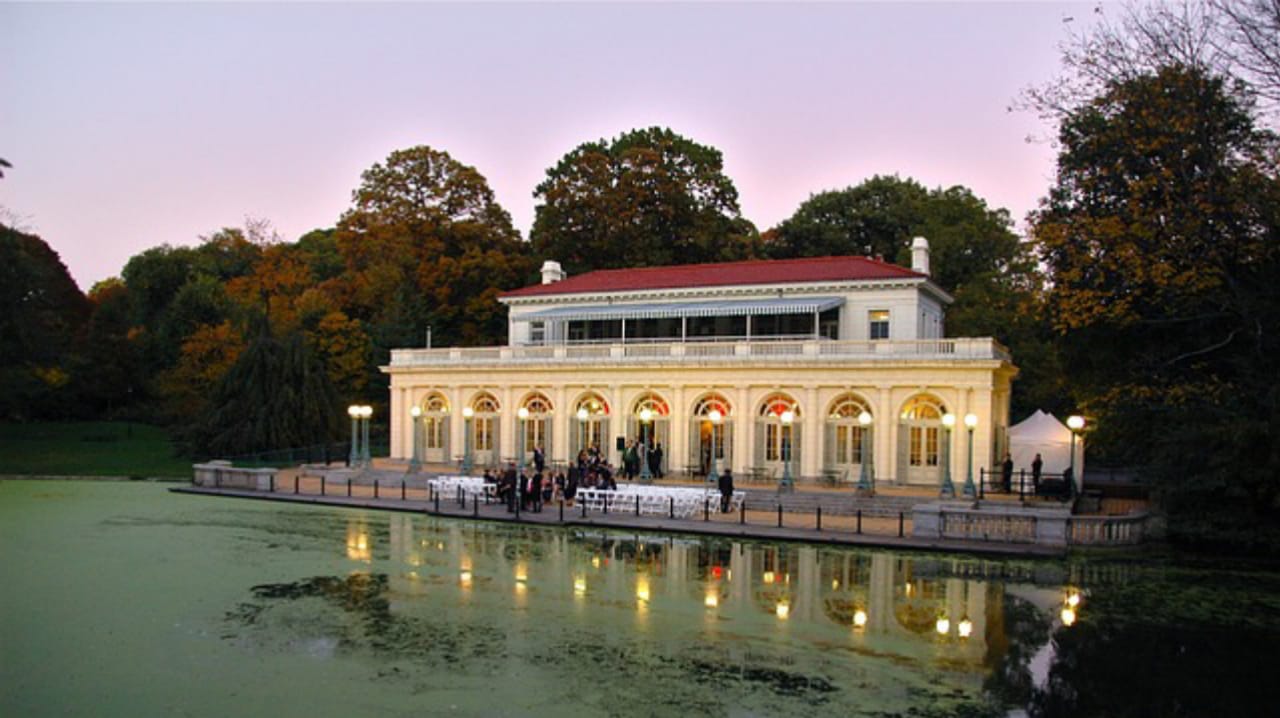
Picturesque landscape. Entrances were formalized, most notably at Grand Army Plaza, which was redesigned with a triumphal arch, columns, and statuary befitting the City Beautiful movement then sweeping American urban design. The elegant 1905 Boathouse, designed by Helmle and Huberty, was added along the lake.
Sharing architectural DNA with grander Beaux-Arts landmarks of the period. The Rose Garden and the Vale of Cashmere were created during this period as well, and the Maryland Monument was erected in 1895 to honor the soldiers who died covering Washington’s retreat during the Battle of Long Island.
In 1898, Brooklyn officially became a borough of the newly consolidated New York City. By then, Prospect Park was drawing an astonishing 15 million visits a year a testament to how central it had become to Brooklyn life, even as the city around it was changing character entirely.
The Robert Moses Era
No single figure reshaped and, depending on who you ask, damaged Prospect Park more than Robert Moses, who served as New York City’s Parks Commissioner from 1934 to 1960. Moses had a fundamentally different philosophy from Olmsted and Vaux. Where they envisioned a park as pastoral escape and passive contemplation, Moses saw parks as sites for active, structured recreation playgrounds, ballfields, and modern amenities.
Using federal funds available through President Franklin Roosevelt’s Public Works Administration, Moses launched an enormous wave of construction. He created the Prospect Park Zoo in 1935, built the Bandshell in 1939.
Added six new playgrounds around the park’s perimeter, and paved over sections of the historic landscape for parking and ballfields, including on portions of the Long Meadow. His most controversial addition came in 1960, when he built the Kate Wollman Memorial Skating Rink, demolishing Music Island and one of Olmsted and Vaux’s most celebrated picturesque views in the process.
Moses’s changes brought new uses and new visitors to the park, but they also treated Olmsted and Vaux’s original design meant to function as one unified, deliberately composed landscape as a site to be modified piecemeal. Many of his additions prioritized function over the sightlines and naturalistic illusions the original designers had worked so hard to engineer.
Decline
When Moses left his post in 1960, Prospect Park entered its darkest chapter. New York City’s mounting fiscal troubles through the 1960s and 70s meant steep cuts to park maintenance and staffing, and the effects were visible almost everywhere: crumbling bridges, decaying rustic structures, overgrown paths, and a rising sense of danger. A 1974 survey found that a striking percentage of New Yorkers actively warned others to stay away from the park altogether.
The numbers tell the story starkly. By 1979, annual visits had collapsed to roughly two million the lowest attendance in the park’s history, and a fraction of the 15 million who had visited at the turn of the century. In a moment that felt almost symbolic, the bronze quadriga sculpture atop the Soldiers’ and Sailors’ Memorial Arch at Grand Army Plaza literally toppled from its perch.
Structures fell into disuse and disrepair. The once-grand 1905 Boathouse, no longer used for its original purpose, was repurposed as a recycling center. In 1964, the city even proposed demolishing the Boathouse outright a plan only stopped after the newly formed preservation group Friends of Prospect Park mounted a public campaign.
Riding a wave of preservation sentiment that had grown nationally after the loss of the original Pennsylvania Station. The vintage 1912 carousel, one of the park’s most cherished attractions, was shuttered by the early 1980s due to lack of maintenance funding.
The Restoration
The turnaround began with a coalition of concerned Brooklynites, city officials, and civic leaders who refused to let the park keep deteriorating. Brooklyn Borough President Howard Golden, Mayor Ed Koch, and Parks Commissioner Gordon Davis developed a plan to restore the crumbling landscape, and in 1980 the city appointed Tupper Thomas as the first Prospect Park Administrator to lead the effort.
In 1987, a group of private citizens, working alongside Parks Commissioner Henry Stern, formalized that work by founding the Prospect Park Alliance a nonprofit, public-private partnership modeled on the successful Central Park Conservancy. Its very first project was fittingly symbolic: restoring the broken-down 1912 carousel, which reopened to the public in 1990 and became an early emblem of the park’s rebirth.
From there, the Alliance’s ambitions grew considerably. In the mid-1990s, it launched a major woodlands restoration effort, stabilizing eroded slopes with thousands of cubic yards of topsoil, introducing roughly 160,000 new plants, and excavating sediment from pools and streams to bring Olmsted and Vaux’s original watercourse back to life.
Restorers sourced plants from within 60 miles of the park to maintain regional ecological authenticity and added tens of thousands of aquatic plants to support wildlife habitat. Rustic wooden bridges throughout the Ravine were rebuilt in their original Adirondack style, reinforced with modern steel framing hidden beneath traditional white oak timbers.
Perhaps most remarkably, much of this restoration work had to be done without the original construction drawings, which had been lost to time restorers instead pieced together Olmsted’s design intentions from surviving correspondence, historic photographs, and archival research.
By 1994, the Alliance had launched a 25-year, roughly $43 million project to complete and restore the historic watercourse, an effort that also revealed small design secrets, like a rebuilt Rockarch Bridge positioned to catch sunlight over the stream below exactly as Olmsted and Vaux had intended more than a century earlier.
The results have been dramatic. Visitor numbers climbed from that 1979 low of around two million back up into the millions within a decade, and they’ve kept climbing ever since the park now draws somewhere between eight and ten million visits a year.
The Boathouse was beautifully restored and today houses the Prospect Park Audubon Center. In 2013, the long-closed Wollman Rink site was replaced by the LeFrak Center at Lakeside, a modern complex with twin ice-skating rinks, a roller rink, and classroom space that also restored several acres of parkland and features Olmsted-and-Vaux-inspired landscaping.
Prospect Park Today
More than 150 years after it first opened to eager, impatient Brooklynites in 1867, Prospect Park remains one of the most celebrated works of American landscape architecture and, in the eyes of many architectural historians, the mature masterpiece of the Olmsted-Vaux partnership. In 1975 it was designated a New York City Scenic Landmark, and in 1980 it was added to the National Register of Historic Places.
The park today is managed through a continuing partnership between the City of New York and the nonprofit Prospect Park Alliance, which funds a significant share of the park’s operating budget and employs roughly three-quarters of the staff who maintain it and run its public programs. Its roughly 30,000 trees represent nearly 200 species, supporting a woodland ecosystem that also serves as a crucial stopover for migratory birds along the Atlantic Flyway.
Visitors today can still trace the bones of Olmsted and Vaux’s original vision: the sweeping openness of the Long Meadow, the shaded, rambling paths of the Ravine, the sparkling expanse of the Lake and Lullwater, and the formal grandeur of Grand Army Plaza.
Historic structures like the Boathouse, Litchfield Villa, the Picnic House, and the restored carousel sit alongside newer additions like the Lakeside complex and the Prospect Park Zoo, now run by the Wildlife Conservation Society. The Lefferts Historic House, an 18th-century Dutch farmhouse relocated into the park in 1918, offers a glimpse of pre-park Brooklyn life, while the Friends Quaker Cemetery remains a quiet, private reminder of the land’s older history.
What makes Prospect Park’s story so compelling isn’t just its design it’s its resilience. This is a landscape that has been battled over, built by hand, celebrated by millions, neglected into near-ruin, and painstakingly restored by people who refused to let Olmsted and Vaux’s vision disappear. Few urban parks in America can claim as dramatic an arc: from Revolutionary War battlefield, to Gilded Age showpiece, to 1970s cautionary tale, to modern-day civic treasure.
Why Prospect Park’s History Still Matters
Prospect Park is often overshadowed by its more famous Manhattan sibling, but its history arguably tells a richer story about American cities: how they build ambitious public spaces, how they neglect them during hard times, and how ordinary citizens not just planners and politicians can bring a landscape back from the edge of ruin.
Walking the Long Meadow on a summer afternoon or wandering the Ravine’s shaded paths, it’s worth remembering that none of it happened by accident. Every curve in the path, every carefully framed view, and every rebuilt bridge represents more than 150 years of vision, neglect, advocacy, and repair.
That layered history is exactly why Prospect Park remains, in the words so many Brooklynites still use today, the borough’s true backyard not a copy of Central Park, but Frederick Law Olmsted and Calvert Vaux’s own hard-won masterpiece.
Tracing the History Yourself
For anyone who wants to experience Prospect Park’s history firsthand, the park itself is essentially an open-air museum, if you know where to look.
Start at Grand Army Plaza, the park’s grand northern entrance, where the Soldiers’ and Sailors’ Memorial Arch with its bronze quadriga sculpture marks the Gilded Age transformation of what was once a simple entrance into a civic monument. From there, the Long Meadow stretches southward, its curving tree lines and rolling grades still doing exactly what Olmsted and Vaux designed them to do: making 90 acres feel like far more.
Head east and the landscape shifts entirely at the Ravine, Brooklyn’s last remaining forest and the site of the park’s most ambitious ecological restoration. Rustic bridges rebuilt in the 1990s span a constructed watercourse of pools, streams, and small waterfalls, all engineered in the 1860s to look as though nature had put them there.
Nearby, Battle Pass still marks the site of the Revolutionary War fighting that helped save Washington’s army, with a monument honoring the Maryland soldiers who held the line. Further south, the Lake and Lullwater open up into the park’s most photographed vistas, framed by the restored Boathouse, now home to the Audubon Center, and the Lakeside complex that replaced the old Wollman Rink.
Along the way, don’t miss Litchfield Villa, the Italianate mansion whose grounds helped shape the park’s original footprint, and the Lefferts Historic House, a Dutch farmhouse relocated into the park in 1918 that predates Prospect Park itself by well over a century.
FAQs
When did Prospect Park open?
The park officially opened to the public on October 19, 1867, though construction continued for several more years and the park wasn’t considered largely complete until 1873.
How big is Prospect Park?
The park spans roughly 585 acres as originally designed, encompassing the 90-acre Long Meadow, the 146-acre Ravine, and the 60-acre Lake, along with numerous smaller gardens, plazas, and structures.
Is Prospect Park older than Central Park?
No. Central Park, also designed by Olmsted and Vaux, opened first, with construction beginning in the late 1850s. Prospect Park’s design process started in 1865, with construction beginning in 1866 and the park opening in 1867.
Why did Prospect Park decline in the 20th century?
Reduced city funding after 1915, combined with decades of piecemeal modification under Parks Commissioner Robert Moses and the fiscal crisis of the 1970s, left the park badly neglected by the late 1970s, when annual visits had fallen to roughly two million.