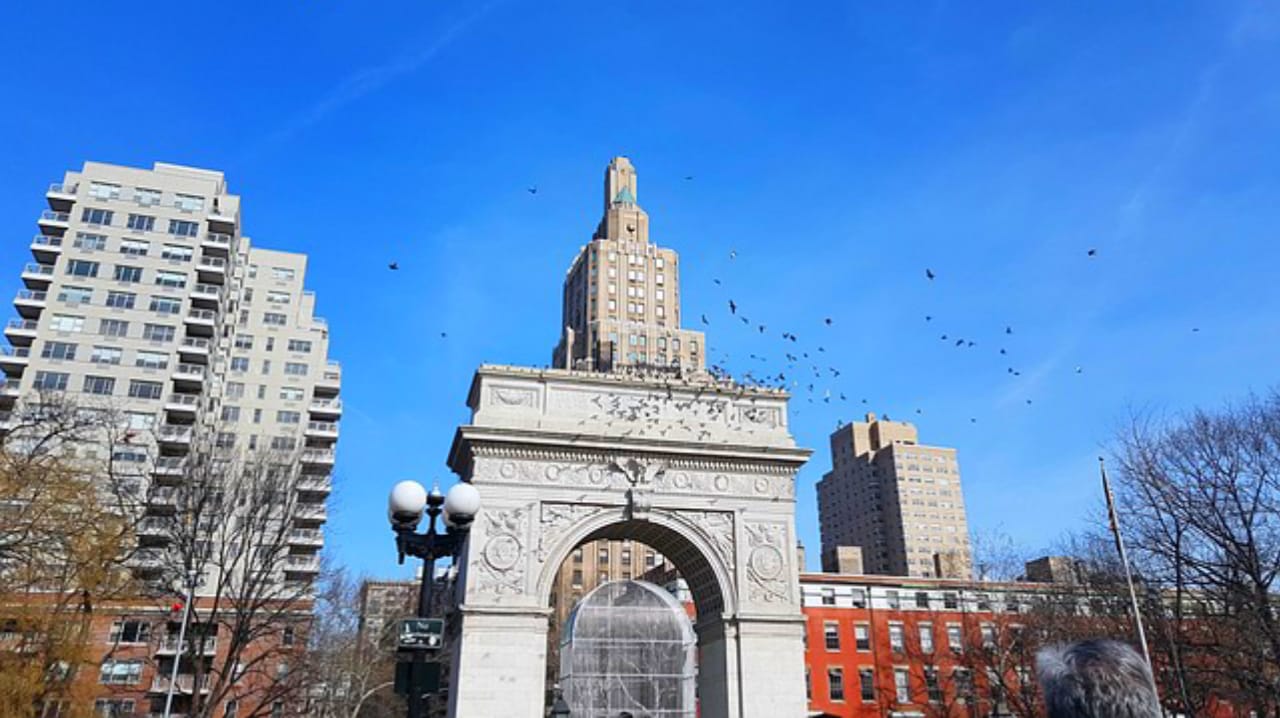
Few patches of ground in the United States have lived as many lives as Washington Square Park. Today the 9.75-acre square in the heart of Greenwich Village is best known for its towering marble arch, its buzzing central fountain, chess hustlers, street musicians, NYU students cutting across campus, and the occasional impromptu protest. But long before it was a postcard-perfect gathering spot, this small patch of Lower Manhattan was a marsh, a farm, a burial ground for thousands of New Yorkers, a public execution site, and a military parade ground. Understanding Washington Square Park history means tracing nearly four centuries of transformation through epidemics, real estate booms, bohemian revolutions, and grassroots activism that turned a grim plot of land into one of the most beloved public spaces in the world.
This guide walks through the complete history of Washington Square Park, from its earliest Indigenous and colonial roots through its most recent renovations, so you can understand exactly why this small square carries such outsized cultural weight.
Before the Park Washington Square Park
Long before Europeans arrived, the land that would become Washington Square Park was marshy ground crossed by a trout stream known as Minetta Creek, once part of the territory of the Lenape people. The area sat near a Native American settlement referred to in historical records as Sapokanikan, and the land itself was a marsh fed by Minetta Brook.
Manhattan’s colonial history entered the picture in the 1620s. The Dutch West India Company set up a trading post at the southern tip of Manhattan in 1624, and by 1642 the director of New Amsterdam had freed a number of enslaved Africans, granting them farmland that overlapped with what is now the park.
This makes the land beneath Washington Square Park one of the earliest sites of free Black land ownership in what would become New York City. That ownership, however, did not last: once the English took control of the colony, those free Black farmers eventually lost their land, which was absorbed into large private estates.
For the rest of the 17th and much of the 18th century, the site remained largely rural a quiet, swampy corner far removed from the dense, growing city at Manhattan’s southern tip.
The Potter’s Field Years
The transformation of this rural land into public space began, grimly, with death. In the 1790s, New York City was repeatedly ravaged by yellow fever epidemics that overwhelmed the city’s existing cemeteries. A yellow fever epidemic in the 1790s decimated neighborhoods and filled the cemetery that then stood where Madison Square Park is today, forcing the city to look elsewhere for burial space.
In 1797, the city took action. The Common Council purchased a 90-lot parcel of land for a public burial ground, covering what is now the eastern two-thirds of Washington Square Park. At the time, this was still fairly remote countryside. The area was sparsely populated aside from a handful of wealthy citizens who tried, unsuccessfully, to block the new potter’s field from being built near them.
A potter’s field, historically, is a burial ground reserved for those who cannot afford a private plot the poor, the unidentified, and victims of epidemics. According to New York Public Library historians, the city purchased a portion of an old farm for $4,500 in 1797 specifically to create this burial ground for the indigent, the poor, criminals, and epidemic victims.
The cemetery filled quickly: it opened in 1797, and within a year almost 700 people had already been buried there. The ground itself posed engineering challenges. Minetta Brook still ran through the potter’s field, causing the soil to settle unevenly, and starting in 1808 the city spent roughly a decade filling and diverting the stream to accommodate both the cemetery and future residential development.
This period also gave rise to one of the park’s most enduring legends. The story of “Hangman’s Elm” dates to this era lore holds that a roughly 300-year-old English elm at the park’s northwest corner was used to hang American Revolutionaries and prisoners after the war. Beyond legend.
The site had a documented function as a public gallows: the city sheriff erected a public gallows near where the park’s fountain now stands, and the burial ground operated for close to thirty years, drawing bodies not only from epidemics but also from a nearby prison.
Just how many people are buried beneath the park remains a subject of ongoing archaeological interest. The New York City Parks and Recreation Department’s 2005 archaeological assessment estimated that as many as 20,000 corpses may lie under varying depths of fill, and historians studying the site have echoed that figure, noting that more than 20,000 remains are still believed to be buried underneath Washington Square Park.
The bulk of those remains were never relocated when the land was later converted into parkland they simply remain beneath the grass and pathways that millions of visitors walk over every year. By the 1820s, complaints from nearby residents and the neighborhood’s growing population made continued burials untenable.
The common council prohibited further burials after May 1, 1825, closing the book on the square’s grim first chapter but not before an outbreak of cholera reinforced just how dangerous the area had become. During the cholera epidemic, wealthier New Yorkers, blaming the city’s poor for the outbreak, fled toward what was then the western edge of the city, and Greenwich Village quickly filled with new residents almost overnight, transforming into the thriving neighborhood recognizable today.
From Parade Ground to Public Park (1826–1827)
With the burial ground closed, the city repurposed the land for a very different use: military training. In 1826 the site was graded and converted into the Washington Military Parade Ground, where volunteer militia companies trained and drilled. That regiment would later be called into service for major New York conflicts, including subduing riots elsewhere in the city.
The choice of name was deliberate and symbolic. According to local historians, the former potter’s field came to be named for George Washington on July 4, 1826 the fiftieth anniversary of the signing of the Declaration of Independence. The transformation from parade ground to full public park followed quickly.
Washington Square’s evolution from potter’s field to parade ground to public landmark was formally set in motion when its conversion to parkland was approved on January 16, 1826, and the square was officially built out as a park in 1826, opening to the public the following year in 1827.
It wasn’t until decades later that the space received its permanent name. In 1878, the park was formally named Washington Square Park, honoring the Commander of the Continental Army and first President of the United States.
The Row, Wealth, and the Birth of a Fashionable Neighborhood
Once burials stopped and the land was cleared for parkland, Greenwich Village’s real estate value soared. Wealthy New York families rushed to build along the newly respectable square.
Between 1829 and 1833, a row of elegant Greek Revival townhouses went up along the north side of the square, becoming known simply as The Row red-brick houses, built in Flemish bond with entrances flanked by Ionic and Doric columns and marble balustrades, quickly became some of the most prestigious addresses in the city.
The developers of The Row leased their land from Sailors’ Snug Harbor, a seamen’s charitable organization that owned much of the acreage north of the park, and the first seven houses were completed within two years, with the remaining six following soon after.
The residents were not ordinary New Yorkers. Their first occupants were leading merchants, bankers, statesmen, and military officers whose families formed a rigid social caste a world later immortalized in Henry James’s 1881 novel Washington Square, which was set inside one of the actual houses on The Row. For roughly a quarter-century, Washington Square stood as one of the most fashionable addresses in New York.
The contrast between the park’s north and south sides only grew starker as the 19th century wore on. By the century’s end, the north side continued attracting the city’s wealthiest citizens, while the south side now largely occupied by what became New York University filled with immigrants living in crowded tenement housing.
Civic improvements followed the city’s broader parks movement: soon after the founding of the Department of Public Parks in 1870, the square was redesigned and improved under engineer-in-chief M.A. Kellogg and chief landscape gardener I.A. Pilat, giving the park much of the layout that shaped its identity for the following century.
The Washington Square Arch
No feature defines Washington Square Park more than its marble arch, but the monument New Yorkers know today started as a temporary structure meant to last only a few weeks.
In 1889, the city prepared to celebrate the centennial of George Washington’s presidential inauguration. Greenwich Village resident William Rhinelander Stewart, of the wealthy Rhinelander real estate family, devised a plan for the celebration inspired by London’s arches for Queen Victoria’s Golden Jubilee two years earlier.
No stone triumphal arch had ever been built in the United States, and Stewart approached architect Stanford White to direct the commemoration White designed a wooden arch coated in “staff,” a mixture of molded plaster over straw, costing $2,500 raised entirely through private donations, and modeled after the Arc de Triomphe in Paris, painted ivory and topped with a wooden statue of George Washington.
The temporary arch was a sensation. It proved so spectacular that the entire centennial parade route was shifted just to pass beneath it, and by the close of the celebrations neighborhood residents were already demanding that it stay. White was asked to design a permanent version and was so enthusiastic that he took on the project without charging a fee.
Construction of the permanent marble arch began soon after. Foundations for the permanent arch were laid in May 1890 by builder David H. King Jr. the same contractor who had built the pedestal for the Statue of Liberty.
Unlike the original, the marble arch was constructed from Tuckahoe marble, a fine-grained, brilliant-white stone historically quarried in Westchester County and highly prized for 19th-century architecture and sculpture. White again drew on classical influences: the arch adapted the form of a Roman triumphal arch, closely resembling the first-century Arch of Titus in Rome, though White aimed for a more modern, simplified design than the arches of Europe.
The finished structure is genuinely monumental, standing roughly 73.5 feet tall and 57 feet wide, with a 30-foot span, marking the formal southern terminus of Fifth Avenue. Sculptor Frederick MacMonnies created the arch’s relief work, while Phillippe Martiny crafted the eagles perched at its top.
After years of construction, the arch was finally unveiled to the public. The Washington Square Arch was formally dedicated on May 4, 1895the ceremony had originally been scheduled for April 30, to align with the anniversary of Washington’s inauguration, but heavy rain pushed it back several days.
The two large sculptures that flank the arch’s piers today weren’t part of the original design. Washington at War by Hermon Atkins MacNeil, completed in 1916, and Washington at Peace by Alexander Stirling Calder. Completed in 1918, were added to the pedestals years after the arch’s dedication. Sadly, White never saw either sculpture installed: Stanford White was murdered in 1906, shot atop the second Madison Square Garden a building he had also designed and did not live to see the two Washington statues completed.
Over the following century, the arch became a cultural flashpoint as much as an architectural one. In a famous 1917 episode, Greenwich Village rebels including John Sloan, Gertrude Drick, and Marcel Duchamp broke into the arch, climbed to its roof, released lit lanterns into the night sky, and playfully declared Greenwich Village the Independent Republic of Washington Square a stunt that captured the neighborhood’s bohemian spirit for generations.
Other Monuments
The arch isn’t the park’s only notable monument. In 1888, a statue honoring Italian nationalist leader Giuseppe Garibaldi was installed near the park’s southwest corner. The bronze-and-granite monument to Garibaldi, celebrated as the Father of Modern Italy, was dedicated in 1888.
Funded and commissioned by Italian immigrants from the surrounding neighborhood who began raising money for the statue almost immediately after Garibaldi’s death in 1880. The park also features a bust of engineer Alexander Lyman Holley by sculptor John Quincy Adams Ward, dated 1890, along with a flagpole commemorating World War I.
A Century of Cultural Transformation
By the turn of the 20th century, Washington Square Park had shed its role as a fashionable enclave and become something far more dynamic: a stage for New York’s artistic and political life.
The Triangle Shirtwaist Factory fire of March 1911 which killed 146 garment workers just one block from the park became a defining moment. The park’s first public use had been as a military parade ground, but in 1911 a solemn procession commemorating the Triangle Shirtwaist Fire moved through the park, followed by a rally demanding better working conditions.
Labor unions marched in the park in the aftermath of the fire, and Ashcan School painters such as John Sloan began setting up easels around the square, capturing everyday city life in a period of significant cultural change.
Bohemian Greenwich Village and Washington Square Park became nearly synonymous over the following decades. By mid-century, the park had transformed into ground zero for a new counterculture: in the 1950s and 60s, Washington Square Park became a center of Beat Generation culture.
With writers and artists such as Jack Kerouac, Allen Ginsberg, and William S. Burroughs frequenting the square as it came to symbolize the emerging bohemian lifestyle of the era. Around the same time, the park became a magnet for folk musicians, who gathered informally near the fountain for what became known as the Washington Square hootenannies an early proving ground for the folk revival that would soon sweep the country.
Saving the Square
Perhaps no chapter in Washington Square Park’s history is more consequential than the mid-20th-century battle to save it from becoming a highway.
For decades, Fifth Avenue traffic actually ran straight through the park, passing directly beneath the arch. City planner Robert Moses, the era’s most powerful advocate for highways and urban renewal, saw an opportunity to expand this into something much larger. Motivated by rising real estate values, Moses pushed forward another of his roadway plans the Lower Manhattan Expressway and continued imagining new ways to route ever-increasing traffic directly through the park.
Local residents organized fiercely in response. Community leaders Shirley Hayes and others coordinated with influential neighbors including urbanist Jane Jacobs, Eleanor Roosevelt, anthropologist Margaret Mead, and writer Lewis Mumford to form the Joint Emergency Committee to Close Washington Square Park to All But Emergency Traffic.
One of the earliest organized historic-preservation efforts in New York City, predating even the fight to save Penn Station. Jacobs proposed a pragmatic first step: she suggested the group request a temporary closure of the park to cars, allowing the city to test the impact before committing to anything permanent.
The campaign succeeded. In April 1959, the Board of Estimate approved a policy statement closing Washington Square Park to all but emergency vehicles, and by 1963 the Board of Estimate had completed the legal process to permanently clear the park of traffic.
The final car to drive through the square did so in 1958. The battle against Robert Moses’ plans stretched roughly from the 1930s through the 1960s, part of a longer preservation story that also included resistance to NYU’s campus expansion beginning in the 1940s. That grassroots victory had ripple effects beyond the park itself: the activism ultimately contributed to the designation of the Greenwich Village Historic District in 1969.
A Gathering Place for Movements
Washington Square Park’s open plaza and central location made it a natural staging ground for social movements throughout the 20th century a role it continues to play today.
The square holds a particularly significant place in LGBTQ history. Washington Square Park became known as a gay meeting place and cruising area from the late 19th century all the way through the 1960s, and after the Stonewall uprising of 1969, it evolved into a space closely associated with LGBT activism. The 1973 Christopher Street Liberation Day rally and festival drew large crowds to the park, cementing its role as a landmark of queer New York history.
The park has also long served as a barometer of the city’s political mood. From the women’s suffrage movement and early labor organizing, through Jane Jacobs’ and Shirley Hayes’ fight to save the square, all the way to Black Lives Matter demonstrations and beyond, Washington Square Park has a long history as a site of protest and activism, including demonstrations during the pandemic and protest era of 2020 to 2022.
The 1970 Renovation
By 1970, decades of heavy use had taken a toll on the park’s Victorian-era layout, and the community once again stepped in to reshape its future. In 1970, poet and playwright Robert Nichols led a community-driven renovation that opened up the central fountain area into a sweeping sunken plaza. That redesign gave the park much of the character it’s known for today: the renovation also created the park’s performance stage and its petanque court, two features that remain central to daily life in the square.
A decade after the fight against Moses, the fountain was lowered and a new two-tiered central plaza was built, cementing the park’s reputation as an informal, open-air performance space. A raised mound on the southwest side became a beloved play area, while chess and gaming tables installed at the south and northwest entrances built a chess culture with an international reputation one that continues to attract hustlers, tourists, and serious players alike to this day.
Preservation Fights Continue
The push and pull between preservation and redevelopment never really stopped. Preservation groups continued advocating throughout the late 20th century, and in 1991 a major renovation of the Washington Square Arch began.
The 2000s brought the park’s most ambitious modern makeover and its most contentious. In 2004, the Parks Department proposed a $16 million redevelopment plan for Washington Square Park involving extensive changes to its layout and landscape.
That same year, the Washington Square Arch received a full restoration, including structural stabilization, conservation of its marble facade, and the addition of architectural lighting, before being rededicated on April 30, 2004 the 215th anniversary of Washington’s inauguration. The restoration was widely recognized: it received preservation awards from both the Greenwich Village Historical Society and the New York Landmarks Conservancy.
The broader park redesign, however, drew significant local pushback. Proposed changes to the fountain’s location and the plaza layout in the 2000s sparked real community resistance, though compromises were ultimately reached that preserved much of the park’s essential character.
Starting in 2003, the arch was restored and the park redesigned in phases, with the fountain raised and relocated slightly east to align with the arch and Fifth Avenue. The most recent major renovation wrapped up in 2014.
Washington Square Park Today
Nearly 230 years after it began life as a burial ground, Washington Square Park has become exactly the kind of vibrant, democratic public space its 20th-century defenders fought to protect. Today Washington Square Park remains one of the jewels of the city’s park system, serving as a dynamic commons for local residents, students, activists, chess players, performers, and tourists from around the globe.
Much of that identity now overlaps with New York University, whose campus surrounds the square on nearly every side. Even so, the park has never fully shed its bohemian roots or its role as a stage for public life buskers performing beneath the arch, dogs cycling through the park’s popular dog run, chess games unfolding at the stone tables, and, inevitably, some kind of demonstration or rally taking shape near the fountain.
It’s worth remembering, walking across the sunbaked plaza or past the arch’s marble columns, that beneath the pavement lie the remains of tens of thousands of New Yorkers whose lives predate the park by more than two centuries a quiet reminder that even the city’s most cheerful public square carries a long and complicated history.
Key Dates in Washington Square Park History
- Pre-1600s: Marshland along Minetta Creek, part of Lenape territory
- 1642: Free Black farmers granted land overlapping the future park site
- 1797: City purchases land for a potter’s field and public burial ground
- 1797–1825: Burial ground and execution site; roughly 20,000 people eventually buried on site
- 1826: Site graded into the Washington Military Parade Ground; named for George Washington
- 1827: Opens as a public park
- 1829–1833: “The Row” townhouses built along the north side
- 1870: Department of Public Parks redesigns the square
- 1878: Formally named Washington Square Park
- 1889: Temporary wood-and-plaster arch erected for Washington’s inauguration centennial
- 1890–1892: Permanent marble Washington Square Arch constructed
- 1895: Arch formally dedicated on May 4
- 1911: Labor march following the Triangle Shirtwaist Factory fire
- 1916 / 1918: Washington statues added to the arch
- 1950s–60s: Beat Generation and folk music scene flourish in the park
- 1958–1963: Park permanently closed to vehicle traffic
- 1969: Greenwich Village Historic District designated
- 1970: Community-led renovation creates the sunken plaza, stage, and petanque court
- 2004: Arch restoration completed and rededicated
- 2014: Most recent major park renovation completed