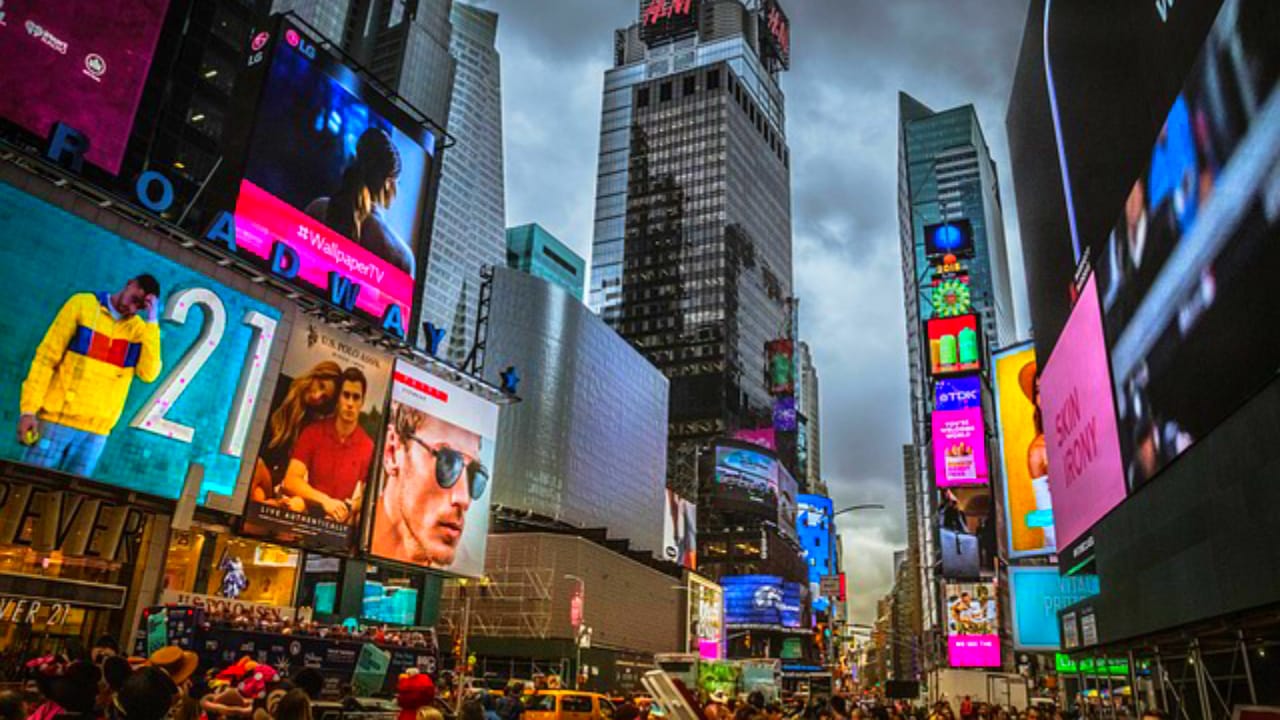
Every year, more than 200,000 people pass through Times Square on an average day, and tens of millions more watch it on television every New Year’s Eve as the crystal ball drops. But amid the glowing billboards, honking taxis, and costumed street performers, few visitors stop to ask a simple question: why is it called Times Square in the first place?
The answer has nothing to do with clocks, watches, or the passage of time despite what the name might suggest.
Instead, it’s a story about a newspaper, a real estate gamble, a subway line, and a New York City mayor who granted one company’s request in 1904. Here’s the full story of how a crossroads once known for horse trading became the “Crossroads of the World.”
It’s Named After The New York Times
Times Square is named after The New York Times newspaper, which moved its headquarters to the area in 1904. The intersection formed where Broadway crosses Seventh Avenue near 42nd Street in Midtown Manhattan was officially renamed from Longacre Square to Times Square that same year, in honor of the paper’s new skyscraper headquarters, known as the Times Tower (now called One Times Square).
It really is that straightforward. Unlike many New York place names that require some digging into colonial history or Native American language.
Times Square’s origin is directly tied to a company that once called the neighborhood home. But how a newspaper ended up giving its name to what would become one of the most photographed places on Earth is a story worth unpacking.
Before Times Square: The Longacre Square Years
To understand why the name change mattered, it helps to know what came before it. Through the 19th century, the intersection now occupied by Times Square was called Longacre Square. The name was borrowed from London’s Long Acre district, an area historically associated with carriage makers and the horse trade.
New York’s version lived up to that reputation. The area became the center of the city’s carriage business, in part thanks to businessman William Henry Vanderbilt, who established the American Horse Exchange nearby. Before it was known for Broadway marquees and Jumbotron screens, Longacre Square was essentially a bustling hub for horse-drawn transportation stables, harness shops, and carriage dealers lined the streets.
By the 1890s, the neighborhood’s reputation had shifted again, and not necessarily for the better. Longacre Square developed something of a seedy edge, becoming known in some circles as a center of illicit activity. It was a far cry from the family-friendly tourist destination it would eventually become.
Enter The New York Times
The turning point came at the dawn of the 20th century, when The New York Times was looking to expand. The newspaper had outgrown its downtown offices and set its sights on Longacre Square, partly because of a new development that promised to transform the neighborhood: the city’s first subway line.
The New York Times bet that the arrival of the subway would bring commercial success to the area, and the paper wasn’t alone in that thinking several businesses looked to relocate near the new transit hub.
In 1904, the Times built its new headquarters on the site of the old Pabst Hotel, at the intersection now recognized as the heart of Times Square. At the time, the Times Tower was the second-tallest skyscraper in New York City, a genuine architectural statement in a rapidly rising skyline.
How the Renaming Actually Happened
Getting the square renamed wasn’t just a symbolic gesture the newspaper granted itself. The New York Times Corporation, together with the Interborough Rapid Transit Company (the operator of the new subway), formally petitioned New York City to rename Longacre Square in honor of the paper’s new headquarters. The city agreed.
On April 8, 1904, Mayor George B. McClellan Jr. officially renamed the area Times Square. Interestingly, New York Times publisher Adolph Ochs was reportedly careful to note that the square was renamed without any special effort or lobbying push on the newspaper’s part, framing it as the city’s own decision rather than corporate self-promotion.
Whether that framing was entirely accurate or a bit of tactful public relations, the effect was the same: one of the world’s most recognizable place names was born.
It’s also worth clearing up a common point of confusion. Because “Times” is plural, people sometimes wonder if the square is actually called “Time Square,” as if it were named for the concept of time itself. It isn’t.
The name is a direct nod to The New York Times, and the connection to the word “time” is purely coincidental. Getting the apostrophe-free, plural spelling right Times Square, not Time’s Square or Time Square is a small detail that tends to matter to native New Yorkers.
A Newspaper’s Brief Stay, A Permanent Legacy
In a twist that’s easy to overlook, The New York Times didn’t actually stay in Times Square very long. The paper occupied its namesake tower for less than a decade before outgrowing the building and moving to a new headquarters less than a block away in 1913.
Yet the name stuck permanently, long after the newspaper itself had moved on. Today, One Times Square is famous less for housing journalists and more for the electronic billboards covering its exterior including the one that hosts the New Year’s Eve ball drop.
That’s arguably the most enduring legacy of the Times’ brief residency: the New Year’s Eve celebration. To mark the move into its new building, Adolph Ochs threw a New Year’s Eve celebration in the newly renamed square, an event that has essentially continued in some form ever since.
The tradition evolved further in 1907, when the paper introduced a new attraction to draw crowds: a wood-and-iron ball, studded with 100 light bulbs, lowered from a flagpole atop the Times building at the stroke of midnight.
That first ball drop launched what’s now a global television spectacle. Today’s version, the “Big Times Square New Year’s Eve Ball,” is a geodesic sphere covered in thousands of Waterford crystal triangles and illuminated by more than 32,000 LEDs, and it draws tens of millions of viewers around the world each December 31.
From Longacre Square’s Decline to Today’s Times Square
The story of Times Square’s name is really only the beginning of its transformation. Over the following century, the area cycled through dramatically different identities. It flourished in the early 1900s and Gay ’90s as the heart of the Broadway theater district sometimes called the “Great White Way” for its blaze of electric marquee lighting.
The Great Depression hit the neighborhood hard, closing many theaters, some of which converted into movie houses to survive. By the mid-20th century, Times Square’s fortunes had soured again.
A widely cited 1960 New York Times article bluntly described the area as “the worst in town,” cataloguing vandalism, loitering, and a thriving adult entertainment scene that came to define the neighborhood’s reputation through the 1970s and 1980s.
The turnaround began in the 1980s under Mayors Ed Koch and David Dinkins, who launched redevelopment efforts for Midtown Manhattan that included Times Square. The cleanup accelerated dramatically in the 1990s under Mayor Rudolph Giuliani, whose administration closed pornographic theaters and adult shops, while New York State purchased several of the historic theaters along 42nd Street for restoration.
That era of revitalization set the stage for the Times Square most visitors recognize today: a hub of massive advertising screens, Broadway theaters, and round-the-clock foot traffic.
More recent changes have continued to reshape the square. In 2009, the city temporarily closed the stretch of Broadway running through Times Square to vehicle traffic as a pilot program. The experiment proved so popular that it became permanent, creating the pedestrian plazas complete with tables, chairs, and benches that now let visitors sit in the middle of what was once one of the busiest vehicle intersections in the city.
Other Landmarks Within Times Square
The Times Square name now technically covers a larger stretch than just the original intersection. The district spans roughly from 42nd Street to 47th Street, between Seventh Avenue and Broadway. Within that footprint sits Duffy Square, the northern section between 46th and 47th Streets, named in honor of Father Francis P. Duffy, a chaplain with the New York Regiment of Infantry during World War I. Duffy Square is also home to the TKTS Booth, the well-known red staircase where visitors line up for discounted, same-day Broadway tickets.
It’s also worth noting that Times Square isn’t the only Manhattan square named after a newspaper. Herald Square, a few blocks south, was similarly named for the New York Herald, which once had offices in the area a small reminder that this practice of naming intersections after the media companies that built there wasn’t unique to the Times.