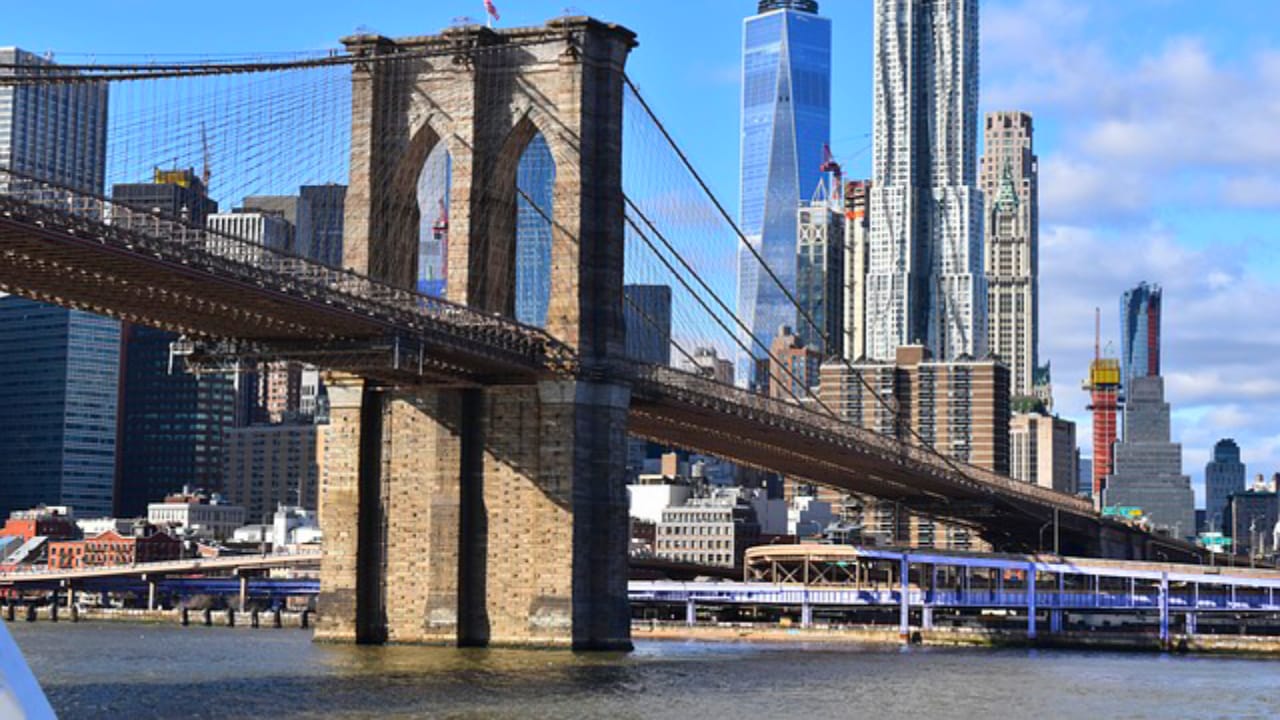
Few structures capture the spirit of American ingenuity quite like the Brooklyn Bridge. Stretching across the East River to connect the boroughs of Manhattan and Brooklyn, this soaring suspension bridge has stood for more than 140 years as a symbol of vision, perseverance, and engineering triumph.
What began as a bold and controversial idea became one of the most celebrated feats of 19th-century construction and remains one of New York City’s most photographed and beloved landmarks today.
In this article, we’ll explore the complete history of the Brooklyn Bridge: how it was conceived, the family that built it against overwhelming odds, the human cost behind its construction, and why it continues to capture the world’s imagination.
Why New York Needed a Bridge
Before the Brooklyn Bridge existed, the only way to travel between Manhattan and Brooklyn was by ferry. In the mid-1800s, both cities were growing rapidly, and thousands of commuters, merchants, and goods relied on ferry crossings every single day.
Harsh winters made the East River treacherous ice floes could halt ferry service entirely, cutting off Brooklyn (then the third-largest city in America) from Manhattan for days at a time.
City leaders and engineers recognized that a permanent connection was essential for continued economic growth. But building a bridge across the East River was no small task. The river was a busy shipping channel, requiring any structure to allow tall-masted ships to pass beneath it.
The distance to span was also far greater than any suspension bridge built up to that point. It would take a visionary engineer to solve this problem.
John A. Roebling’s Bold Vision
That engineer was John Augustus Roebling, a German-born civil engineer who had already made a name for himself building suspension bridges, including the Cincinnati-Covington Bridge over the Ohio River. Roebling was a pioneer in the use of steel-wire cables, a technology he believed could support a bridge of unprecedented length and height.
In 1869, Roebling proposed a suspension bridge that would span nearly 1,600 feet between two massive stone towers, with a roadway suspended high enough to allow ships to pass beneath. His design called for four enormous steel cables a first for a project of this scale anchored deep into bedrock on both shores.
Tragically, Roebling would never see his design come to life. While surveying the site for the bridge’s Brooklyn tower, his foot was crushed by an incoming ferry. He developed tetanus from the injury and died just weeks later, in July 1869, before construction had even begun.
Washington Roebling Takes Over
Leadership of the project fell to John Roebling’s son, Washington Roebling, a Civil War veteran and engineer who had assisted his father on earlier projects. Washington took over as chief engineer and oversaw the construction of the bridge’s two great towers and its cable system.
To build the underwater foundations for the towers, workers used massive wooden and iron structures called caissons airtight chambers sunk to the riverbed and filled with pressurized air to keep water out while workers dug through the mud below.
It was dangerous, grueling labor. Workers who spent long hours in the pressurized caissons and then returned too quickly to normal air pressure often suffered from a painful and sometimes fatal condition later known as decompression sickness, or “caisson disease.” Washington Roebling himself was severely affected, leaving him partially paralyzed and largely confined to his home for the rest of the project.
Emily Roebling: The Bridge’s Unsung Engineer
With her husband bedridden, Emily Warren Roebling stepped in to manage the day-to-day operations of the construction site. Over more than a decade, she taught herself advanced engineering concepts including cable construction, stress analysis, and material strength calculations so she could relay her husband’s instructions to the work crews and communicate directly with the board of trustees.
Emily became the public face of the project, and many historians now consider her the de facto chief engineer during the bridge’s final years of construction. Her contributions were largely overlooked for decades, but today she is widely celebrated as one of the unsung heroes of American engineering history proof that the Brooklyn Bridge was as much a triumph of determination as it was of technical skill.
Building the Towers and Cables
Construction of the Brooklyn Bridge took 14 years, from 1869 to 1883, and involved thousands of workers. The two Gothic-style stone towers, rising roughly 276 feet above the water, were among the tallest structures in North America at the time and served as the anchor points for the bridge’s massive cable system.
Spinning the four main cables was itself an extraordinary undertaking. Workers used a technique developed by Roebling’s company that involved stretching thousands of individual steel wires back and forth across the river to form each cable, which was then compacted and wrapped. Each of the bridge’s main cables contains thousands of individual wires bundled together, capable of supporting immense weight.
The project was not without controversy or tragedy. In addition to the caisson-related illnesses, a fire in one of the caissons, cost overruns, and allegations of corruption involving substandard steel wire all threatened to derail construction. In total, it’s estimated that around two dozen workers lost their lives during the bridge’s construction a sobering reminder of the human cost behind the achievement.
Opening Day: May 24, 1883
After 14 years of construction, the Brooklyn Bridge officially opened on May 24, 1883. The celebration was massive: fireworks lit up the sky, ships filled the East River in a grand nautical parade, and President Chester A. Arthur crossed the bridge alongside New York Governor Grover Cleveland.
Emily Roebling was given the honor of being the first person to cross the bridge, reportedly carrying a rooster as a symbol of victory.
At the time of its completion, the Brooklyn Bridge was the longest suspension bridge in the world, and its towers were the tallest structures in the Western Hemisphere. It was an engineering marvel that captured global attention and cemented New York’s reputation as a city of ambition and innovation.
The Bridge’s Early Challenges
Despite the triumphant opening, the bridge’s early years weren’t without incident. Just six days after it opened, a rumor that the bridge was collapsing sparked a deadly stampede that killed 12 people.
To prove the bridge’s stability to a skeptical public, circus showman P.T. Barnum famously led a parade of 21 elephants across the bridge in 1884 a publicity stunt that helped restore public confidence in the structure’s safety.
Engineering Significance
The Brooklyn Bridge was revolutionary for several reasons:
- Hybrid design: It combined suspension cables with a diagonal stay system, giving the bridge both flexibility and rigidity a design choice that helped it withstand storms, temperature changes, and heavy loads far better than earlier bridges.
- Steel cable construction: It was one of the first major bridges to rely primarily on steel wire cables rather than iron, setting a precedent for modern suspension bridge design.
- Scale: At the time, its main span was nearly 50% longer than any suspension bridge previously built.
These innovations influenced the design of countless bridges that followed, including the Williamsburg Bridge, the Manhattan Bridge, and even the Golden Gate Bridge decades later.
The Brooklyn Bridge Today
More than 140 years after it opened, the Brooklyn Bridge remains a vital transportation link and a beloved cultural landmark. Today it carries roughly six lanes of vehicle traffic along with a dedicated elevated pedestrian and bicycle path that offers sweeping views of the Manhattan skyline, the East River, and the Statue of Liberty in the distance.
The bridge has been named a National Historic Landmark and a National Historic Civil Engineering Landmark, recognitions that reflect both its technical achievements and its enduring role in American history. It has appeared in countless films, photographs, and works of art, and it continues to be one of the most visited attractions in New York City, drawing millions of pedestrians and cyclists every year.
Periodic restoration projects have preserved the bridge’s original stonework and cables while reinforcing it for modern traffic demands, ensuring that this 19th-century masterpiece continues to serve 21st-century New York.